
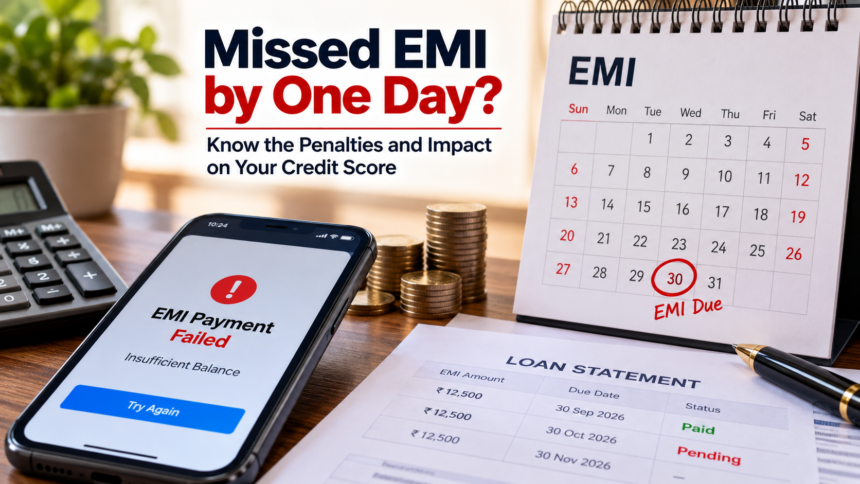
Missing a loan EMI by even a single day can cause a borrower’s account to become overdue and may result in late-payment charges. However, a one-day delay does not necessarily lead to an immediate fall in the credit score. The actual impact depends on the lender’s policies, the length of the delay and the borrower’s repayment history.
While an occasional short delay may have a limited effect on a credit profile, repeatedly missing EMI deadlines can weaken creditworthiness and make it harder to secure loans in the future.
The Reserve Bank of India (RBI) requires lenders to treat an amount as overdue if it remains unpaid by the end of the due date. However, the date an account becomes overdue and the date the information appears in a credit report may differ because lenders submit credit information according to the applicable reporting schedule.
Can a One-Day EMI Delay Attract Late-Payment Charges?
Borrowers should not assume that a one-day delay will be ignored or that they automatically receive a penalty-free grace period.
Santosh Agarwal, CEO of Paisabazaar, explained that even if a lender allows a grace period, it may still impose a penalty for delayed repayment.
The charges applicable to a missed EMI depend on the loan agreement, the lender’s disclosed policies and the rules governing the loan. Borrowers should review their agreement to understand whether a grace period applies and what charges may be imposed.
RBI rules require regulated lenders to follow their disclosed policies on penal charges. Such charges must be reasonable and cannot be added to the loan principal for the purpose of charging further interest. Penal charges are separate from the regular interest payable on the outstanding loan.
When Does a Missed EMI Affect Your Credit Score?
A payment delay of one day may not have a significant immediate effect on a credit score. However, repeated late payments can gradually damage a borrower’s credit profile, and the potential consequences generally increase as the overdue period becomes longer.
According to Agarwal, credit bureaus reflect repayment information based on the data received from lenders. A brief delay may have a limited impact, but frequent missed deadlines can contribute to a decline in the credit score over time.
Since January 1, 2025, the RBI has required lenders to update credit information with credit bureaus every fortnight, or at shorter intervals where mutually agreed. This allows repayment records to be updated more frequently than under the earlier monthly reporting system.
A payment that remains overdue for more than 30 days can have a more serious effect on a borrower’s credit profile. Extended non-payment may also make future borrowing more difficult.
A loan account generally becomes a non-performing asset (NPA) when interest or principal remains overdue for more than 90 days, subject to the applicable prudential norms and classification rules. This is a separate stage from an EMI initially becoming overdue.
What Should You Do After Missing an EMI?
If you expect to have difficulty making a payment, contact your lender before the due date to discuss the options available under the loan agreement and the lender’s policies. Any restructuring or moratorium facility will depend on the applicable rules and eligibility requirements.
If an EMI has already been missed, making the payment as soon as possible can help limit the period of delay. Agarwal also advised borrowers to clear overdue payments promptly rather than allowing the delay to continue.
Borrowers should check whether the payment was successfully processed, especially when the EMI is collected through an automatic debit. If the transaction failed because of insufficient funds or a technical problem, contact the lender, clear the outstanding amount and confirm whether any charges have been applied.
It is also important to review the credit report periodically. If an EMI is incorrectly shown as overdue despite having been paid on time, borrowers can raise a dispute with the lender and the relevant credit bureau. Payment receipts and bank statements can be submitted as supporting evidence.
Disclaimer: This article is intended for general informational purposes only and should not be treated as financial or legal advice. Late-payment charges, credit reporting and loan classification depend on the applicable RBI rules, lender policies and loan terms. Borrowers should consult their lender and review the latest official guidelines to understand how a delayed EMI may affect their individual circumstances.