
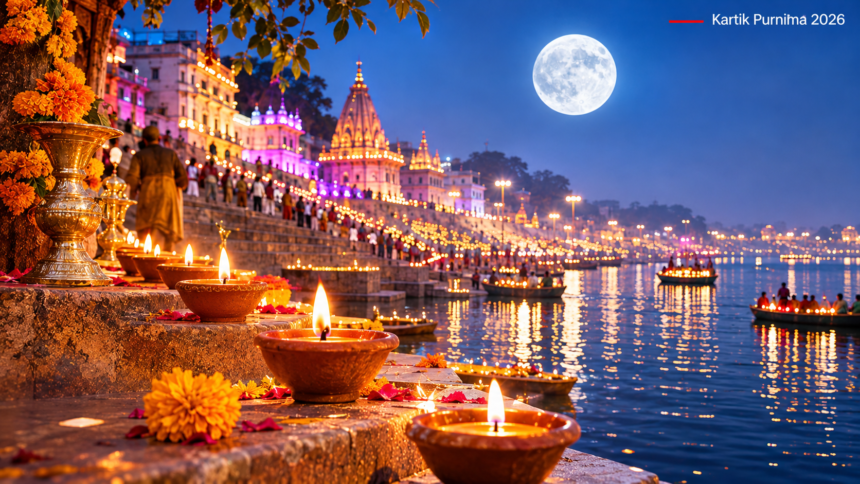
New Delhi: Kartik Purnima holds a special place in Hindu religious traditions. Celebrated on the full moon day of the Kartik month, the festival is also known as Dev Deepawali in Varanasi and Tripurari Purnima in connection with Lord Shiva’s victory over Tripurasura.
Observed fifteen days after Diwali, Kartik Purnima is associated with sacred river baths, lighting earthen lamps, charitable donations and prayers. However, its importance goes beyond these traditional rituals. The occasion brings together several religious stories connected with Lord Shiva, Lord Vishnu and the spiritual significance of the Kartik month.
From the destruction of Tripurasura to the divine celebration along the Ganga, several beliefs explain why this full moon night is considered especially auspicious.
Tripurari Purnima: The Story of Lord Shiva’s Victory Over Tripurasura
One of the most important legends associated with Kartik Purnima describes Lord Shiva’s battle against the demon Tripurasura.
According to Hindu mythology, Tripurasura received a powerful boon from Lord Brahma and constructed three nearly invincible cities. One was made of gold, another of silver and the third of iron. These cities moved across heaven, earth and the netherworld and could only be destroyed simultaneously with a single arrow at a particular moment.
On Kartik Purnima, Lord Shiva accomplished this extraordinary task by releasing a divine arrow. Lord Vishnu is believed to have taken the form of the arrow, helping Shiva destroy all three cities in a single strike.
This victory is also associated with the name Tripurari, meaning the destroyer of Tripura.
Beyond the mythological story, the three cities are often interpreted as symbols of the human body, mind and ego. Their destruction represents the need to overcome inner weaknesses through awareness, discipline and spiritual understanding.
This belief also explains the importance of lighting lamps on Kartik Purnima. A single diya offered with genuine devotion is considered meaningful because the intention behind the worship matters more than the number of rituals performed.
Dev Deepawali: Why Do Gods Celebrate Along the River Ganga?
Another important belief connects Kartik Purnima with the divine celebration in Varanasi.
According to tradition, after Lord Shiva defeated Tripurasura, the gods descended to Kashi to celebrate the victory and take a holy dip in the River Ganga. This event is believed to be the origin of Dev Deepawali, also known as the Diwali of the Gods.
Every year, the ghats of Varanasi are illuminated with countless earthen lamps on this occasion. The lighting of diyas represents remembrance of the divine victory and devotion towards Lord Shiva and Goddess Ganga.
There is also a traditional belief that Lord Brahma, Lord Vishnu and Lord Shiva are present along the riverbanks on Kartik Purnima. For this reason, the pre-dawn Kartik Snan is considered particularly sacred.
The ritual is not viewed simply as bathing in holy water. Devotees consider it an opportunity for spiritual purification and a closer connection with the divine.
However, visiting Varanasi is not necessary to observe the festival. According to traditional beliefs, devotees can perform prayers and offer water or light a diya at home with sincerity and devotion.
Kartik Purnima, Tulsi Mata and the Story of Lord Vishnu’s Matsya Avatar
Kartik Purnima also marks the conclusion of the sacred month of Kartik, which holds particular importance for followers of the Vaishnava tradition.
Throughout this month, devotees worship Lord Vishnu and Tulsi Mata through prayers, fasting and the lighting of evening lamps. Tulsi Vivah, the symbolic marriage of Tulsi Mata with Shaligram, a form associated with Lord Vishnu, is celebrated shortly before Kartik Purnima.
Traditional religious texts describe Kartik as an especially dear month to Lord Vishnu. Offering an evening diya before Tulsi Mata is also considered highly auspicious, with the Kartik Mahatmya highlighting the spiritual value of such devotional practices.
Another religious story associated with Kartik Purnima concerns Lord Vishnu’s Matsya Avatar.
According to Hindu belief, Lord Vishnu assumed the form of a divine fish to protect the Vedas and humanity from a great flood. Unlike his warrior manifestations, Matsya represents divine protection and the preservation of knowledge.
The story is remembered as an example of how divine guidance can protect life and preserve wisdom during difficult times.
Kartik Purnima Beyond Hinduism: Its Importance in Sikhism and Jainism
Kartik Purnima is significant not only in Hindu traditions but also in other religious communities.
For Sikhs, the occasion is associated with the Prakash Parv of Guru Nanak Dev Ji, whose teachings emphasised truth, equality and the presence of the Divine in every human being.
For followers of Jainism, Kartik Purnima is also an important occasion for religious observances, pilgrimage and devotion.
In Hindu traditions, the day is particularly associated with Snan, Daan and Deepdaan. These practices represent purification, charity and the offering of light.
The festival’s importance across different religious traditions reflects a shared emphasis on spirituality, compassion and devotion.
How to Celebrate Kartik Purnima 2026: Three Important Rituals
Devotees can observe Kartik Purnima through simple religious practices at home. Elaborate arrangements are not necessary; sincerity and devotion remain central to the observance.
1. Kartik Snan: Take a Holy Bath
Taking a bath in a sacred river before sunrise is an important Kartik Purnima tradition. Those who cannot visit a river can take a bath at home and add a few drops of Gangajal to the water, if available.
Devotees offer prayers while bathing and seek spiritual purification.
2. Deepdaan: Light an Earthen Lamp
Lighting diyas in the evening is one of the most important rituals of Kartik Purnima. Devotees traditionally place lamps near Tulsi Mata, temples, their homes or water bodies.
The light symbolises knowledge, gratitude and the removal of darkness. Even a single diya can be offered as an expression of devotion.
3. Daan: Donate Food and Essential Items
Charity is another important part of the festival. Donating food, clothes, sesame seeds, jaggery or providing a meal to someone in need is considered auspicious.
According to the Kartik Mahatmya, charity performed on this day carries great religious merit. The importance of giving lies not in the size of the donation but in the sincerity and selflessness behind it.
The Deeper Spiritual Meaning of Kartik Purnima
Diwali is traditionally associated with overcoming darkness and welcoming light into our homes. Kartik Purnima takes this message further by encouraging people to look within themselves.
The story of Lord Shiva defeating Tripurasura is often understood as a reminder to overcome anger, desires and ego. It encourages individuals to develop self-awareness, humility and inner strength.
The full moon represents completeness and illumination, making Kartik Purnima an opportunity for reflection, gratitude and spiritual growth.
Whether someone celebrates by taking a holy bath, lighting a single diya, offering prayers or helping someone in need, the festival carries a message of devotion and compassion.
The significance of Kartik Purnima lies not simply in the number of lamps we light, but in the positive values and understanding we bring into our lives.
Disclaimer
This article is based on traditional Hindu scriptures, religious beliefs, mythological stories and customary practices associated with Kartik Purnima. Interpretations and rituals may vary across regions and religious traditions. The content is intended for general informational and educational purposes and does not represent a compulsory religious guideline.