
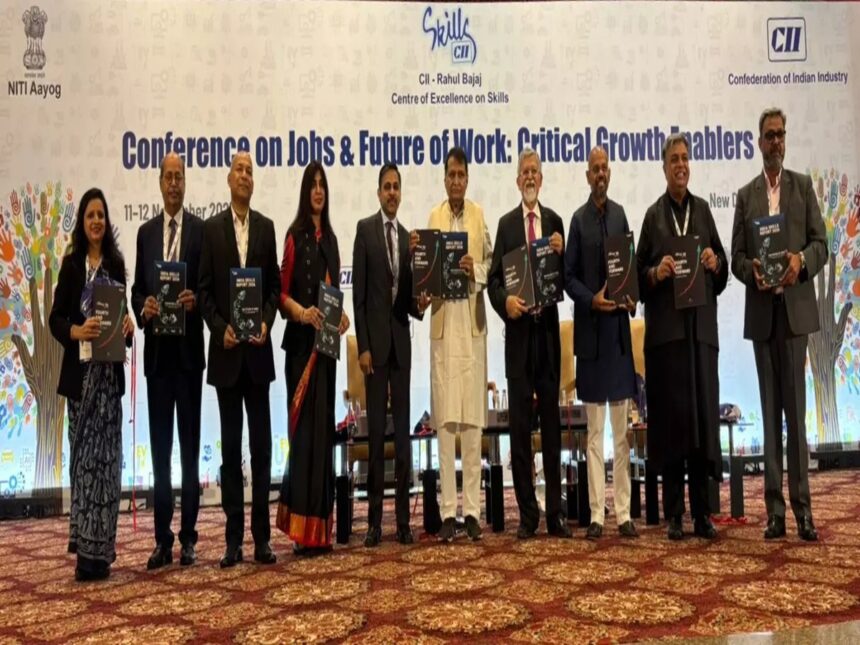
India’s employment landscape is undergoing a significant transformation, with Uttar Pradesh emerging as the country’s most employable state, according to the India Skills Report 2026. Maharashtra secured the second position, while Karnataka ranked third.
The latest report also points to a broader improvement in India’s workforce readiness. Overall employability increased from 54.81% in 2025 to 56.35% in 2026, highlighting gradual progress in the skills and job-readiness of India’s young workforce.
India Skills Report 2026: How Employability Was Assessed
The India Skills Report 2026, released by ETS in collaboration with the Confederation of Indian Industry (CII), the All India Council for Technical Education (AICTE) and other partners, analysed data from more than one lakh candidates who appeared for the Global Employability Test (GET).
The study also incorporated responses from over 1,000 organisations across seven major industries, providing insights into the changing requirements of employers and the skills being developed among India’s workforce.
This year’s report examines how students, educators and companies are adapting to a rapidly changing employment environment shaped by technology, flexible work models and innovation.
Top 10 Most Employable States in India
According to the India Skills Report 2026, the top 10 states and regions by employability are:
- Uttar Pradesh
- Maharashtra
- Karnataka
- Kerala
- Punjab
- Madhya Pradesh
- West Bengal
- Rajasthan
- Arunachal Pradesh
- Jammu and Kashmir
Uttar Pradesh’s rise to the number-one position marks a significant development in the country’s employability landscape. Maharashtra and Karnataka followed closely in the rankings.
Tier-2 and Tier-3 Cities Strengthen India’s Talent Pool
One of the notable findings of the report is the growing contribution of Tier-2 and Tier-3 cities to India’s workforce.
As companies expand their hiring networks beyond traditional metropolitan centres, smaller cities are increasingly becoming important sources of skilled talent. This trend could help create more employment opportunities outside major urban hubs while allowing businesses to access a wider pool of workers.
The report also projects continued expansion of the gig economy. India’s gig workforce is expected to reach approximately 23.5 million by 2030, reflecting the growing popularity of flexible and non-traditional employment models.
India’s AI Talent Pool Continues to Expand
Artificial intelligence is emerging as another major factor influencing India’s employment market.
The report estimates that India now accounts for around 16% of the global AI talent pool, with more than 600,000 AI professionals working in the country.
The expanding AI ecosystem is expected to create demand for workers with specialised technical skills, while also increasing the importance of digital capabilities across traditional industries.
Which Sectors Are Hiring the Most?
Several industries continue to act as major employment generators in India. According to the report, the key hiring engines include:
- Technology and IT
- Banking, Financial Services and Insurance (BFSI)
- Manufacturing
- Renewable energy
- Healthcare
The growing demand across these sectors reflects the changing nature of India’s economy and the increasing need for workers equipped with both technical and adaptable skills.
India’s Employability Outlook
The India Skills Report 2026 suggests that India’s workforce is gradually becoming better prepared for the demands of a technology-driven economy. The rise in overall employability, combined with the growing role of smaller cities, AI professionals and the gig workforce, points to a broader transformation in the country’s employment ecosystem.
With Uttar Pradesh leading the state-wise employability rankings, followed by Maharashtra and Karnataka, the findings also indicate that India’s talent base is becoming increasingly distributed beyond its traditional employment centres.
As technology, AI and new forms of work continue to reshape the job market, the ability to build industry-relevant skills could become increasingly important for India’s young workforce.