
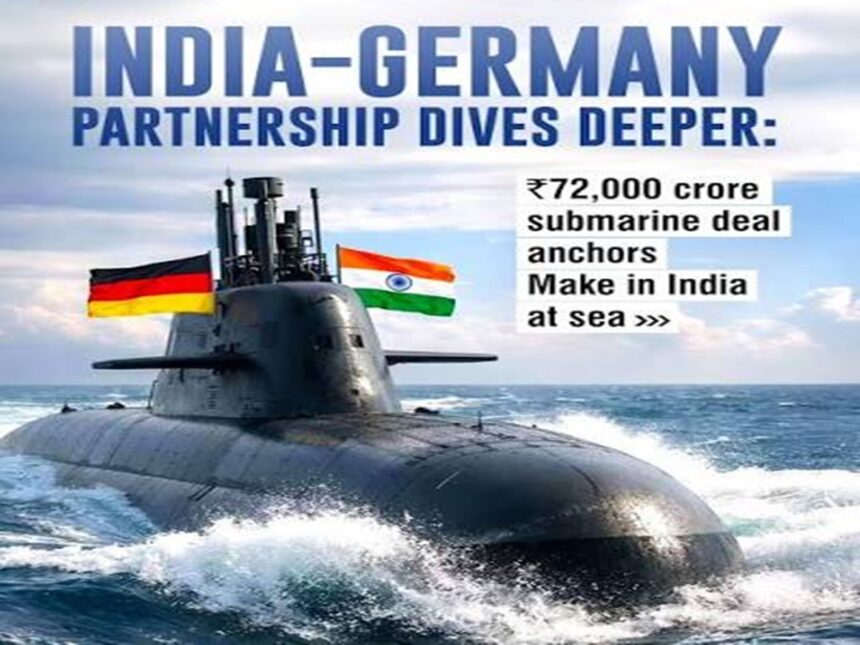
India’s long-pending Project 75(I) submarine programme could finally move forward, with the proposed ₹70,000-crore deal for six advanced conventional submarines expected to come up before the Cabinet Committee on Security (CCS) soon, according to reports.
The project is aimed at strengthening the Indian Navy’s underwater warfare capabilities while significantly expanding domestic submarine-building expertise.
Under the proposal, six advanced conventional submarines would be constructed largely in India by Mazagon Dock Shipbuilders Ltd (MDL) in Mumbai in partnership with Germany’s ThyssenKrupp Marine Systems (TKMS).
The programme has faced prolonged delays, with negotiations repeatedly running into disagreements over commercial conditions and technical requirements. A CCS approval could clear one of the final major hurdles before the contract is signed and construction begins.
Project 75(I): Why the Deal Matters
Project 75(I) is not simply about adding six submarines to the Navy’s fleet.
For India, the larger objective is to develop a stronger domestic underwater defence industry capable of handling submarine construction, maintenance, upgrades and eventually more advanced indigenous design and development.
The proposed submarines are expected to feature air-independent propulsion (AIP), allowing them to remain underwater for considerably longer periods than conventional diesel-electric submarines without AIP.
They are also expected to incorporate modern:
- Sonar and surveillance systems
- Torpedoes
- Missile systems
- Electronic warfare equipment
- Stealth technologies
- Air-independent propulsion systems
These capabilities would improve the Navy’s ability to conduct prolonged underwater patrols and surveillance missions.
TKMS Expands Its Indian Partnerships
Even as the government works towards a final decision on Project 75(I), TKMS has been expanding its network of Indian industrial partners.
The German defence company has signed an agreement with Hyderabad-based VEM Technologies covering the development, construction, integration and future modernisation of heavyweight torpedoes.
TKMS subsidiary ATLAS ELEKTRONIK is also involved in the arrangement, with VEM expected to undertake integration and testing activities in India.
The partnership has subsequently developed into a broader teaming arrangement involving technology transfer and a Make-in-India torpedo programme.
TKMS has also partnered with Mumbai-based CFF Fluid Control for anti-submarine warfare systems and is reportedly exploring additional collaborations with Indian organisations, including the Defence Research and Development Organisation (DRDO).
India Wants More Than Submarine Assembly
One of the most important issues surrounding Project 75(I) is the extent of technology transfer and domestic industrial participation.
India’s objective is to ensure that local shipyards and defence companies do not merely assemble imported components.
Instead, the programme is expected to help Indian industry develop the expertise required to manufacture, maintain, upgrade and eventually improve advanced submarine technologies.
The final agreement will therefore be important in determining how responsibilities and technology are divided between the government, MDL and TKMS.
Indian Navy Faces a Conventional Submarine Shortfall
The proposed deal comes as the Indian Navy continues to deal with a shortage of conventional submarines.
The six new boats are expected to provide greater underwater endurance, stealth, surveillance and strike capabilities.
Their AIP technology would allow submarines to remain submerged for extended periods, making them better suited for long-duration patrols and sea-denial operations across the Indian Ocean.
The requirement has become even more important as Chinese naval and submarine activity in the Indian Ocean region increases.
MDL Already Has Experience With Modern Submarine Construction
India’s Mazagon Dock Shipbuilders has already built six Kalvari-class submarines with French assistance.
The first submarine in that series entered service in 2017, while the sixth and final boat, INS Vagsheer, was commissioned in January 2025.
The experience gained through the Kalvari-class programme provides MDL with an established foundation for taking on another major submarine-building project.
India and Germany Have a Long Submarine Partnership
The proposed TKMS-MDL collaboration also builds on a relationship that goes back several decades.
The Indian Navy has operated German-designed Type 209/1500 Shishumar-class submarines for many years, with some of these submarines having been constructed at MDL beginning in the 1980s.
Project 75(I) could therefore revive an established India-Germany submarine-building relationship, but with a significantly stronger emphasis on domestic production and technology transfer.
What Happens After CCS Approval?
If the Cabinet Committee on Security gives the project the go-ahead, the next major steps would involve finalising and signing the contract, followed by the start of construction activities.
The agreement is expected to establish the detailed division of work between the government, MDL and TKMS.
It would also need to specify production schedules, technology-transfer arrangements, industrial participation and long-term maintenance responsibilities.
For India, the significance of Project 75(I) extends well beyond acquiring six submarines. If implemented as planned, the programme could help create a broader domestic ecosystem for submarine manufacturing, advanced underwater weapons, maintenance and naval technology, while strengthening the Indian Navy’s capabilities in the increasingly contested Indian Ocean region.