
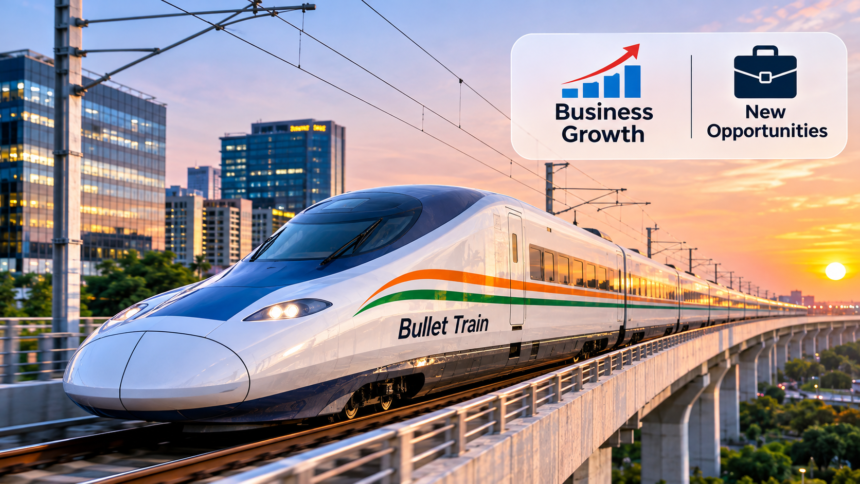
India’s first bullet train is eagerly awaited, with people keen to know when the high-speed service will begin operations. Beyond reducing travel time, the project is also expected to create new opportunities for businesses, industries and regional economies.
The introduction of high-speed rail could significantly improve connectivity between major cities and emerging commercial centres. Faster journeys may encourage investment, support job creation and make business travel more convenient. The Mumbai-Ahmedabad corridor is expected to play an important role in this transformation.
Here are five major ways the bullet train project could influence India’s business landscape.
1. Faster Business Travel and More Efficient Meetings
One of the biggest advantages of bullet trains will be the reduction in travel time between cities. For example, a journey between Mumbai and Ahmedabad that currently takes around 8–9 hours by road could be completed in approximately 2–3 hours by bullet train.
This improvement could make same-day business trips more practical. Professionals may be able to travel to another city for meetings in the morning and return home by evening.
Faster connectivity could also improve coordination between companies, speed up business discussions and make corporate travel more frequent.
2. Smaller Cities Could Become New Business Hubs
High-speed rail connectivity may create fresh commercial opportunities for smaller cities located between major urban centres.
Places such as Vapi, Surat, Bharuch and Anand could attract more businesses because of their improved access to Mumbai and Ahmedabad.
Companies looking to reduce operating expenses may consider setting up offices, manufacturing facilities and other business operations in these locations instead of paying higher rental costs in major metropolitan cities.
As connectivity improves, these smaller urban centres could gradually develop into important satellite business hubs.
3. Growth in Real Estate, Hotels and Retail Businesses
The bullet train project could also create opportunities in the commercial property and hospitality sectors.
Locations surrounding proposed stations are attracting attention from property investors. Commercial developments such as office spaces, shopping malls and warehouses could benefit from improved connectivity.
An increase in passenger movement may also create demand for hotels, restaurants, retail outlets and business meeting facilities near bullet train stations.
This could provide additional opportunities for local businesses and property developers.
4. Boost for Manufacturing and Supply Chain Industries
The development of high-speed rail infrastructure is also expected to support India’s manufacturing sector.
Domestic production of bullet trains, including the B28 mentioned in the project details, along with their components, could generate business opportunities for Indian companies operating in engineering, electronics, steel and automation.
There may also be indirect benefits for freight transportation. As more passengers use high-speed rail services, pressure on conventional railway services and highways could reduce. This may create additional capacity for freight trains and trucks, potentially improving supply chain operations.
5. New High-Speed Rail Corridors Could Strengthen Regional Trade
The potential benefits of bullet trains are not limited to the Mumbai-Ahmedabad route. Government initiatives for seven additional high-speed rail corridors are also progressing.
These proposed routes include Delhi-Varanasi, Varanasi-Siliguri, Mumbai-Pune-Hyderabad and Chennai-Bengaluru.
Such corridors could improve connections between eastern regions, including Bihar and West Bengal, and major industrial and IT centres in southern India.
Better connectivity between these regions may encourage commercial activity, improve business access and create opportunities for regional economic development.
Challenges That Could Affect Bullet Train Benefits
Despite its potential economic advantages, the bullet train project faces several challenges. The construction and development of high-speed rail infrastructure require substantial initial investment.
Ticket prices are also expected to be considerably higher than those of regular trains. As a result, the initial benefits may be more accessible to corporate travellers, large businesses, the tourism sector and real estate companies.
Smaller businesses may benefit more indirectly through improved market access, increased customer movement and new commercial opportunities.
Overall, India’s bullet train project has the potential to influence business activity well beyond faster passenger travel. Its long-term impact will depend on connectivity, investment, infrastructure development and the growth of commercial activities around the proposed corridors.
Disclaimer: This article is intended for general informational purposes and is based on the project details provided in the source material. Proposed railway corridors, economic benefits and infrastructure plans may change as the project progresses. Readers should refer to official government and railway announcements for confirmed updates.