
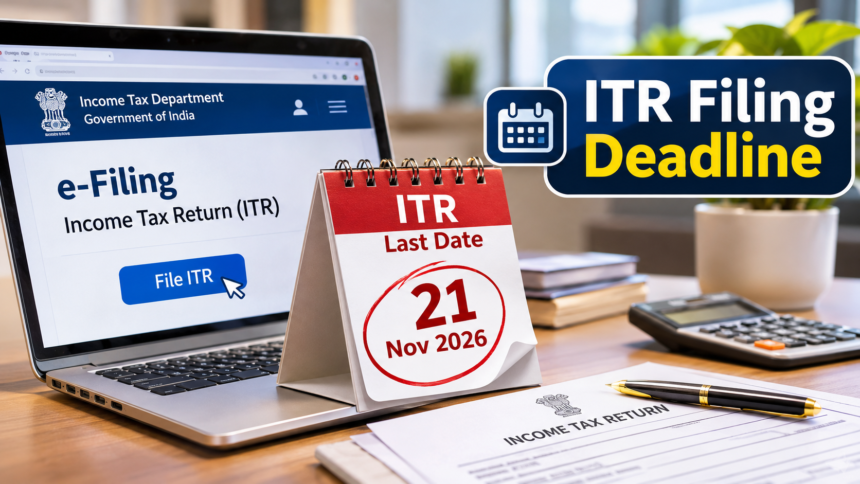
New Delhi: The Central Board of Direct Taxes (CBDT) has provided additional time to certain taxpayers to file their Income Tax Returns (ITR) for Assessment Year 2026-27. Businesses and companies whose accounts are required to undergo a tax audit can now submit their returns by November 21, 2026, instead of the earlier deadline of October 31, 2026.
However, the extended deadline is not applicable to every taxpayer. Salaried employees, individuals and businesses that are not required to undergo a tax audit must follow their respective original filing deadlines. Taxpayers should check their category carefully to avoid late filing charges and additional interest.
Who Can File ITR by November 21, 2026?
The CBDT’s deadline extension primarily covers businesses and companies whose accounts are subject to audit under the Income Tax Act.
Eligible taxpayers have received an additional period to complete their income tax return filing after the audit process. Partners of audit firms may also qualify for the extension, subject to the applicable conditions.
The additional time is intended to help taxpayers complete financial reconciliations and ensure that the information reported in their income tax returns matches their audited accounts.
No Deadline Extension for Salaried Employees and Non-Audit Businesses
Not all taxpayers can use November 21 as their new ITR filing deadline. The extension does not cover salaried individuals and other taxpayers whose accounts are not required to be audited.
Small businesses and professionals outside the tax audit requirements are also excluded. Similarly, Hindu Undivided Families (HUFs) that do not fall under the audit category will not receive this additional time.
Taxpayers required to report international transactions under Section 92E are also not covered by this particular extension.
For Assessment Year 2026-27, the earlier filing deadlines mentioned for different categories were:
- July 31, 2026: Salaried individuals and other eligible individual taxpayers.
- August 31, 2026: Businesses and professionals not covered by tax audit requirements.
- October 31, 2026: Taxpayers covered under the audit category, subsequently extended to November 21, 2026.
Therefore, taxpayers who are not eligible for the extension should not wait until November to submit their returns.
Late ITR Filing Penalty and Additional Tax Charges
Rashid Ali, co-founder of Cashlo App (MJ Digital Services), explained that the November 21 extension applies specifically to taxpayers whose accounts are required to be audited under the Income Tax Act.
According to him, individuals and businesses without audit requirements must follow their original filing schedules. Taxpayers who have missed their applicable deadlines may still be able to submit a belated return by December 31, 2026, subject to the prescribed rules.
Late filing can attract a fee of up to ₹5,000. However, taxpayers whose total income does not exceed ₹5 lakh may be charged a reduced late fee of ₹1,000. Additional interest may also apply if any tax remains unpaid.
Can You File an Updated ITR After December 31?
Taxpayers who miss the belated return deadline may have another option through an Updated Income Tax Return (ITR-U).
Under the applicable provisions, an updated return can be filed within a period of 48 months, subject to eligibility requirements and additional tax payments. This facility comes with specific conditions and should not be treated as a replacement for filing the original return on time.
Taxpayers are advised to organise their income records, reconcile financial documents and complete the filing process within the applicable deadline rather than waiting until the last moment.
Disclaimer
This article is intended for general informational purposes only and does not constitute professional tax or financial advice. Income tax filing deadlines, late fees and eligibility conditions are based on the information provided and may be subject to changes in government notifications and applicable tax laws. Taxpayers should verify the latest rules through the official Income Tax Department website or consult a qualified tax professional before filing their returns.