
Honey is an important food source for honeybees, helping them survive when flowers are scarce. Bees collect nectar from blooming flowers and convert it into honey, which they store in honeycomb cells for later use. Since flowers do not produce nectar throughout the year, these reserves help colonies meet their food needs during winter and other periods when nectar is difficult to find.
Honey’s high sugar concentration provides energy, while its low moisture content helps prevent spoilage when it is properly stored. But how do bees turn flower nectar into honey, and is it really true that honey comes from bee vomit?
Is Honey Really Bee Vomit?
Many people believe honey is bee vomit because bees release nectar through their mouths before it becomes honey. However, this description is misleading.
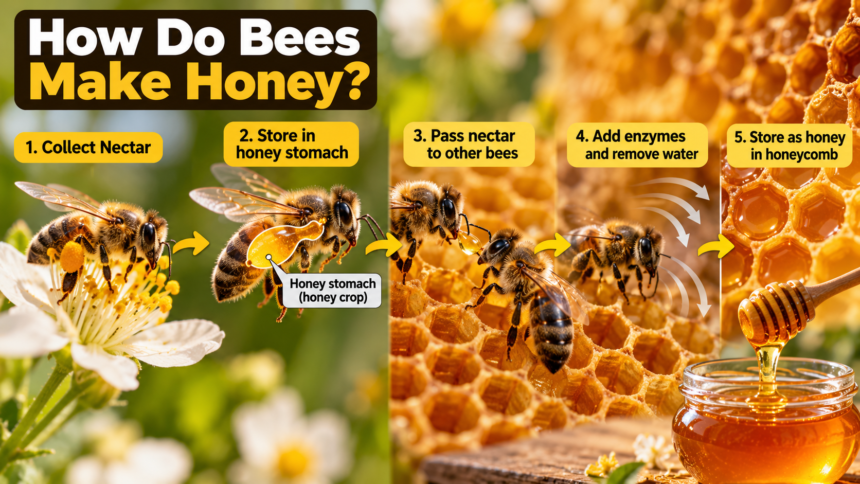
When a worker bee collects nectar, it stores the liquid in a specialised pouch called the honey stomach or honey crop. This structure is separate from the bee’s main digestive stomach and is primarily used to transport nectar back to the hive.
Once the bee returns, it transfers the collected nectar to other worker bees. During this process, the nectar is mixed with enzymes that begin changing its sugars.
Unlike vomit, which involves material returning from the digestive system, the nectar carried in the honey crop is primarily being transported for honey production. This is why describing honey as bee vomit does not accurately explain how it is made.
Do Bees Have Two Stomachs?
Bees have a digestive system that processes food for their own energy needs, along with a specialised storage pouch for carrying nectar.
The honey crop temporarily holds nectar collected from flowers as the worker bee travels back to the hive. The main digestive stomach, meanwhile, helps process food that the bee consumes to sustain its body.
Although these structures perform different functions, calling them two separate stomachs can be misleading. The honey crop is primarily a transport and storage compartment, rather than a second digestive stomach.
This distinction helps explain how bees can carry nectar back to the colony without immediately digesting the entire load.
How Do Bees Turn Nectar Into Honey?
Honey production involves several stages, with different worker bees contributing to the process.
First, worker bees visit flowers and collect nectar. They carry it back to the hive in their honey crops and transfer it to other bees. During these exchanges, enzymes are added to the nectar, changing its sugar composition.
Next, the bees spread the nectar through the honeycomb cells. They flap their wings to circulate air inside the hive, helping excess moisture evaporate. As the water content decreases, the liquid becomes thicker and gradually develops into honey.
Once the honey reaches a suitable consistency, the bees store it in the honeycomb cells. These reserves provide food for the colony when fresh nectar is unavailable.
Why Honey Production Requires the Whole Colony
A single honeybee cannot manage the entire honey-making process alone. Honey production depends on the coordinated work of many bees, from collecting nectar and transferring it inside the hive to adding enzymes, reducing moisture and storing the finished product.
Each stage contributes to turning flower nectar into a concentrated food reserve. The colony stores this honey so that it can draw on the supply when flowers are not blooming or food becomes difficult to find.
Ultimately, honey is the result of a collective process involving specialised bee behaviour and natural changes in nectar. The honey crop plays an important role in transporting nectar, while the bees’ combined efforts transform it into the honey stored in their hive.
Disclaimer: This article is intended for general informational and educational purposes only. It explains the basic honey-production process in honeybees and should not be considered a substitute for specialist scientific or entomological guidance.