
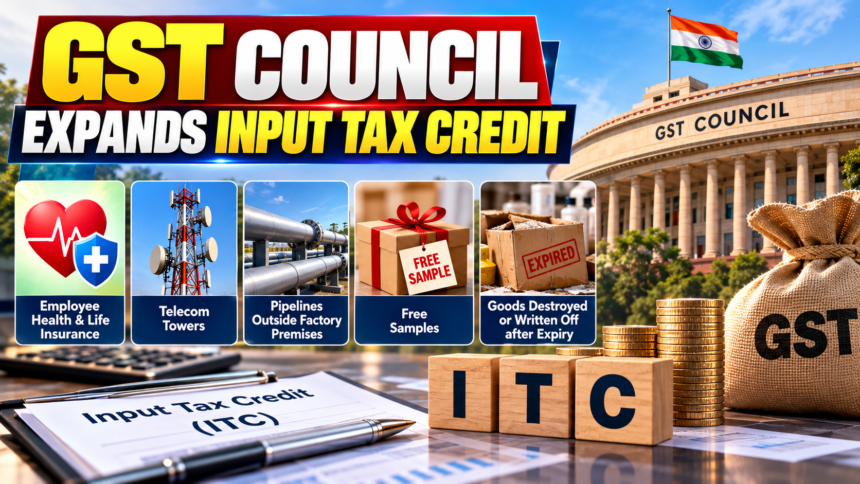
The 57th GST Council meeting has recommended changes to input tax credit (ITC) rules covering several business expenses, including employee health and life insurance, telecommunication towers, pipelines, free samples and expired inventory that must be destroyed under applicable laws.
The proposed changes aim to reduce the tax burden arising when businesses cannot claim credit for eligible inputs and expenses. They also form part of a broader effort to simplify GST compliance and improve the flow of tax credits across the supply chain.
By expanding ITC availability in selected areas, the Council aims to reduce tax cascading, where taxes paid on business inputs become an additional cost rather than being offset against output tax liabilities.
GST Relief on Employee Insurance and Infrastructure Costs
One of the key recommendations concerns health and life insurance policies taken for employees. Removing restrictions on input tax credit for these expenses could help businesses reduce the GST cost associated with employee benefits.
The change is intended to bring greater alignment between eligible business expenditure and the GST credit mechanism, particularly for companies that include insurance coverage as part of their employee benefit programmes.
The Council has also recommended allowing ITC on telecommunication towers and pipelines installed outside factory premises. These assets are important investments for businesses operating in telecommunications and infrastructure.
Previously, restrictions on claiming credit for such items could leave GST embedded in the cost of investment. Allowing eligible ITC would enable businesses to offset the applicable input tax against their output tax liability, potentially reducing the overall cost of these assets.
ITC on Free Samples and Expired Inventory
The proposed changes also address issues faced by businesses that distribute free product samples or manage goods with limited shelf lives.
Under the recommendations, input tax credit will be available on free samples. Credit will also be permitted for inventory written off due to expiry when another law requires the goods to be destroyed.
These provisions could be relevant to businesses that use product samples for marketing and sales, as well as industries handling products that must be disposed of after their expiry dates.
The changes seek to address situations in which businesses incur GST on goods used for legitimate commercial purposes but face restrictions on claiming the corresponding credit.
GST Changes Aim to Reduce Tax Cascading
The wider objective of the ITC recommendations is to prevent eligible business expenses from carrying unnecessary tax costs. A smoother credit mechanism can help businesses manage their tax liabilities and improve the efficiency of the GST system.
The Council has also recommended changes relating to accumulated input tax credit on input services and capital goods in specified refund cases involving inverted duty structures. According to the proposal, input-service credit will be available for ITC availed from November 1, 2026.
An inverted duty structure occurs when the tax rate on inputs is higher than the rate applicable to the final goods or services supplied. This can result in accumulated input tax credit for businesses.
The proposed expansion of credit availability is intended to address certain issues arising from such situations and improve the movement of credits through the tax system.
What the ITC Recommendations Mean for Businesses
The recommendations cover a range of expenses and investments that can affect business costs, working capital and tax compliance. If implemented through the relevant amendments and rules, the changes could reduce embedded GST costs and make the credit mechanism more efficient.
However, the actual benefits will depend on the final provisions, eligibility conditions and implementation details issued by the authorities. Businesses should review the applicable notifications and rules before changing their GST accounting or credit-claiming practices.
Disclaimer: This article is intended for general informational purposes only and does not constitute tax, legal, accounting or financial advice. The changes discussed are based on the recommendations described in the article, and their application will depend on the relevant official notifications, amendments and rules. Businesses should consult a qualified tax professional and refer to official GST guidance before claiming input tax credit.