
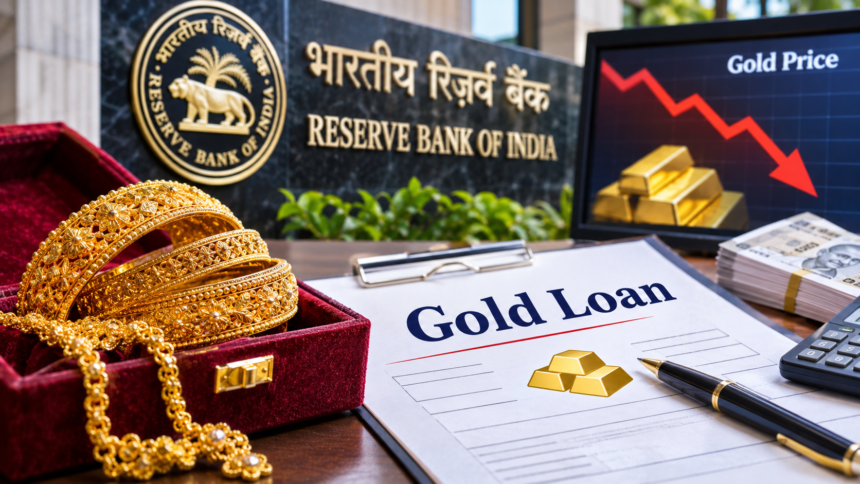
New Delhi: Falling gold prices may be creating fresh challenges for people who have taken loans by pledging their jewellery. While cheaper gold is generally welcomed by buyers, the decline in prices has reduced the value of gold kept as collateral against existing loans.
Amid this situation, the Reserve Bank of India (RBI) has reportedly asked Non-Banking Financial Companies (NBFCs) to closely monitor their gold loan portfolios and strengthen risk management.
Gold prices have reportedly fallen around 30% from their recent peak. This decline has affected the value of gold pledged by borrowers who took loans when prices were considerably higher. Consequently, several existing accounts are facing pressure as their loan-to-value (LTV) ratios approach the RBI’s prescribed limit of 85%.
The developments could affect borrowers through additional repayment requirements, stricter verification and closer monitoring of outstanding gold loans.
1. Falling Gold Prices May Lead to Additional Repayment Demands
A significant decline in gold prices reduces the market value of jewellery pledged with banks and finance companies.
When the value of the pledged gold falls, the loan amount becomes higher in comparison to the value of the collateral. This can push the LTV ratio closer to the permitted 85% limit.
To maintain the required margin, finance companies may ask borrowers to make partial repayments or provide additional gold as security.
For customers who borrowed against gold at higher market prices, this could mean arranging additional funds or jewellery to maintain their loan accounts.
2. Monthly Interest Payments Become Important for Gold Loan Borrowers
Another important development concerns the repayment structure of gold loans.
Traditionally, some borrowers preferred bullet repayment, under which the principal and accumulated interest were paid together at the end of the loan period.
However, under the RBI’s revised requirements described in the report, gold loans with a tenure exceeding one year require monthly interest payments.
Borrowers must therefore pay attention to their interest repayment schedules. Failure to make the required payments could result in the account being classified as a Non-Performing Asset (NPA), along with applicable penalties.
This makes timely interest payments particularly important for people who previously relied on paying the entire amount at maturity.
3. Loan Amount Against the Same Gold Weight May Decrease
The amount a customer can borrow by pledging a particular quantity of gold depends largely on its prevailing market value and applicable lending limits.
With gold prices declining, borrowers may receive a smaller loan amount for the same weight of jewellery compared with the amount available when prices were higher.
Finance companies are also expected to strengthen their verification procedures. This could include more detailed checks of customer documents and the purity of pledged gold.
As a result, borrowers may face stricter assessment before their gold loan applications are approved.
4. Multiple Gold Loan Accounts May Face Greater Scrutiny
Customers who have taken gold loans from multiple lenders could also face closer examination.
According to credit bureau TransUnion CIBIL, borrowers maintaining several gold loan accounts are more likely to face repayment difficulties and defaults.
In response to these concerns, finance companies are expected to pay greater attention to applicants’ credit scores, existing loan obligations and previous repayment records.
The objective is to identify potential repayment risks before approving additional loans and to prevent excessive lending.
5. RBI Asks NBFCs to Strengthen Gold Loan Risk Management
According to reports, RBI officials recently held a meeting lasting approximately 90 minutes with the chief executives of NBFCs to discuss several important regulatory and financial issues.
During the discussion, officials reportedly emphasised the need for stronger monitoring of gold loans following the decline of approximately 30-40% in gold prices.
The central bank also stressed that lenders should maintain appropriate margins and follow stricter procedures for recovery and additional security requirements whenever the value of pledged gold declines.
Other important matters discussed during the meeting included:
- Monthly interest compliance: NBFCs were advised to strictly follow the requirement for monthly interest payments on applicable gold loans.
- Net Owned Fund requirement: NBFCs that fail to achieve the required Net Owned Fund of Rs 10 crore by March 2027 will not receive an additional grace period, according to the report.
- Responsible lending: Finance companies were advised against approving loans too quickly simply to increase their business growth.
- Technology and cybersecurity: NBFCs were encouraged to work with new technology partners while conducting proper assessments of potential cyber risks.
The RBI’s reported instructions highlight the importance of responsible lending and stronger risk management in the gold loan sector.
For borrowers, the key takeaway is to keep track of gold loan interest payments, outstanding balances and collateral requirements. Falling gold prices could make it more important than ever to maintain sufficient security and avoid repayment delays.
Disclaimer: This article is intended for general informational purposes only and is based on the information provided in the source report. RBI regulations, gold loan conditions, LTV requirements and repayment policies may vary according to the applicable guidelines and lender-specific terms. Borrowers should check their loan agreements and consult their respective banks or NBFCs for clarification before making financial decisions.