
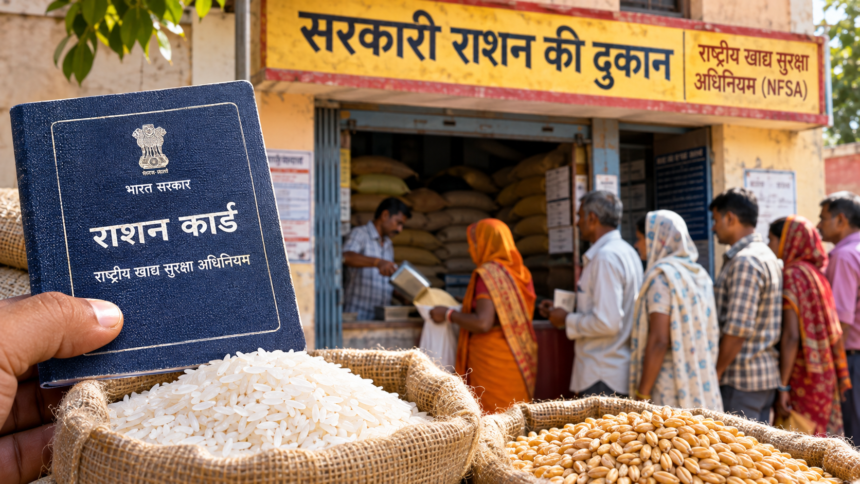
A fresh evaluation of the government’s free foodgrain programme has identified shortcomings in the selection and verification of ration beneficiaries across India. The report estimates that 13.2% of beneficiaries covered under the National Food Security Act (NFSA) did not meet the eligibility conditions set by their respective states but continued to receive free foodgrains.
West Bengal recorded the highest inclusion error at 39.5%, followed by Tripura and Tamil Nadu. The findings have highlighted the need for more effective verification of ration cards and regular updates to beneficiary records.
Free Ration Scheme: What Does the Latest Report Reveal?
The evaluation was commissioned by the Department of Food and Public Distribution (DFPD) and conducted during the financial year 2025–26. It covered 51,303 beneficiary households across all 36 states and Union Territories.
According to the findings, an estimated 13.2% of surveyed beneficiaries were receiving foodgrain benefits despite not fulfilling the eligibility requirements prescribed by their respective state governments.
The findings have brought attention to possible gaps in the process of identifying eligible households, checking beneficiary information and updating ration card databases.
West Bengal, Tripura and Tamil Nadu Record High Inclusion Errors
West Bengal reported the highest inclusion error, with 39.5% of surveyed beneficiaries falling outside the applicable state eligibility criteria. Tripura followed closely at 39.2%, while Tamil Nadu recorded 38.7%.
Several other states also reported notable figures. Bihar recorded an inclusion error of 25.5%, followed by Odisha at 22.9%, Sikkim at 21.9%, Punjab at 20.6% and Maharashtra at 20.3%.
The evaluation also found differences between rural and urban areas. The estimated inclusion error stood at 12.5% in rural regions, compared with 15.6% in urban areas.
These percentages refer to the share of surveyed beneficiaries identified as ineligible under the relevant state rules. They do not represent the proportion of the entire population or all ration cardholders in these states.
Which Households Were Identified as Ineligible?
The report identified several household characteristics associated with beneficiaries continuing to receive free foodgrains despite not meeting the prescribed eligibility conditions.
These included owning a permanent house with three or more rooms, having a car or another motor vehicle, possessing an air conditioner and having family members employed in government services.
However, ration eligibility conditions are not uniform across India. State governments are responsible for identifying eligible households under the NFSA and establishing their own selection and exclusion criteria.
Depending on the state, these conditions may take into account household income, land ownership, assets, employment and other financial or social factors. Differences in eligibility rules and the frequency with which beneficiary records are updated may contribute to variations in inclusion errors across states.
Government May Strengthen Ration Card Verification
The evaluation has emphasised the importance of improving the beneficiary identification process to ensure that foodgrain assistance reaches the households it is intended for.
It has recommended periodic verification of ration card databases, regular updating of beneficiary information and stronger eligibility checks, including Aadhaar seeding.
The purpose of these measures is to identify households that no longer qualify while ensuring that genuinely eligible families continue receiving their benefits. Verification exercises must also be handled carefully to prevent deserving poor households from being mistakenly removed from the ration list.
What Should Existing Ration Card Holders Know?
The report does not mean that all ration cards will be cancelled or that free foodgrain distribution will immediately stop. Its findings are based on a sample-based evaluation and indicate areas where beneficiary monitoring and verification could be improved.
Under the National Food Security Act, the central government provides food security assistance, while state governments have a major responsibility for identifying eligible households.
Better coordination between the Centre and states, along with accurate beneficiary records and regular verification, could help reduce inclusion errors and ensure that government assistance reaches the people who genuinely need it.
Disclaimer
This article is based on the findings and information provided in the evaluation report on the National Food Security Act. Eligibility conditions and ration distribution policies may vary between states and can change over time. Ration cardholders should consult their respective state food departments or official government notifications for the latest information about their eligibility and benefits. This content is intended for general news and informational purposes only.