
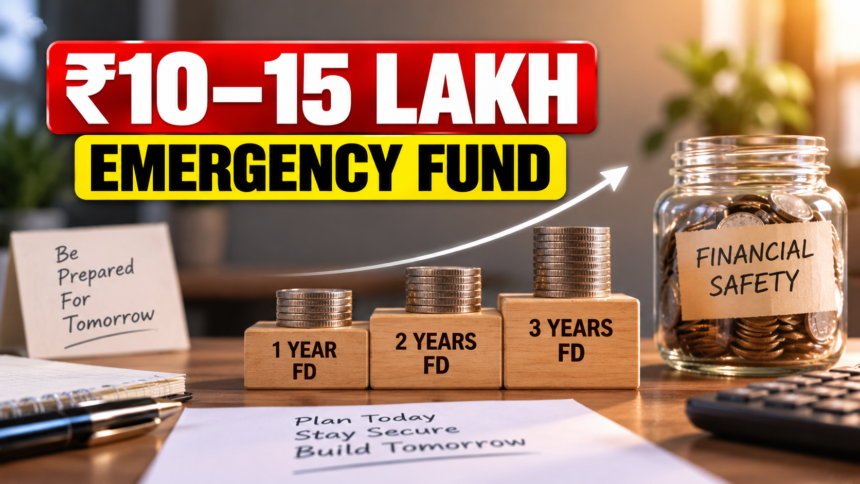
Building a sizeable emergency fund can provide a financial cushion against unexpected medical expenses, job loss, home repairs and other urgent needs. If you have an emergency corpus of ₹10 lakh to ₹15 lakh, keeping the entire amount in one fixed deposit (FD) may not always provide the flexibility you need.
One approach is FD laddering, where the money is divided among multiple fixed deposits with different maturity periods. The idea is to balance accessibility with interest earnings instead of locking the entire emergency corpus into one FD.
How FD Laddering Works
Suppose you have an emergency fund of ₹10 lakh. Rather than putting the entire amount into one deposit, you could split it into three FDs:
- ₹3 lakh for one year
- ₹3 lakh for two years
- ₹4 lakh for three years
For a ₹15 lakh emergency fund, the amount could be divided into three deposits of ₹5 lakh each, with one-, two- and three-year maturities.
Because the deposits mature at different times, the entire emergency fund does not remain locked for the same period. When one FD matures, the money can be used if required or reinvested based on the prevailing interest rates and financial needs.
Why an FD Ladder Can Offer More Flexibility
Putting the entire emergency fund into one long-term FD could create a problem if you suddenly need the money before maturity. Breaking the entire deposit early may result in a lower interest payout or premature withdrawal charges, depending on the bank’s rules.
With multiple FDs, you may only need to access the portion required rather than disturbing the entire corpus. However, premature withdrawal rules and applicable charges vary between banks and FD products.
If you expect that some money may be needed within the next few months, a portion of the emergency fund could also be kept in a three- to six-month FD rather than locking everything into one- to three-year deposits.
The appropriate FD tenure should depend on your expected expenses, liquidity requirements and the possibility of changes in interest rates.
What a Possible Repo Rate Change Could Mean
The Reserve Bank of India kept the repo rate unchanged at 5.25% in its August 2026 monetary policy meeting. SBI Research, however, has recommended a 25-basis-point repo rate increase in October and December, citing high crude oil prices and inflationary pressures.
Repo rates and bank FD rates are generally connected, although the response can differ between banks and across different FD tenures. The rate increases mentioned by SBI Research are its estimates and are not an announced RBI decision.
FD laddering can provide some flexibility in such an environment. Instead of committing the entire emergency fund at one interest rate, deposits mature at different points. If FD rates are higher when a deposit matures, the amount can potentially be reinvested at the prevailing rate.
Check Premature Withdrawal Charges Before Investing
Banks may impose charges or reduce the applicable interest when an FD is withdrawn before maturity. The information provided indicates that Indian banks commonly charge around 0.5% to 1% of the applicable interest rate, although the actual terms depend on the bank and the specific deposit.
For example, SBI’s stated terms provide for a 0.50% reduction for domestic retail term deposits up to ₹5 lakh and 1% for deposits above ₹5 lakh but below ₹2 crore in cases of premature withdrawal. The applicable interest rate is reduced accordingly.
Therefore, anyone considering FD laddering should check the bank’s latest premature withdrawal rules, interest rates and other terms before opening the deposits.
Disclaimer
This article is meant for general financial awareness and should not be treated as personalised investment advice. FD interest rates, premature withdrawal conditions, bank policies and monetary policy expectations can change. Readers should verify the latest terms directly with the concerned bank and consider their own liquidity requirements before making financial decisions.