
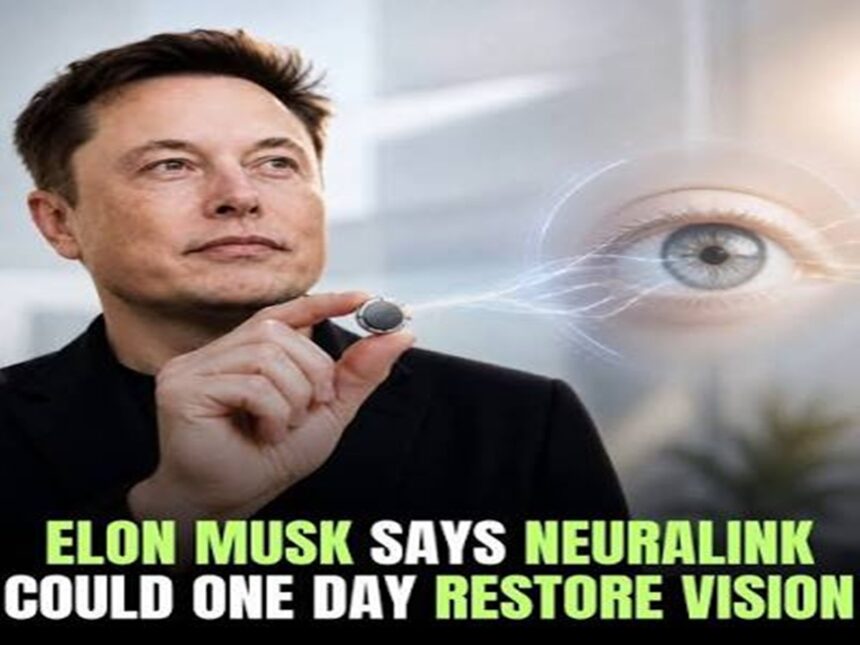
Elon Musk has made another ambitious prediction about the future of brain-computer technology, saying Neuralink could potentially help restore vision in people who are blind and, in the longer term, even allow humans to experience forms of sight beyond natural capabilities.
According to Musk, a future Neuralink visual implant could bypass damaged eyes and optic nerves by sending visual information directly to the brain’s visual processing centre. He has also suggested that more advanced versions of the technology may one day enable people to detect infrared and ultraviolet light, or even process other types of sensory information beyond normal human vision.
The claims have generated significant excitement, but medical experts caution that there is a considerable gap between what brain-computer interfaces can currently achieve and what may be possible in the future.
What Has Elon Musk Said About Neuralink’s Vision Implant?
Musk has said that Neuralink could implant its first vision-focused device within the next six to 12 months.
The proposed technology is intended to help people with severe blindness by bypassing parts of the normal visual system that may be damaged. Instead of relying on the eyes and optic nerves to transmit visual information, the implant could theoretically communicate directly with the visual cortex—the area of the brain responsible for processing what we see.
Musk has also claimed that the technology could potentially help some people who have been blind since birth. Future versions, he says, may go even further by providing extremely high-resolution visual information and allowing users to perceive wavelengths such as infrared and ultraviolet light.
For now, however, these possibilities remain future goals rather than proven clinical outcomes.
How Could a Neuralink Brain Implant Help Restore Vision?
The proposed system is based on a brain-computer interface, or BCI. This technology uses tiny electrodes to establish communication between an implanted device and the brain.
A visual prosthesis could work through a multi-step process:
- An external camera captures information from the surrounding environment.
- The system converts that visual data into electrical signals.
- Those signals are transmitted to electrodes placed in or near the visual cortex.
- The electrodes stimulate specific brain cells.
- The brain learns to interpret these patterns as visual information.
Rather than repairing damaged eyes, this approach attempts to bypass them altogether.
The basic scientific concept has been studied for decades. Researchers have long explored whether stimulating the visual cortex could help create visual sensations for people with profound blindness.
The major challenge is not simply producing a flash of light or basic shape. Recreating detailed, stable and natural-looking vision remains an extremely difficult problem in neuroscience and biomedical engineering.
Could People Born Blind Really Gain Vision?
This is one of the most complicated questions surrounding Musk’s claims.
The answer may depend heavily on the underlying cause of blindness.
If a person’s eyes or optic nerves were damaged but the visual areas of the brain developed normally, a device that delivers information directly to the visual cortex could theoretically have potential.
However, the situation may be far more complex for people whose visual pathways did not develop normally during childhood.
Vision is not created by the eyes alone—the brain must also learn how to process and interpret visual signals. Scientists are still studying how much the adult brain can adapt to completely new forms of sensory input, especially in people who have never experienced normal vision.
As a result, the claim that a brain implant could restore meaningful sight to everyone born blind should be treated cautiously until it is supported by clinical evidence.
Could Neuralink Give Humans ‘Superhuman’ Vision?
Musk’s longer-term idea of enhanced vision is perhaps even more futuristic.
Humans naturally see only a limited portion of the electromagnetic spectrum. Infrared and ultraviolet wavelengths exist outside the range that human eyes can normally detect.
However, cameras and specialised sensors can capture this information.
In theory, a brain-computer interface could collect signals from infrared or ultraviolet sensors and convert them into a form that the brain might eventually learn to understand.
That does not necessarily mean a person would suddenly “see” infrared exactly as they see the colour red or blue. The brain may need to learn an entirely new way of interpreting the incoming information.
At present, there is no clinical evidence showing that implanted brain devices can safely provide humans with infrared, ultraviolet or other enhanced forms of sensory perception.
The concept is scientifically interesting, but it remains highly experimental.
Where Does Neuralink’s Technology Stand Today?
Neuralink has already implanted its brain-computer interface in a small number of human participants through early clinical trials.
The current research is primarily focused on helping people with severe paralysis interact with computers and other digital devices using their thoughts.
These early trials represent an important step for brain-computer interface research, but they are very different from proving that a device can restore detailed human vision.
A Neuralink vision implant would need extensive clinical testing before it could become widely available. Researchers would need to demonstrate that the technology is safe, effective and reliable over long periods of time.
Questions about durability, infection risk, surgical complications, brain tissue response and the quality of the visual information would all need to be carefully studied.
A Promising Goal, But the Science Is Still Developing
The possibility of restoring sight through direct stimulation of the brain is one of the most ambitious goals in modern neuroscience.
If successful, the technology could have a life-changing impact on people living with certain forms of blindness. At the same time, claims about giving vision to everyone born blind or creating “superhuman” abilities should be viewed as long-term possibilities, not established medical achievements.
Neuralink’s vision for the future of brain-computer interfaces is undeniably bold. Restoring vision, enabling people to interact with technology using their thoughts and potentially expanding human sensory capabilities could transform medicine and human-machine interaction.
But for now, the technology remains at an early stage.
The science behind direct brain stimulation is real, and research into visual prosthetics is continuing. Whether Neuralink can eventually turn Musk’s most ambitious predictions into a safe and effective medical reality will depend on years of clinical research and evidence.
The future may be promising—but when it comes to restoring natural vision or creating “superhuman” sight, the biggest breakthroughs are still ahead.