
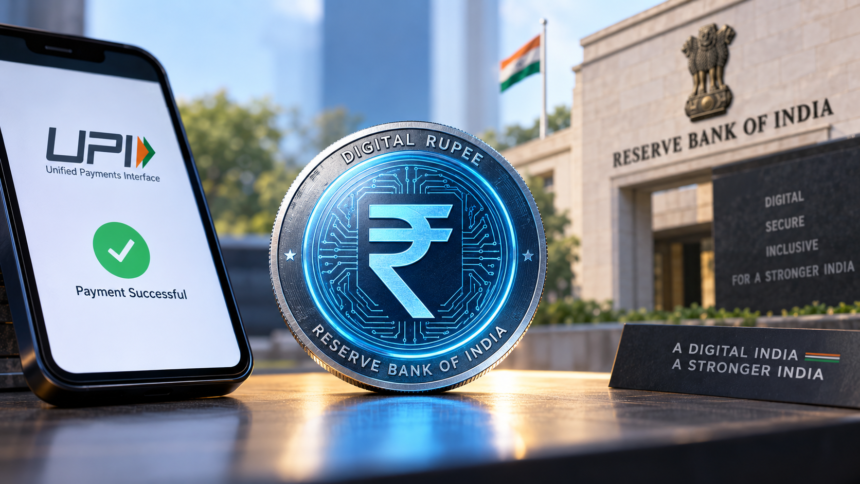
The debate over UPI transaction charges has been growing, but another major development in India’s digital payment system has been taking shape for several years. This development is the Digital Rupee, India’s proposed digital currency.
The idea was announced by Finance Minister Nirmala Sitharaman during the 2022 Budget. Nearly four and a half years have now passed, and the initiative has continued to move forward through pilot projects. The Digital Rupee is being developed with the aim of changing how people use money for digital transactions.
But what exactly is the Digital Rupee? Is it simply another way to make online payments like UPI, or is it fundamentally different?
Digital Rupee vs UPI: What Is the Difference?
At first glance, the Digital Rupee may appear similar to UPI because both can be used for digital payments. However, the two systems work differently.
UPI connects bank accounts and enables money to move between them through digital payment platforms. A typical UPI transaction involves several participants and systems working together. The payment request goes from the user’s app to NPCI and then to the payer’s bank. The bank verifies the transaction and deducts the amount before NPCI communicates with the recipient’s bank. The recipient’s bank then credits the money and sends confirmation through the system.
All of this happens within seconds, but several entities and computer systems are involved in completing the transaction.
The Digital Rupee is based on a different concept. It is intended to function more like digital cash. Instead of transferring money directly from one bank account to another, the digital currency can be held in a digital wallet.
Why the Digital Rupee Could Change Digital Payments
The biggest difference is that a Digital Rupee transaction does not work in the same way as online banking or a conventional UPI payment. According to the concept behind the system, users would not necessarily need a bank account or an internet connection for every digital currency transaction.
For example, when paying a merchant, the digital money would not necessarily move into the merchant’s bank account. Instead, it could be transferred to the merchant’s digital wallet.
This can be compared with the way physical cash works. When a customer hands a ₹100 note to a shopkeeper, the money moves directly from one person’s possession to another without banks processing the transaction at that moment. The Digital Rupee aims to create a similar experience in digital form.
Why UPI Charges Are Part of the Discussion
The ongoing discussion around UPI charges is linked to the infrastructure required to process UPI transactions. Multiple computer systems communicate with one another during each payment, involving the customer, banks, NPCI and the recipient.
After transactions are processed throughout the day, banks also have to reconcile the amounts exchanged between them. Although the entire process is completed very quickly, it involves several stages of communication between different systems.
The Digital Rupee represents a different approach because the digital currency itself can be stored in a wallet and transferred directly between parties. This is one of the reasons the technology has been undergoing trials for several years.
India’s Digital Rupee project is therefore not simply another version of UPI. It represents a separate approach to digital money, with the potential to change how digital transactions are carried out as the system develops further.