
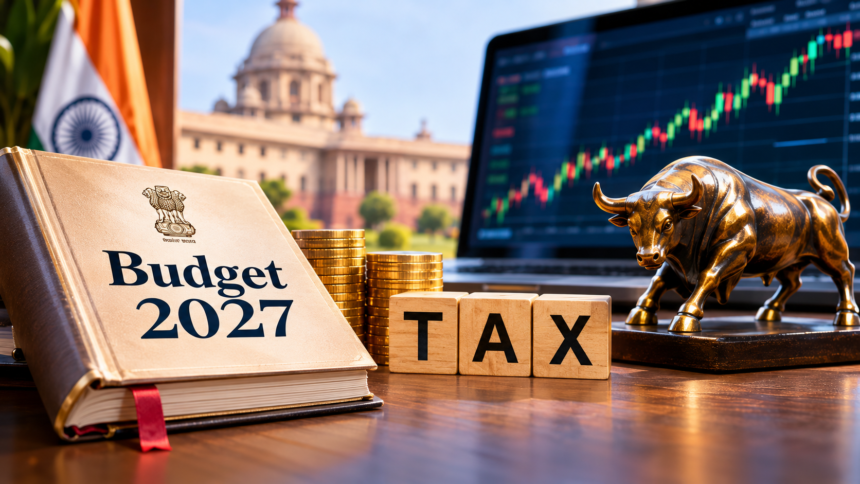
Investors and stock market traders could see significant changes in the taxation system in Budget 2027. The government is reportedly examining proposals to make cash market investments more attractive while discouraging excessive speculative activity in futures and options (F&O) trading.
Among the proposals being considered are a 50% reduction in Securities Transaction Tax (STT) on cash market share transactions and a possible increase in taxes on derivatives trading. The government is also examining whether the Long-Term Capital Gains (LTCG) tax can be reduced to provide relief to long-term equity investors.
Recommendations regarding these changes are expected to be presented to Finance Minister Nirmala Sitharaman ahead of Budget 2027. However, these proposals are still under consideration and no final decision has been announced.
STT on Cash Market Transactions May Be Reduced by 50%
One of the key proposals being examined is a reduction in Securities Transaction Tax (STT) on buying and selling shares in the cash market. The government is considering bringing the existing STT rate down by 50% to reduce the cost of equity transactions.
Currently, investors are required to pay STT based on the transaction value whenever they purchase or sell shares. This charge applies independently of whether the investor makes a profit or incurs a loss on the trade.
A reduction in STT could make cash market trading less expensive and encourage more investors to participate directly in equity investments. The broader objective is to strengthen participation in the cash segment rather than allowing speculative activity in derivatives to dominate stock market trading.
Higher Tax on Futures and Options Trading Under Consideration
Alongside the proposed reduction in cash market STT, the government is also considering increasing the tax burden on futures and options transactions.
The growing popularity of F&O trading, particularly among retail investors participating in options, has become a concern for policymakers. Derivatives allow traders to take large market positions with relatively small initial capital, making them attractive to investors. However, these trades also involve considerable financial risks.
The government is exploring higher taxation as a possible way to discourage excessive speculation and make retail investors more cautious about entering derivatives positions without properly understanding the risks.
Data on market activity highlights the difference between cash and derivatives trading in India. According to reports, equity derivatives turnover in the Indian stock market is around 227 times the cash market turnover. By comparison, the ratio stands at approximately four times in the United States and 29 times in Germany.
This significant difference reflects the scale of derivatives activity in India’s stock market and is one of the reasons behind the government’s reported efforts to review the existing tax structure.
88% of Retail Traders Lost Money in F&O Trading
Losses among individual investors in the derivatives segment have added to concerns surrounding the rapid expansion of F&O trading.
According to data from market regulator Securities and Exchange Board of India (SEBI), approximately 88% of retail traders incurred losses in equity derivatives during the year ending March 2026. Their combined net losses were reported at ₹917 billion. Options trading accounted for 92% of these losses.
The structure of options trading allows investors to take relatively large positions with limited upfront capital. However, incorrect predictions about market direction can result in substantial losses, including the possibility of losing the entire amount invested in a position.
This trend has strengthened calls for measures to control excessive speculation and improve investor awareness about the risks associated with derivatives.
The government had also revised F&O taxation in the February 2026 Budget. Securities Transaction Tax on equity futures was increased from 0.02% to 0.05%. Meanwhile, the STT rate on option premiums and option exercise was set at 0.15%.
The latest proposals indicate that the government may continue reviewing the tax structure to discourage excessive derivatives activity.
LTCG Tax Cut May Offer Relief to Long-Term Investors
Apart from changes in STT and derivatives taxation, a possible reduction in Long-Term Capital Gains (LTCG) tax is another proposal being considered ahead of Budget 2027.
Currently, profits earned from selling listed equity shares after holding them for more than one year attract LTCG tax at 12.5%. For shares sold within one year of purchase, investors are required to pay Short-Term Capital Gains (STCG) tax at 20%.
A reduction in the LTCG tax rate could provide some relief to investors who hold shares for longer periods. It may also make long-term equity investments more attractive.
However, the extent of any proposed reduction remains unclear. The government will also need to consider the impact on its tax revenues before making a final decision.
Investors will therefore be watching Budget 2027 closely for announcements concerning cash market STT, F&O taxation and capital gains tax. Any changes could influence trading costs and investment decisions across different segments of the stock market.