
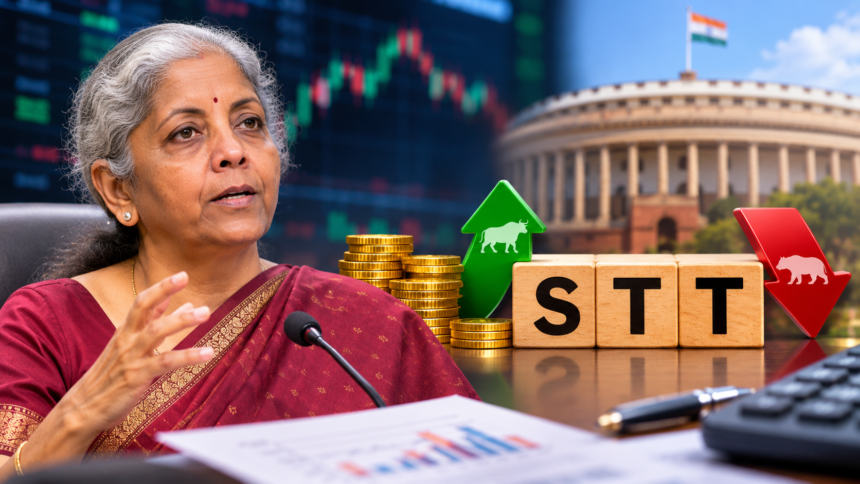
The Indian government is considering a proposal to reduce the Securities Transaction Tax (STT) on share trading by 50% while increasing taxes on derivatives transactions. The move is aimed at discouraging speculative trading in the derivatives segment while making equity share transactions less expensive, according to a Bloomberg report published on Wednesday.
The shortlisted recommendations are expected to be placed before Finance Minister Nirmala Sitharaman for consideration.
The proposals are being examined ahead of the Union Budget 2027. Central Board of Direct Taxes (CBDT) Chairman Ravi Agrawal had earlier confirmed that the Finance Ministry was reviewing suggestions received from different stakeholders during pre-Budget consultations.
Speaking on the sidelines of an event in New Delhi, Agrawal said the government was assessing concerns and recommendations related to taxation, including the capital gains tax structure. He added that various aspects of the existing system would be reviewed before the Union Budget announcement scheduled for February 1, 2027.
Why Market Participants Want Changes in STT and Capital Gains Tax
The proposals come amid growing concerns among market participants about the tax burden on equity investments and derivatives trading.
Securities Transaction Tax is charged on the value of eligible stock market transactions, regardless of whether an investor makes a profit or incurs a loss.
Relatively lower taxation on derivatives has encouraged speculative activity, particularly in options trading, while activity in the cash equity market has remained comparatively subdued.
Data from the Securities and Exchange Board of India (SEBI) highlights the risks associated with derivatives trading. Nearly 88% of individual traders in equity derivatives reported losses during the financial year ended March 2026. Their combined losses were approximately ₹91,700 crore, or around $10 billion. Options trading accounted for 92% of these losses.
Market participants have also raised concerns about the combined impact of STT and short-term and long-term capital gains taxes. Some industry representatives have called for the removal of long-term capital gains (LTCG) tax on equity investments.
FICCI Seeks Restoration of LTCG Tax Exemption
The taxation issue was also discussed during a meeting between representatives of the industry body FICCI and Finance Minister Nirmala Sitharaman on Tuesday.
FICCI proposed restoring the exemption from LTCG tax on listed securities through the upcoming Budget, arguing that the move could encourage long-term investments.
The organisation also suggested a calibrated increase in STT on delivery-based transactions to help the government protect some of its tax revenue.
The proposal refers to the changes introduced in 2004, when then Finance Minister P. Chidambaram abolished LTCG tax on listed securities and introduced STT instead. The LTCG tax was brought back in 2018 by then Finance Minister Arun Jaitley.
FICCI’s recommendation seeks to revisit the earlier tax arrangement by restoring the exemption on long-term gains while adjusting STT rates on delivery-based trades.
Current LTCG Tax and STT Rates in India
Under the present tax structure, long-term capital gains from equities, mutual funds, property and gold exceeding ₹1.25 lakh in a financial year are taxed at 12.5%. The indexation benefit is no longer available.
Short-term capital gains on equities are taxed at 20%.
STT rates on derivatives transactions have also been revised. The current rates are:
- Equity futures: STT is 0.05% on the sale transaction, compared with the earlier rate of 0.02%.
- Sale of options: The tax is 0.15% of the option premium, increased from 0.1%.
- Exercise of options: The buyer pays STT at 0.15% of the option’s intrinsic value, compared with the previous rate of 0.125%.
For futures and options transactions, STT is generally paid by the seller. However, when an option is exercised, the tax liability falls on the buyer.
The proposals under review could bring changes to the taxation of both cash-market transactions and derivatives. The final decision will depend on the government’s assessment of the recommendations ahead of the Union Budget 2027.
Disclaimer: This article is based on the information and proposals reported in the source material, including the Bloomberg report and stakeholder recommendations. The proposals are under consideration and should not be treated as announced government decisions. Tax rates and regulations may change following official Budget announcements. Readers should consult official government notifications or qualified tax professionals for guidance on their individual tax obligations.