
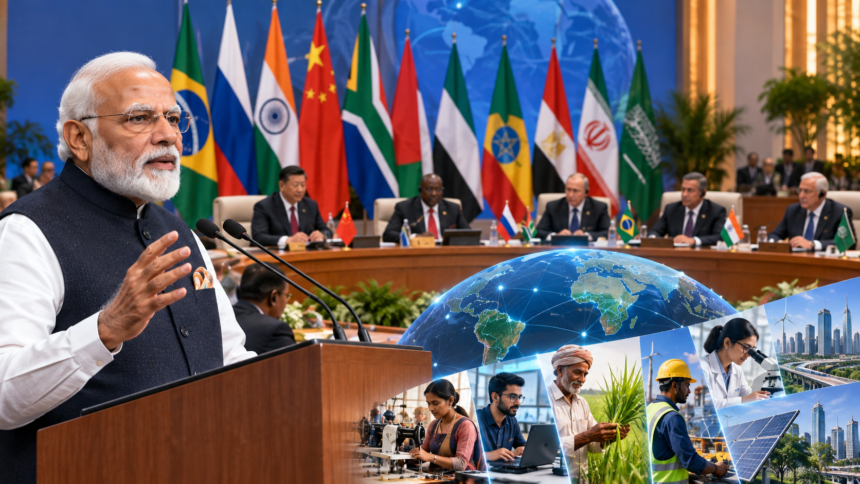
BRICS Summit 2026: Prime Minister Narendra Modi has called for a broader and more people-focused approach to BRICS cooperation, highlighting a series of platforms and initiatives aimed at connecting small businesses, startups, farmers, workers, researchers and cities across member nations.
Speaking on the second day of the BRICS Summit 2026 in New Delhi, Modi said the grouping should evolve beyond cooperation between governments and create opportunities for ordinary citizens and institutions to participate directly.
“We want our entrepreneurs, farmers, researchers, women, youth and ordinary citizens to become active participants as well,” Modi said.
According to India, the expanded BRICS grouping now represents around 49.5% of the world’s population and 40% of global GDP. Modi’s address focused on turning this economic and demographic strength into practical cooperation in areas such as business, agriculture, technology, employment, energy and urban development.
BRICS MSME Portal to Open New Markets for Small Businesses
One of the major initiatives highlighted by Modi is the BRICS MSME Cooperation Portal, which aims to help small and medium-sized businesses gain access to knowledge, financing opportunities and international markets.
According to an official government backgrounder, the digital platform is designed to bring together MSMEs, technology centres, trade organisations, financial institutions, training bodies and policymakers from BRICS countries.
The grouping has also strengthened discussions around MSME financing and developed a work plan focused on helping smaller enterprises expand internationally.
These measures are particularly aimed at tackling two major challenges for small businesses: access to affordable finance and the ability to enter overseas markets.
BRICS Startup Network to Boost Innovation
Startups are another important part of the new BRICS cooperation framework.
The grouping has created an Incubator Network that links national nodal agencies, selected startup incubators and entrepreneurs across member countries. Eligible startups can potentially be connected with incubators in other BRICS economies, giving them access to expertise, networks and institutional support outside their domestic markets.
India has also put forward the proposal for a BRICS Startup Innovation Fund. The proposed fund is intended to support early-stage and growth-stage companies working on scalable solutions.
The New Delhi Declaration supports further consideration of the proposal. However, details regarding its corpus, financing model and launch date have not yet been finalised.
AI and Digital Technology to Support Farmers
Agriculture also featured prominently in Modi’s vision for greater BRICS cooperation.
The BRICS Network on Digital Agriculture aims to bring technologies such as artificial intelligence, geospatial tools and digital public infrastructure closer to the needs of farmers.
The initiative covers multiple areas, including agriculture, agroforestry, fisheries and aquaculture. The initial phase is being coordinated by IIT Delhi, according to the government.
BRICS has also established a network of centres of excellence focusing on agroecology and regenerative agriculture. These centres are expected to combine traditional agricultural knowledge with modern scientific methods to improve climate resilience and productivity.
BRICS CONNECT Focuses on Skills and Employment
The people-centric agenda also includes BRICS CONNECT, or the BRICS Cooperation Network for Capacity Building, Employability, and New Skills and Technologies.
The voluntary platform focuses on several areas, including:
- Skills development and employability
- Social-security capacity
- Women’s participation in the workforce
- Digital public infrastructure
BRICS countries have also agreed to increase cooperation in forecasting future workforce requirements, particularly in digital, green, care and other emerging sectors.
The goal is to help member countries prepare their workers for changing labour-market demands and new employment opportunities.
New Urban Mobility Hub for Sustainable Transport
BRICS cooperation is also expanding into urban development.
The grouping has established an Urban Mobility Hub to encourage member countries to share experiences and solutions related to affordable, inclusive and sustainable transportation.
The initiative could help cities exchange knowledge on improving public transport systems while making urban mobility more accessible and environmentally sustainable.
BRICS Digital Centre to Focus on Smart Grids and Energy Storage
Another initiative highlighted at the summit is the Digital Centre of Excellence for Smart Grids and Energy Storage.
The voluntary platform is designed to facilitate the exchange of technical expertise, regulatory approaches and potential pilot projects related to smart electricity networks and energy storage.
Modi said the centre could help BRICS countries make their clean-energy infrastructure more efficient, reliable and accessible.
BRICS Cooperation Extends Beyond Governments
The initiatives announced or highlighted at the BRICS Summit are currently at different stages of development.
While several networks, centres and hubs have already been established, the proposed startup innovation fund is still under consideration. Some of the cooperation mechanisms are also voluntary and non-binding.
Nevertheless, these initiatives represent an effort to take BRICS cooperation beyond high-level government meetings and establish practical connections between businesses, workers, farmers, researchers and communities.
Modi Calls for BRICS Solutions to Benefit the Global South
Modi also emphasised that the benefits of solutions developed within BRICS should not be restricted to member countries.
According to the Prime Minister, successful initiatives should be designed in a way that allows them to be adapted and made accessible to countries across the Global South.
The approach reflects India’s broader emphasis on using BRICS cooperation to address practical development challenges through technology, innovation and shared expertise.
“The strength of BRICS lies in our diversity and cooperation,” Modi said.
Conclusion
The BRICS Summit 2026 has placed greater emphasis on people-to-people and institution-to-institution cooperation. From MSME financing and startup incubation to digital agriculture, workforce skills, urban mobility and clean-energy technology, the new initiatives seek to turn BRICS into a more practical platform for collaboration.
If these mechanisms develop as planned, they could create new opportunities for entrepreneurs, farmers, startups, workers and cities while also providing solutions that can be adapted across the wider Global South.