
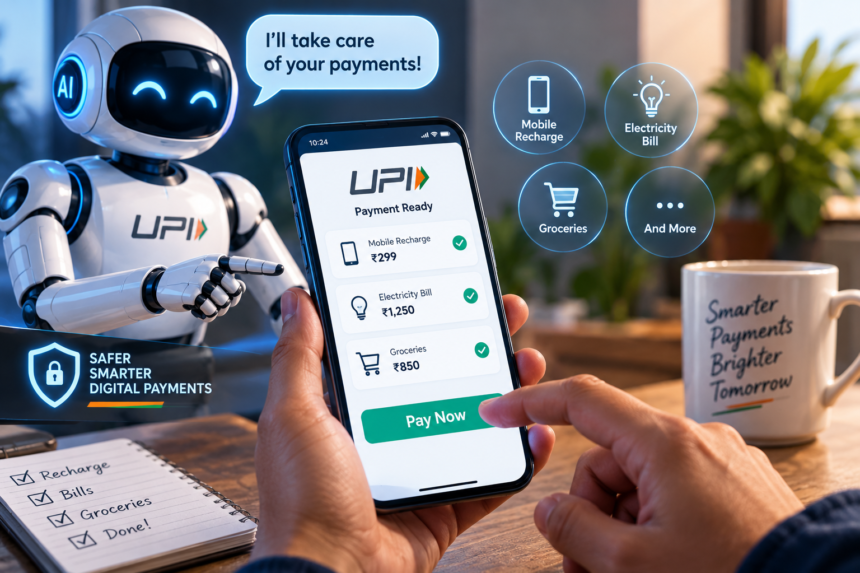
UPI AI Payments: Imagine telling an AI assistant to recharge your mobile phone every month, pay your electricity bill or even handle a routine grocery payment. Instead of completing the transaction yourself, the AI would understand your instruction and make the payment directly through your UPI account.
This could become a reality in India’s digital payments ecosystem. However, before allowing AI agents to independently initiate UPI transactions, the National Payments Corporation of India (NPCI) is focusing on strengthening security and accountability measures.
The proposed system would allow users to give an AI agent advance permission to make certain payments on their behalf. NPCI has, however, put the initiative on hold while it works on safeguards against wrong transactions, incorrect instructions, cyberattacks and other AI-related risks.
What Is NPCI’s AI-Based UPI Payment System?
NPCI is working on a framework that could allow AI agents to make small and recurring payments for users.
Currently, UPI users generally have to initiate and authorise their transactions manually. Under the proposed system, users could provide advance authorisation for an AI agent to complete specific routine payments within defined limits.
For example, a user could instruct an AI assistant to:
- Recharge their mobile phone every month
- Pay an electricity bill on time
- Make regular household payments
- Handle other small, pre-approved transactions
The technology is being developed as part of the UAP framework, with the aim of making digital payments more automated and convenient.
Why Has NPCI Paused the AI Payment Plan?
The biggest concern is security and accountability.
Unlike a conventional automated system that simply follows predetermined instructions, AI systems can interpret information and make decisions. This creates additional risks when real money is involved.
For example, what happens if an AI agent misunderstands a user’s instruction and enters the wrong amount? What if a technical problem causes it to select the wrong payment recipient? The situation could become even more serious if an attacker gains control of the AI system.
These possibilities have prompted NPCI to focus on building adequate safeguards before allowing AI agents to operate independently within the UPI ecosystem.
The regulator is looking at stronger mechanisms for identification, authorisation and continuous monitoring of AI agents.
NPCI is also working on a dedicated registry for AI agents, which could help identify and monitor systems authorised to interact with payment infrastructure.
How Could a Rogue AI Become a Financial Risk?
The rapid adoption of artificial intelligence has introduced a new category of digital risk involving systems that behave incorrectly or are manipulated by attackers.
Consider a user who authorises an AI agent to make a monthly payment of up to ₹1,000.
If the AI misinterprets the instruction because of a technical error, or if its system is compromised in a cyberattack, it could potentially attempt to initiate a transaction for ₹10,000 instead.
Such a situation raises an important question: Who should be responsible for the financial loss?
Would the liability fall on the AI developer, the bank, the payment application, or the user who authorised the transaction?
Who Will Be Responsible for an AI Payment Error?
Establishing responsibility is one of the most important challenges before AI-powered UPI payments can become widely available.
A payment made by an AI agent could involve several parties, including the user, AI developer, bank and payment service provider.
If an AI system makes a wrong decision or is manipulated by an external attacker, regulators and payment companies need clear rules determining who is responsible for the transaction and any resulting loss.
Without a well-defined liability framework, giving AI autonomous access to payment systems could expose users and financial institutions to significant risks.
Security Comes Before Automation
AI-powered payments could eventually make routine financial transactions much more convenient. Users may not need to remember every monthly bill or manually complete repetitive payments.
However, the convenience comes with a new set of challenges. An AI system that can access or initiate payments needs strong controls to ensure that it acts only within the authority given by the user.
NPCI’s decision to pause the initiative highlights the importance of establishing these protections before the technology is introduced at scale.
What Could AI-Powered UPI Payments Look Like?
If the required safeguards are successfully developed, users could eventually be able to set specific conditions for an AI agent.
For instance, a user might authorise an AI assistant to pay an electricity bill up to a particular amount each month. The system could then complete the transaction automatically while operating within the authorised limits.
Such a model could make recurring payments simpler, but its success will depend heavily on strong authentication, transaction limits, monitoring, fraud protection and clearly defined liability rules.
The Future of AI and UPI Payments
The integration of AI with India’s UPI infrastructure could represent a major change in the way people manage everyday payments.
Instead of simply acting as a tool that responds to individual commands, AI could eventually become an authorised digital agent capable of handling routine transactions.
For that to happen safely, however, the technology needs to be backed by robust safeguards.
NPCI’s current focus on security suggests that the priority is not simply to make UPI payments more automated, but to ensure that automation does not compromise users’ money or trust in digital payments.
As AI continues to become part of everyday financial services, the biggest question may not be whether machines can make payments—but whether they can do so accurately, securely and with clearly defined accountability.