
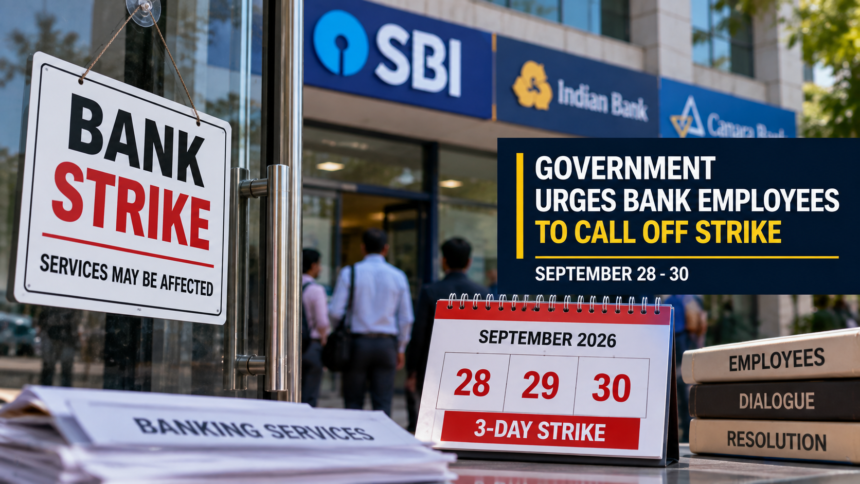
The government has appealed to employees of public sector banks and regional rural banks to call off the proposed three-day strike scheduled from September 28 to 30 and settle the remaining issues through discussions.
The government has warned that the strike could affect banking operations during the half-yearly closing period, particularly because September 30 is an important date for reconciliation, provisioning, treasury activities and market-related operations.
Bank unions have mainly been demanding the introduction of a five-day banking week and the withdrawal of the Performance Linked Incentive (PLI) scheme.
Five-Day Banking Week Remains the Main Demand
The United Forum of Bank Unions, along with various unions and associations representing public sector bank employees and supported by regional rural banks, has called for industrial action over the pending demands.
The government said it had already agreed to keep the PLI scheme in abeyance following discussions with employee representatives. This addressed one of the two major demands raised by the unions.
Despite several rounds of conciliation, employees went ahead with a one-day strike on September 11. A three-day strike is now planned for September 28, 29 and 30. The unions have also proposed an indefinite strike from October 26 over the remaining demand for a five-day working week.
Government Warns of Banking Service Disruption
The government has pointed out that the September 28-30 strike falls alongside the half-yearly closing of banks on September 30. Banking institutions carry out several important activities during this period, including account reconciliation, provisioning and treasury and market operations.
With the strike coming immediately before the weekend, the government said banking services could effectively remain disrupted for five consecutive days. Such a situation could affect customers, businesses, government-related transactions and international banking operations.
The government has therefore urged employees to maintain uninterrupted banking services and use dialogue to address the outstanding issue.
Government Highlights Employee Welfare Measures
The government also pointed to various measures taken for the benefit of bank employees, including increases in salaries and allowances, expansion of executive positions and recruitment.
According to the government, public sector banks recruited around 4.82 lakh employees between FY2014-15 and FY2025-26. Recruitment has doubled over the past three years, it said.
As of July 1, 2026, 95.84% of officer positions and 92% of subordinate and award staff positions were filled.
Other measures cited by the government include changes to transfer and promotion procedures, special leave provisions for women employees, revised family pension benefits, enhanced medical insurance for retirees and an increase in conveyance allowance for employees with disabilities.
The government has also started discussions for the next Bipartite Settlement ahead of the November 2027 deadline. It said the early negotiations are intended to facilitate the timely revision of salaries and allowances for bank employees.
The demand for a five-day banking week remains under consideration. The government has urged bank employees and unions to continue discussions and resolve the issue through constructive engagement while ensuring that banking services remain available to customers.
Disclaimer: This article is based on the information and statements provided in the source material and is intended for general informational purposes. Strike schedules, negotiations and government decisions may change following further discussions. Readers should check official announcements from the government, banks and employee unions for the latest updates before relying on the information.