
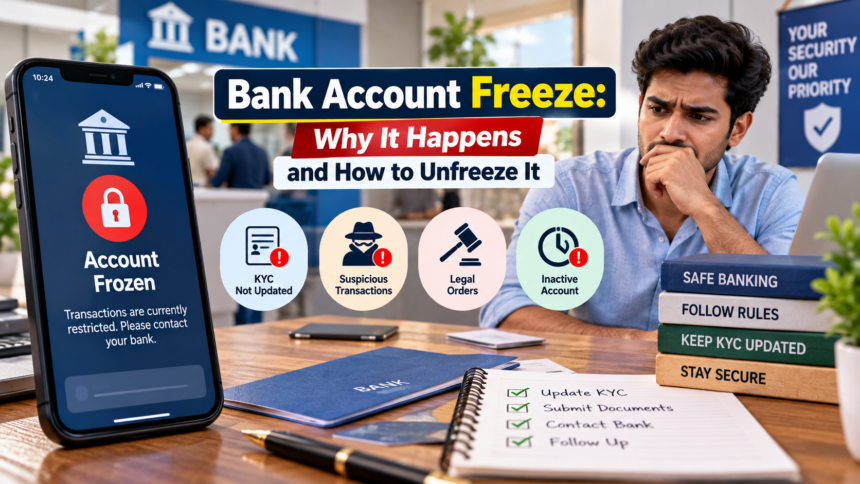
Bank Account Freeze: In today’s digital-first world, having a bank account is almost essential. From paying for a cup of tea to transferring money through UPI, most everyday transactions now happen digitally. But imagine trying to make a payment and suddenly discovering that your bank account has been frozen.
A frozen bank account can be stressful because you may be unable to withdraw cash, make online payments, use UPI or issue cheques. However, a frozen account does not necessarily mean that your money has disappeared. In most cases, the funds remain in the account but access to them is restricted.
So, why do banks freeze accounts and what should you do if your account is blocked? Here’s everything you need to know.
Why Do Banks Freeze Bank Accounts?
There can be several reasons behind a bank account freeze. Some are related to KYC compliance, while others may involve suspicious transactions or legal instructions.
1. KYC Not Updated
One of the common reasons for restrictions on a bank account is failure to complete KYC (Know Your Customer) requirements.
Banks are required to periodically update and verify customer information under applicable regulatory requirements. If you fail to complete re-KYC within the required timeframe, the bank may place restrictions on the account.
Updating your KYC details can generally help resolve this issue.
2. Suspicious or Unusual Transactions
Banks continuously monitor transactions to identify potentially fraudulent activity.
For example, an unusually large amount of money entering your account or multiple transfers from unfamiliar sources could trigger the bank’s risk-monitoring systems.
If the bank suspects that an account may be connected to cyber fraud, money laundering or another unauthorised activity, it may restrict transactions while the matter is reviewed.
The purpose of such restrictions is primarily to protect the account holder and prevent potential misuse of the banking system.
Legal Reasons for a Bank Account Freeze
A bank account can also be restricted because of instructions from a government agency, court or law-enforcement authority.
For example, restrictions may arise in connection with:
- Income-tax proceedings
- Court orders
- Police or law-enforcement investigations
- Certain financial disputes
- Suspected illegal transactions
- Other regulatory or legal proceedings
In such situations, the bank may not have the authority to remove the restriction without receiving appropriate instructions from the concerned authority.
What Happens If Your Account Is Inactive?
Long periods without transactions can also cause an account to become inactive or dormant, depending on the bank’s classification and applicable rules.
Banks monitor inactive accounts partly to reduce the risk of misuse. If an account has not been operated for a prolonged period, the customer may need to complete a reactivation process before normal transactions can resume.
It is important to distinguish a dormant or inactive account from an account frozen because of a legal or fraud-related restriction, as the process for restoring access can be different.
How to Unfreeze a Bank Account?
If your bank account has been frozen, the first step is to determine why the restriction was placed. The solution depends entirely on the reason.
You can contact your bank’s customer service team or visit your home branch and ask for details about the restriction.
Once the reason is known, follow the procedure specified by the bank.
If the Account Is Frozen Due to KYC Issues
If incomplete or outdated KYC information is responsible for the restriction, the process is generally straightforward.
You may need to:
- Visit the bank branch or use the bank’s available digital KYC facility.
- Submit the required KYC form or request.
- Provide valid identity and address documents, where required.
- Complete any additional verification requested by the bank.
- Wait for the bank to process and update your KYC information.
Once the verification is successfully completed, restrictions may be removed. The exact processing time can vary from one bank to another, so customers should confirm the timeline with their bank.
If the Account Is Frozen Due to Suspicious Transactions
If unusual transactions triggered the account restriction, the bank may ask you to explain the source and purpose of the money involved.
You may be required to provide supporting documents such as:
- Invoices or bills
- Payment records
- Bank statements
- Proof of the source of funds
- Other documents requested by the bank
The bank will review the information before deciding whether the restrictions can be removed.
If the transaction is found to be legitimate and all required verification is completed, the bank may restore account operations.
What If a Court or Government Agency Ordered the Freeze?
If the restriction was imposed following an order or instruction from a court, Income Tax Department, police or another authorised agency, the bank generally cannot remove it simply at the customer’s request.
In such cases, you need to approach the relevant authority and follow its instructions.
After the concerned authority issues the necessary clearance or revised instructions, the bank can take further action according to the applicable order.
How to Reactivate a Dormant Bank Account?
If your account has become inactive or dormant because it has not been operated for a long period, you may need to submit a reactivation request to the bank.
Depending on the bank’s requirements, you may be asked to:
- Submit a written application
- Complete KYC or verification formalities
- Provide updated documents
- Make a qualifying transaction after reactivation
The exact procedure can differ between banks, so it is advisable to check with your bank before making any transaction.
Bank Account Frozen? Don’t Panic
A frozen bank account can certainly cause inconvenience, but it does not automatically mean that your money has been lost. The most important thing is to find out the exact reason for the restriction.
If the issue is related to KYC, updating your details may resolve it. For suspicious transactions, the bank may require supporting documents and an explanation of the funds. If a legal authority has ordered the freeze, you will need to work with that authority before the bank can restore access.
Therefore, if you suddenly find that your UPI, ATM withdrawals, online banking or cheque transactions are not working, contact your bank immediately and ask why the account has been restricted. Taking prompt action can help you understand the issue and complete the required process more quickly.