
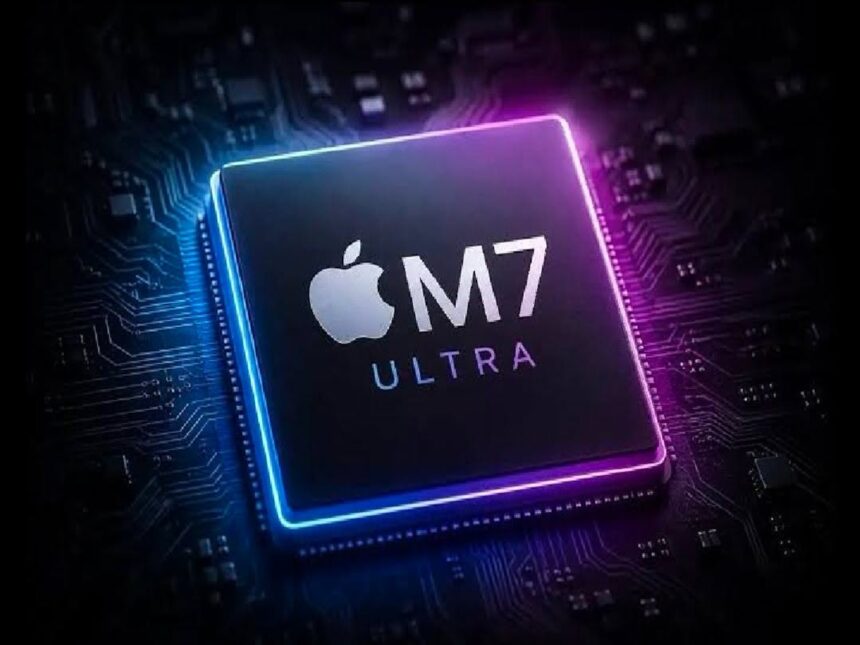
Apple is reportedly planning one of the biggest upgrades in the history of its custom silicon chips. According to recent leaks, the upcoming Apple M7 Ultra could dramatically raise the bar for performance by supporting up to 1.5TB of unified memory, delivering faster memory bandwidth, and offering major improvements for AI-powered workloads.
Although the next-generation M6 chip is expected to debut later this year, reports suggest Apple’s long-term focus has shifted toward the M7 family, with the flagship M7 Ultra expected to become the company’s most powerful processor yet.
Apple May Skip M6 Ultra to Focus on M7 Series
Fresh reports indicate Apple could be changing its roadmap for high-end desktop processors.
While the standard M6 chip is still expected to power upcoming Mac models, the company is reportedly no longer developing the M6 Pro, M6 Max, and M6 Ultra variants. Instead, Apple is said to be investing its resources in the M7 lineup to deliver a much larger performance leap.
If true, the M7 Ultra could become Apple’s first processor designed to compete not only with premium workstation chips but also with entry-level server processors.
M7 Ultra Could Support Up to 1.5TB Unified Memory
The biggest highlight of the leaked specifications is the enormous increase in unified memory capacity.
According to reports, the Apple M7 Ultra may support as much as 1.5TB of unified memory, making it the largest memory capacity ever available on an Apple Silicon processor.
For comparison:
- M3 Ultra: Up to 512GB unified memory
- Expected M5 Ultra: Up to 768GB
- Rumoured M7 Ultra: Up to 1.5TB
If these reports are accurate, the M7 Ultra would triple the maximum memory supported by the current M3 Ultra.
However, this doesn’t necessarily mean Apple will offer every Mac configuration with the full 1.5TB capacity. The company has previously chosen not to release Macs with the highest memory configurations despite hardware support.
Mac Studio Could Be the First Device With M7 Ultra
The first Mac expected to feature the M7 Ultra is a next-generation Mac Studio, reportedly scheduled for release in early 2028.
Leaks suggest Apple will redesign the workstation’s cooling system to handle the processor’s increased performance and higher power requirements.
In addition to the larger memory capacity, the chip is expected to include:
- More CPU cores
- Upgraded GPU performance
- Better thermal efficiency
- Higher overall computing power for demanding professional workloads
Apple Is Targeting AI and Professional Computing
The M7 Ultra appears to be designed with artificial intelligence and professional users in mind.
Its larger memory pool and improved processing capabilities could allow it to compete more directly with powerful workstation processors such as:
- AMD Medusa Halo
- Intel Nova Lake AX
Reports also suggest the M7 Ultra could handle some workloads typically reserved for entry-level server processors, including:
- AMD EPYC
- Intel Xeon
- Qualcomm Dragonfly C1000
This could make Apple’s flagship chip more attractive for AI development, scientific computing, 3D rendering, machine learning, and other memory-intensive professional applications.
Faster Memory Bandwidth Expected
Apple is also expected to significantly improve memory performance across the M7 lineup.
Current reports indicate the M6 architecture may already introduce:
- Redesigned memory architecture
- Improved Neural Engine
- Enhanced graphics performance
- Around 200GB/s memory bandwidth, compared to approximately 153GB/s on the M5.
The M7 generation is expected to build on these improvements by increasing memory bandwidth to approximately 240GB/s, enabling faster communication between the CPU, GPU, and Neural Engine.
The result could be noticeably better performance for AI processing, video editing, software development, and other demanding workflows.
Stronger AI Features Could Be a Major Focus
Artificial intelligence is expected to play an even bigger role in Apple’s future chips.
Reports suggest the M7 Ultra will feature a significantly upgraded Neural Engine, allowing faster on-device AI processing and improved support for generative AI applications.
The enhanced AI hardware could improve performance in tasks such as:
- Large language models
- AI-assisted coding
- Image generation
- Video editing
- Voice recognition
- Advanced productivity tools
These improvements align with Apple’s growing focus on AI across macOS and its broader ecosystem.
Manufacturing Process Still Unclear
The manufacturing strategy for Apple’s future chips remains uncertain.
Some reports claim future entry-level M-series processors could be produced using Intel’s 18A-P manufacturing process, while the premium M7 Ultra is expected to continue being fabricated by TSMC.
Given its expected 2028 launch, analysts believe the M7 Ultra will likely be built using one of TSMC’s advanced N2-family process nodes, although Apple has not confirmed any production details.
Final Thoughts
While Apple has yet to officially announce the M7 Ultra, current leaks suggest it could become the company’s most powerful Apple Silicon processor to date. With support for up to 1.5TB of unified memory, 240GB/s memory bandwidth, enhanced AI capabilities, and workstation-class performance, the M7 Ultra could redefine what Apple’s professional Macs are capable of.
If the rumours prove accurate, the Mac Studio powered by the M7 Ultra could become one of the most powerful desktop systems available when it arrives in 2028.
Disclaimer: The information in this article is based on leaks, rumours, and industry reports. Apple has not officially confirmed the M7 Ultra, its specifications, launch timeline, or product roadmap. Final hardware and features may differ from current expectations.