
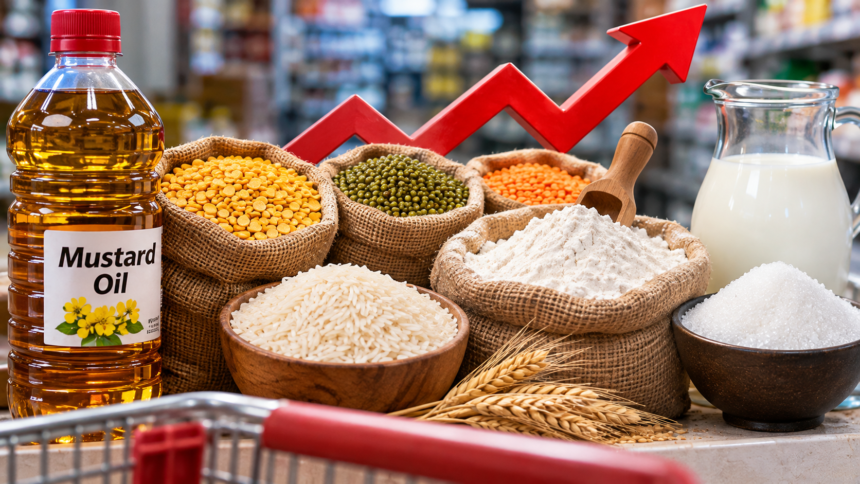
Rising prices of essential food items are putting additional pressure on household budgets across India. From mustard oil and pulses to rice, wheat, milk and sugar, several everyday commodities have become more expensive, affecting consumers in cities ranging from Delhi and Mumbai to Kolkata and Ranchi.
Recent data from the Consumer Affairs Ministry show that prices of several varieties of pulses have crossed ₹100 per kg in major cities. Cooking oil prices have also increased, with mustard oil recording one of the sharpest rises over the past year.
Pulses Prices Rise Across Major Cities
According to the latest price information available on the Consumer Affairs Ministry’s website, gram dal and moong dal have become more expensive in several major markets.
Gram dal is now priced at ₹100 per kg in Delhi, compared with ₹88 earlier. In Mumbai, its price has increased from ₹97 to ₹118 per kg. Chennai has also recorded a rise from ₹82 to ₹105 per kg, while the price in Ranchi stands at ₹99.
Arhar dal has witnessed an even bigger increase. Its price in Delhi has climbed from ₹106 per kg a year ago to ₹150 per kg. Consumers are paying around ₹157 in Mumbai, ₹150 in Kolkata, ₹147 in Chennai and ₹144 per kg in Ranchi.
Urad dal has also become costlier, reaching ₹150 per kg in Delhi, an increase of ₹20 over the past year. Meanwhile, moong dal is selling in the range of ₹110 to ₹120 per kg, with Ranchi recording a price of ₹112.
International supply conditions, including trade disruptions, higher transportation costs, geopolitical uncertainty and unfavourable weather in major producing countries, have also contributed to pressure on commodity prices.
Government Steps to Control Pulses Prices
India is the world’s largest producer and consumer of pulses, with annual demand estimated at approximately 30 million tonnes. Around 20% of this requirement is met through imports.
To maintain adequate supplies in the domestic market, the government has allowed duty-free imports of pigeon pea (tur) and black gram (urad) until March 31, 2027.
However, import duties continue to apply to other pulses. Chickpeas and lentils attract a 10% duty, while yellow peas are subject to a 30% import duty.
These measures are intended to support domestic availability and help manage supply-related price pressures.
Mustard Oil Records a Sharp Price Increase
Cooking oil prices have also moved higher across the country. During the past month, prices of almost all major edible oils increased, with palm oil being the exception.
Mustard oil has recorded a particularly strong rise. Its reported average price increased by 4.15% in one month to ₹215.43 per kg. Compared with the previous year, the increase stands at 15.46%.
Other cooking oils have also become more expensive. Peanut oil prices have moved up from ₹203 to ₹227 per kg, while soy oil has increased from ₹168 to ₹181 per kg.
City-wise mustard oil prices show further variation. Chennai has recorded a rate of ₹258 per kg, followed by Mumbai at ₹256, Kolkata at ₹235 and Ranchi at ₹224 per kg. The reported price in another comparison stands at ₹227 per kg, which is ₹33 higher than a year earlier.
Sugar and Rice Prices Add to Household Expenses
The increase in food prices is not limited to pulses and cooking oil. Sugar has recorded a rise of approximately 32% over the past year, making it one of the commodities with the biggest price increases.
Rice prices have also increased by around 15% during the same period, while wheat has become approximately 3% more expensive.
In Delhi, Mumbai, Kolkata and Ranchi, sugar is currently priced between ₹63 and ₹69 per kg, adding to the financial burden on consumers.
To address the rise in rice prices, the government increased the sales target under the Open Market Sale Scheme (OMSS) from 2.5 million tonnes to 5 million tonnes on November 6.
According to government figures, 2.5 million tonnes of rice had been sold through e-auctions by October 31. During the corresponding period last year, sales stood at 1.1 million tonnes.
The government has also directed rice and paddy dealers, wholesalers, retailers and processors to submit weekly stock information. The move is aimed at improving monitoring of available supplies and keeping track of market conditions.
Disclaimer: This article is intended for general informational purposes only. Commodity prices and market conditions can change depending on supply, demand, location and other economic factors. The figures mentioned are based on the information provided and may not represent current retail prices in every market. Consumers should check the latest local prices before making purchasing decisions.