
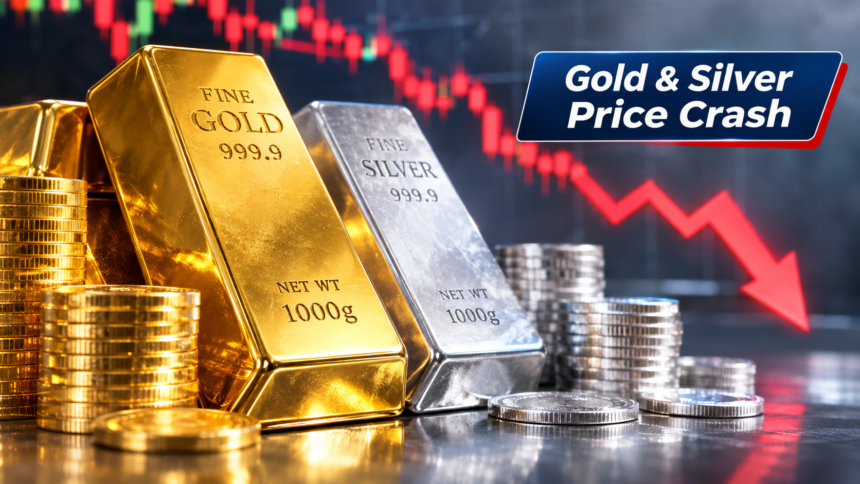
Gold and silver prices have witnessed a sharp correction in November 2026, putting investors on alert after a strong rally earlier in the year. The latest decline has pushed precious metals to their lowest levels in more than a year, raising an important question for buyers: is this the right opportunity to invest at lower prices, or could the market fall further?
On November 20, gold futures on the Multi Commodity Exchange (MCX) came under heavy selling pressure. Gold settled at around Rs 1,21,949 per 10 grams, while silver prices dropped close to Rs 1.48 lakh per kg. The fall has erased a significant portion of the gains recorded during the earlier rally.
Why Are Gold and Silver Prices Falling?
One of the major reasons behind the recent decline is the strengthening of the US dollar. When the dollar becomes stronger, gold and silver generally become more expensive for buyers using other currencies, which can reduce demand.
Rising US bond yields have also put pressure on precious metals. Since gold and silver do not generate regular interest income, investors may prefer interest-bearing assets when bond yields increase.
Expectations of a possible US Federal Reserve interest rate hike in December have added to the uncertainty. Recent signals from the central bank suggest that inflation remains a concern, making investors cautious about the possibility of tighter monetary policy.
Profit booking after the earlier rally has further increased selling pressure. Some investors have also been selling assets to raise cash and reduce risk amid weakness in global financial markets.
How Much Have Gold and Silver Prices Fallen?
The correction has been particularly sharp compared with the record levels reached earlier in 2026. Gold prices in India had touched approximately Rs 1,80,779 per 10 grams in January. By November 20, the MCX benchmark had fallen to around Rs 1,21,949 per 10 grams.
Silver has experienced an even sharper correction. Its decline has been driven by the stronger dollar, higher interest-rate expectations and concerns about industrial demand. Unlike gold, silver is used extensively in industrial applications, making its price sensitive to both investment sentiment and economic conditions.
The recent fall has also affected investors holding gold and silver exchange-traded funds (ETFs), whose values move with the underlying metal prices.
Should Investors Buy Gold and Silver at Lower Prices?
The sharp decline has created an opportunity for investors who were waiting for lower prices. However, a significant correction does not automatically mean that prices have reached their bottom.
Market experts remain cautious about the near-term outlook. If the US dollar continues to strengthen and bond yields remain elevated, gold and silver could face further pressure. On the other hand, softer inflation data or a change in expectations about Federal Reserve policy could support a recovery.
Investors considering fresh purchases may prefer to avoid investing their entire amount at once. Staggered buying can help spread the risk of entering the market at an unfavourable price. Those investing for the long term should also consider their financial goals, investment horizon and ability to handle price fluctuations.
Short-term traders, particularly those using borrowed funds or leveraged positions, should be especially careful during periods of sharp volatility.
What Should Investors Watch Next?
The direction of gold and silver prices will largely depend on upcoming US economic data and the Federal Reserve’s policy outlook.
Investors will closely monitor US manufacturing and services activity data scheduled for November 23, followed by the Personal Consumption Expenditures (PCE) inflation report on November 25. These updates could influence expectations about interest rates and the future movement of the US dollar.
For now, the precious metals market remains volatile. Investors may want to wait for clearer signs of price stabilisation before making large purchases rather than attempting to predict the exact bottom.
Disclaimer: This article is intended for general informational and educational purposes only. It does not constitute investment advice or a recommendation to buy or sell gold, silver or related financial products. Precious metal prices are subject to market fluctuations, and investors should assess their financial goals and risk tolerance or consult a qualified financial adviser before making investment decisions.