
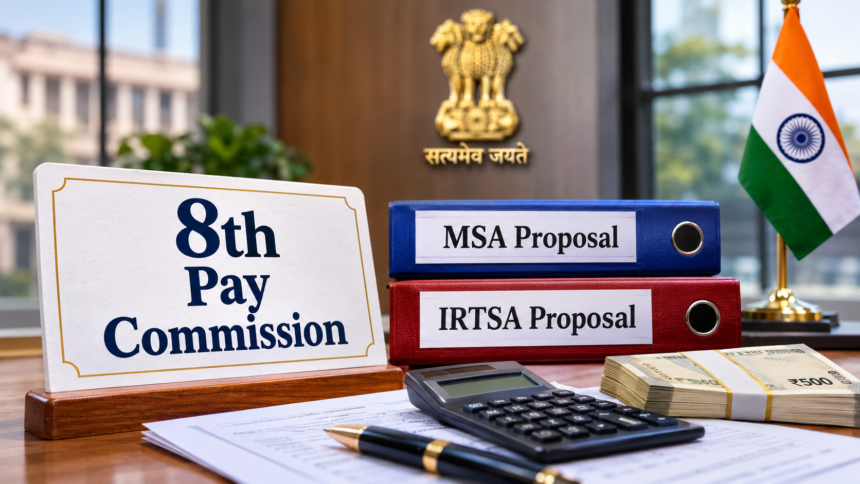
New Delhi: The 8th Pay Commission is expected to bring changes to the salary structure of central government employees, but the impact may not be limited to higher basic pay. The proposed revisions could also influence the salary difference between junior and senior officials.
Two prominent employee organisations, the Ministerial Staff Association (MSA) and the Indian Railways Technical Supervisors Association (IRTSA), have submitted different proposals for revising the pay structure. Their recommendations differ mainly in the fitment factor and the way salary increases should be distributed across pay levels.
While the MSA has suggested a uniform fitment factor, IRTSA has recommended different fitment factors for different levels. If considered by the 8th Pay Commission, these approaches could produce significantly different salary outcomes.
MSA vs IRTSA: What Are Their Fitment Factor Proposals?
The Ministerial Staff Association has proposed a minimum basic salary of ₹65,000 and a maximum basic salary of ₹9 lakh. These figures indicate a uniform fitment factor of approximately 3.61.
Under this proposal, employees across different pay levels would receive salary increases in roughly the same proportion. For instance, the basic pay of a Level 1 employee could increase from the existing ₹18,000 under the 7th Pay Commission to ₹65,000. Similarly, the basic pay at Level 18 could rise from ₹2.5 lakh to approximately ₹9.02 lakh.
However, applying the same fitment factor across all levels would retain the existing minimum-to-maximum salary ratio of around 1:13.9.
IRTSA has proposed a different approach. It has recommended a graded fitment factor, starting at 2.92 for Level 1 and increasing to 4.38 for Levels 17 and 18.
Under this system, employees in higher pay levels would receive a comparatively larger increase. The proposal is also intended to modify the existing gap between the minimum and maximum salaries.
8th Pay Commission Salary Comparison: MSA and IRTSA Proposals
The following comparison uses the existing entry-level basic pay under the 7th Pay Commission to illustrate how salaries could change under the two proposals.
| Pay Level | 7th CPC Basic Pay | MSA Proposal (3.61) | IRTSA Proposal |
|---|---|---|---|
| Level 1 | ₹18,000 | ₹65,000 | ₹52,600 |
| Level 6 | ₹35,400 | ₹1,27,800 | ₹1,23,900 |
| Level 12 | ₹78,800 | ₹2,84,500 | ₹2,99,500 |
| Level 18 | ₹2,50,000 | ₹9,02,500 | ₹10,95,000 |
The comparison highlights the different outcomes of the two recommendations. Under the MSA formula, the salary increase remains broadly proportional across pay levels. In contrast, IRTSA’s graded approach gives a relatively higher increase to senior-level employees.
According to the estimates, IRTSA’s proposal could increase the minimum-to-maximum basic pay ratio to approximately 1:20.8.
These figures are illustrative and are based on the respective associations’ proposals. They should not be treated as confirmed future salaries.
What Do Employee Associations Want From the 8th Pay Commission?
The primary objective behind these recommendations is to improve the salary and pension structure for serving central government employees and retired personnel.
Employee associations and recognised organisations get an opportunity to present their demands, suggestions and concerns before a formally constituted Pay Commission. Such revisions generally take place at intervals of around 10 years.
The recommendations of the 8th Pay Commission will therefore have an important bearing on salaries, allowances and pensions over the coming decade, until the next Pay Commission is constituted.
The three-member 8th Pay Commission panel, headed by Justice Ranjana Prakash Desai, will need to consider different expectations while preparing its recommendations.
Two important considerations are providing meaningful salary increases to employees at lower levels and ensuring that promotions, experience and additional responsibilities receive appropriate financial recognition.
Will the MSA or IRTSA Proposal Be Accepted?
At present, neither the MSA nor the IRTSA proposal has received official approval from the 8th Pay Commission or the Central Government.
The final salary structure will depend on the Commission’s recommendations and the government’s decision. Until an official announcement is made, the proposed fitment factors and revised salary figures should be viewed only as possible scenarios rather than confirmed pay revisions.
Disclaimer: The salary calculations and revised pay figures mentioned in this article are illustrative estimates based on proposals submitted by employee associations. These recommendations have not been officially approved by the 8th Pay Commission or the Central Government. Actual changes to basic pay, allowances and pensions will depend on the Commission’s final recommendations and the government’s approval.