
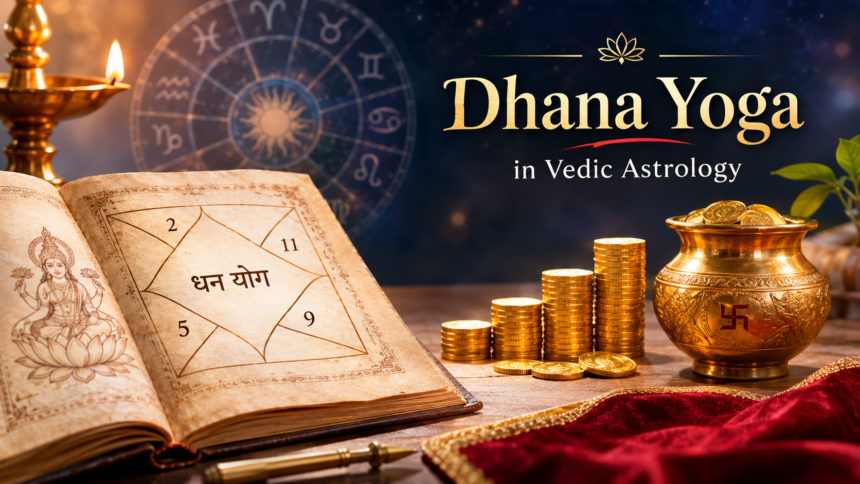
In the previous article, we discussed Raja Yoga in Vedic Astrology and explored how connections between Kendra Lords and Trikona Lords can form combinations associated with authority, success and recognition. Continuing this series, we now turn to another important concept in Jyotish: Dhana Yoga (धन योग).
Dhana Yoga refers to specific planetary combinations traditionally associated with wealth, financial growth, income and material prosperity. However, identifying this Yoga requires more than looking at a single planet or house. An astrologer must examine the relevant Bhavas, their ruling planets, planetary strength, mutual relationships and the influence of the Dasha system.
Understanding these factors together helps provide a more complete interpretation of wealth-related combinations in a birth chart.
What Is Dhana Yoga in Vedic Astrology?
The Sanskrit term Dhana means wealth or material possessions, while Yoga refers to a combination or connection.
In Vedic Astrology, Dhana Yoga describes certain planetary arrangements involving houses and their lords that are associated with financial resources, earnings, savings and prosperity.
However, different aspects of financial life must be understood separately. Earning money, increasing income, building assets, saving and maintaining wealth are not necessarily the same thing.
For this reason, the presence of one favourable planetary placement should not automatically be considered a guarantee of financial prosperity. The entire horoscope must be examined before reaching an interpretation.
Important Houses Responsible for Dhana Yoga
Several Bhavas play an important role in analysing financial combinations. Among them, the second, fifth, ninth, tenth and eleventh houses are particularly relevant.
1. Second House: Accumulated Wealth and Family Resources
The Second Bhava (द्वितीय भाव) is one of the most important houses in financial astrology. It represents accumulated wealth, family resources, speech, food habits and personal values.
When examining Dhana Yoga, astrologers study the condition of the second house, its ruling planet and the influence of other planets.
The strength and placement of the second lord are particularly important when assessing indications related to saving money and maintaining financial resources.
Its connection with income, profession and fortune-related houses can provide additional insight into a person’s financial circumstances.
2. Eleventh House: Income, Financial Gains and Opportunities
The Eleventh Bhava (एकादश भाव) is traditionally associated with income, gains, social networks, fulfilment of desires and benefits received through different activities.
Its lord is examined to understand the possibilities of financial gains and the achievement of material objectives.
A favourable relationship between the second and eleventh house lords can become significant in Dhana Yoga analysis when the required classical conditions are fulfilled.
However, earning a substantial income does not necessarily mean that a person will accumulate wealth. The ability to save and manage financial resources must also be considered.
3. Fifth House: Intelligence, Judgement and Purva Punya
The Fifth Bhava (पंचम भाव) represents Buddhi (बुद्धि), intelligence, education, creativity, children and Purva Punya in traditional Vedic Astrology.
It also plays a role in certain wealth-related combinations, particularly when its lord forms a qualifying relationship with the lords of the second, ninth or eleventh houses.
The fifth house is associated with intelligence and decision-making abilities. These qualities are relevant when understanding how someone may use their knowledge and skills to pursue opportunities.
However, the presence of a favourable fifth-house combination should not automatically be interpreted as a guarantee of profits from stock markets, trading or speculative investments.
4. Ninth House: Bhagya, Dharma and Fortune
The Ninth Bhava (नवम भाव) represents Bhagya (भाग्य), Dharma, higher education, teachers, principles and spiritual guidance.
In Dhana Yoga analysis, this house is important because it is traditionally connected with fortune and favourable opportunities.
When the ninth lord forms a qualifying relationship with the second or eleventh lord, the combination may contribute to wealth-related interpretations, depending on the strength and placement of the planets.
Nevertheless, fortune should not be viewed independently of personal effort, judgement and practical circumstances.
5. Tenth House: Profession, Karma and Financial Growth
The Tenth Bhava (दशम भाव) represents Karma, profession, responsibilities, reputation and public activities.
Although it is not exclusively a wealth-related house, it is important when studying the professional sources through which an individual may generate income and financial resources.
Connections between the tenth lord and the second, fifth, ninth or eleventh house lords can become relevant to certain financial combinations.
A complete horoscope analysis considers professional indicators alongside income, savings and other wealth-related houses.
How Is Dhana Yoga Formed? Important Planetary Combinations
Dhana Yoga can develop through specific relationships between the ruling planets of wealth-related houses.
Some important combinations examined in Vedic Astrology include:
- Second and Eleventh Lords: Their relationship connects accumulated wealth with income and financial gains.
- Second and Ninth Lords: These combinations connect savings and resources with fortune-related indications.
- Fifth and Ninth Lords: Their relationship involves intelligence, Dharma and fortune, which may contribute to certain prosperity-related Yogas.
- Fifth and Eleventh Lords: Qualifying connections can indicate relationships between abilities, opportunities and gains.
- Second, Fifth, Ninth and Eleventh Lords: Specific relationships among these planetary rulers may create recognised wealth-related combinations.
These are broad categories used in astrological interpretation rather than automatic definitions of Dhana Yoga. Every combination must be checked against its specific classical formation rules.
Depending on the Yoga being examined, planetary conjunctions, mutual aspects, sign exchanges and other recognised relationships may contribute to its formation.
Does Dhana Yoga Guarantee Wealth?
No. The presence of a potential Dhana Yoga does not automatically guarantee that someone will become wealthy.
Even when a planetary arrangement fulfils a classical formation rule, its actual significance depends on several factors within the horoscope.
An astrologer generally examines the following aspects:
Planetary dignity: Whether the relevant planets occupy their own signs, exalted signs, debilitated signs or other positions affecting their strength.
Functional lordship: Which houses the planets rule for the particular Ascendant or Lagna.
Condition of Bhavas: The strength and placement of the second and eleventh houses and their respective lords.
Planetary relationships: Whether conjunctions, aspects, exchanges or other associations influence the combination.
Overall horoscope: Whether professional, financial and other relevant indicators support a similar interpretation.
Dasha periods: Whether the planetary periods connected with the wealth-related combination are operating and what they indicate in the complete chart.
Only after considering these factors can an astrologer provide a meaningful interpretation of a possible Dhana Yoga.
Difference Between Earning, Saving and Retaining Wealth
One important principle in financial horoscope analysis is that income, savings, expenditure and wealth retention should be examined separately.
The Second Bhava is particularly relevant to accumulated resources, while the Eleventh Bhava represents gains and income.
The Twelfth Bhava is also examined because it is associated with expenditure, losses in certain contexts, foreign connections, isolation and other related significations.
The Sixth and Eighth Bhavas may also become relevant depending on the nature of the financial question and the planetary combinations involved.
Therefore, analysing financial prospects requires understanding how different houses interact rather than relying on one particular Bhava.
Role of Vimshottari Dasha in Dhana Yoga
The Vimshottari Dasha system is widely used in Parashari astrology to study the timing of planetary periods and their possible results.
When examining Dhana Yoga, astrologers may consider the Mahadasha and Antardasha of the planets involved in the combination.
Their functional lordship, placement, strength and relevant planetary transits may also be considered while interpreting the possible timing of financial developments.
However, the operation of a particular Dasha does not independently guarantee financial gains. Its significance must always be assessed alongside the complete birth chart.
Astrological predictions should also not replace practical financial planning, professional guidance or an understanding of investment risks.
Classical Principles: Why Correct Dhana Yoga Identification Matters
A proper understanding of Dhana Yoga requires knowledge of classical principles involving Bhava lordship, planetary strength, relationships and the specific rules governing different Yogas.
Texts such as Brihat Parashara Hora Shastra provide an important foundation for studying these concepts within the Parashari tradition.
An important distinction must be maintained between a clearly defined classical Yoga and a general favourable planetary placement. Not every positive combination qualifies as Dhana Yoga, and different wealth-related Yogas may have different levels of significance.
The correct approach is to first establish whether the required combination exists, examine the strength of the planets, assess the entire horoscope and then study the relevant Dasha periods.
Conclusion: Understanding the Fundamental Principle of Dhana Yoga
Dhana Yoga is an important concept in Vedic Astrology for studying planetary combinations traditionally associated with financial resources, income, savings and material prosperity.
The Second, Fifth, Ninth, Tenth and Eleventh Bhavas contribute to different aspects of financial interpretation. However, their ruling planets, mutual relationships and overall strength must be examined according to the relevant classical rules.
The most important principle is that a wealth-related Yoga must first satisfy its specific formation conditions. Only after establishing its presence should an astrologer assess its strength, timing and possible results.
In the next part of this series, we will explore Pancha Mahapurusha Yoga in Vedic Astrology, covering Ruchaka, Bhadra, Hamsa, Malavya and Shasha Yoga, their classical formation rules, planetary dignity and the importance of examining each Yoga within the complete horoscope.
Disclaimer
This article is intended for educational and informational purposes only. The concepts discussed are based on traditional principles of Vedic Astrology and should be understood within their classical context. Astrological interpretations are matters of traditional belief and are not scientifically established guarantees of wealth, income or financial success. Readers should not make financial, investment or professional decisions solely on the basis of astrological predictions.