
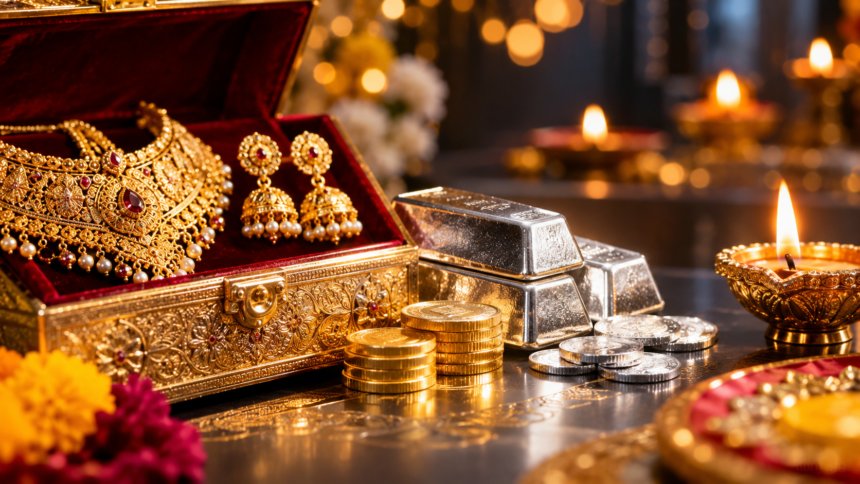
Gold and silver prices have witnessed a significant decline ahead of Dhanteras and Diwali, offering potential relief to people planning festive and wedding purchases. During October, gold futures on the Multi Commodity Exchange (MCX) dropped by nearly 7%, while silver prices declined by around 20%. This means silver experienced a fall almost three times greater than gold.
The sharp correction has raised an important question among buyers: Is Dhanteras 2026 a good opportunity to purchase gold and silver, or could prices fall further in the coming days?
Market reports attribute the decline to expectations of higher interest rates, rising crude oil prices and weakness in the global commodity market. While the recent fall has reduced prices, investors and jewellery buyers are closely watching market movements before making their purchases.
Gold and Silver Prices Recover on November 2
After facing selling pressure during the final days of October, gold and silver futures showed signs of recovery on November 2. Greater stability in the international bullion market ahead of Dhanteras and Diwali provided support to both precious metals.
Gold futures for December delivery traded between Rs 1,39,065 and Rs 1,39,179 per 10 grams. This represented a gain of approximately 0.23% to 0.42% compared with the previous closing price.
Silver recorded a stronger recovery during the session. MCX silver futures gained more than 1.3% to 2%, trading in the range of Rs 1,81,611 to Rs 1,82,701 per kilogram.
The recovery has brought some stability to the bullion market following the substantial correction seen in October.
Why Are Gold and Silver Prices Declining?
One of the major factors affecting gold prices is uncertainty surrounding interest rates in the United States. In October, the US Federal Reserve maintained interest rates within the range of 3.75% to 4%. However, two members supported an increase in rates, bringing the possibility of another hike in December into focus.
Higher interest rates can make gold less attractive to investors because the precious metal does not generate interest income. As a result, interest-bearing investment options may become more appealing when borrowing costs rise.
Increasing crude oil prices have also added to inflation concerns. Persistent inflation could encourage central banks to maintain higher interest rates or consider further increases, putting additional pressure on precious metal prices.
Compared with their January record levels, gold has fallen approximately 28%, while silver has declined nearly 50%. On a calendar-year basis, gold is down around 10% and silver approximately 19%.
Both metals recorded gains in August before experiencing declines over the following two months. However, silver has faced a sharper correction because its prices generally fluctuate more than gold. Industrial demand also plays an important role in determining silver prices, whereas gold is widely regarded as a safe-haven investment.
Important Support Levels for Gold and Silver
The technical levels of gold and silver are important for buyers and traders monitoring the recent market correction.
According to the report, gold futures on MCX have remained under pressure over the past month. The immediate support level for gold is around Rs 1,38,250 per 10 grams. A break below this level could lead to another round of selling.
For silver, the immediate support level is estimated at Rs 1,78,800 per kilogram. Since silver generally experiences greater price fluctuations than gold, investors need to remain cautious while making purchasing decisions.
For people planning to buy gold around Dhanteras, purchasing in two or three instalments instead of investing the entire amount at once could help manage the risk of short-term price movements.
Is the Current Fall in Gold and Silver a Buying Opportunity?
The recent decline in precious metal prices may offer an opportunity for investors with a long-term investment horizon. Historical market movements show that gold has recovered from significant corrections on several occasions.
During the 1970s, gold was trading below $40 per ounce in 1970. By January 1980, its price had climbed to approximately $850 per ounce, following a substantial rise over the decade.
A similar pattern was observed during the global financial crisis of 2008. Gold prices initially dropped to around $700 per ounce amid market uncertainty. However, the metal subsequently recovered and reached approximately $1,917 per ounce by August 2011.
Another example came during the COVID-19 pandemic in March 2020. As investors sold assets to meet their immediate cash requirements, gold prices declined to around $1,472 per ounce. Prices later recovered as investors increased their purchases of physical gold and exchange-traded funds (ETFs).
These historical examples highlight how precious metal prices have experienced major corrections followed by recoveries. However, past market performance does not guarantee similar movements in the future.
For Dhanteras 2026 buyers, the recent fall in gold and silver prices has made market levels particularly important. Those planning purchases should consider their budgets, buying requirements and tolerance for price fluctuations before making a decision.
Disclaimer
This article is intended for general informational and educational purposes only. Gold and silver prices are subject to market fluctuations, and the price levels and historical data mentioned are based on the information available at the time of writing. Historical performance does not guarantee future returns. This article should not be considered investment advice or a recommendation to buy or sell precious metals. Readers should conduct their own research and consult a qualified financial advisor before making investment decisions. Investments in financial markets are subject to market risks.