
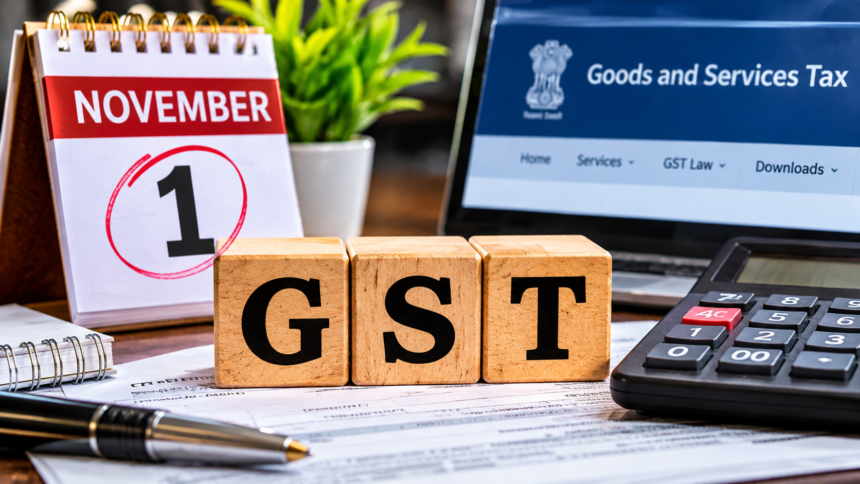
Several changes to the Goods and Services Tax (GST) system will come into effect from November 1, 2026. The reforms cover GST registration, return filing, refund processing and the treatment of discounts offered after sales.
The 57th GST Council meeting, held on October 8, approved these administrative measures. Their implementation will take place in phases, beginning Sunday. The changes are expected to simplify compliance for businesses, particularly small sellers operating through e-commerce platforms.
Here is a closer look at the four major GST reforms and how they will work.
1. Easier GST Registration for Small E-Commerce Sellers
One of the important changes will benefit small businesses selling products through online marketplaces across multiple states and Union Territories.
Under the revised provision, eligible sellers who do not have a physical business establishment in every state can use an e-commerce platform’s warehouse located there as their principal place of business. This facility will apply to sellers who pass on input tax credit, subject to a monthly limit of ₹2.5 lakh.
To qualify, sellers must have a genuine business presence in at least one state, where physical verification and Aadhaar authentication will be carried out. For registration in other states, consent from the e-commerce platform will be required. The process will not require the involvement of a tax officer.
The reform could benefit approximately 9.5 lakh small sellers by allowing them to access customers across the country without establishing separate offices in every state. It is also expected to create a more level playing field between different e-commerce business models.
2. GST Registration Process to Become Simpler
The second reform focuses on making GST registration easier for businesses and applicants.
From November 1, the GST department will specify the documents and information required for registration. Having clearly defined requirements is expected to make the application process more straightforward and improve processing efficiency.
The GST portal will also receive a more user-friendly interface. Features such as improved navigation, drop-down menus and explanatory tooltips will help applicants understand what information needs to be provided.
These improvements are intended to reduce mistakes, incomplete applications, unnecessary queries and registration rejections. Businesses may also benefit from faster application processing.
3. Faster GST Refunds Through Automated Processing
Another major reform aims to reduce the time required to receive GST refunds.
Under the new system, eligible refund claims relating to excess balances in the electronic cash ledger will be automatically sanctioned in full without requiring an officer’s intervention.
The process will also become quicker for refund applications involving zero-rated supplies and the inverted duty structure. In these cases, 90% of the claimed refund amount will be released provisionally through an automated process.
Before approval, the system will assess the risk associated with the application. This approach is expected to speed up eligible refund payments while retaining risk-based checks.
4. New Flexibility for Discounts Offered After Sales
The fourth change relates to discounts provided by businesses after completing a sale.
From November 1, businesses will receive greater flexibility in offering post-supply discounts. Under the earlier provisions, such discounts generally required a prior agreement and a direct connection with a specific invoice.
These requirements will be removed under the revised arrangement. However, existing safeguards relating to credit notes will continue to apply. Businesses will also remain responsible for reversing the corresponding input tax credit wherever required.
The change could be particularly useful for industries such as fast-moving consumer goods (FMCG), manufacturing and small businesses, where volume-based incentives, trade schemes and year-end rebates are common.
Mahesh Jaisingh, Partner and Indirect Tax Leader at Deloitte India, told PTI that the reform would be particularly relevant for these sectors. He also highlighted that the change could provide working capital relief to micro, small and medium enterprises (MSMEs).
Disclaimer: This article is intended for general information and is based on the GST reform details provided. The implementation of individual provisions may depend on applicable government notifications, rules and conditions. Businesses and taxpayers should consult official GST announcements or qualified tax professionals before making compliance-related decisions.