
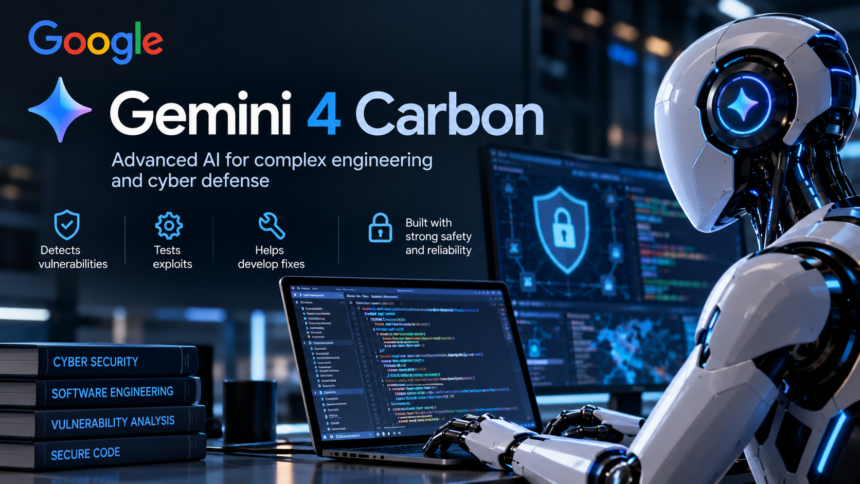
Google has introduced Gemini 4 Carbon, a new artificial intelligence model developed to tackle complex engineering challenges and cybersecurity tasks. The model is designed to identify software vulnerabilities, test potential exploits and help developers create fixes, while placing greater emphasis on safety and reliability.
According to Google, the model has secured the top position on the Artificial Analysis Intelligence Index, scoring 59 points. Its initial rollout will be limited to selected cybersecurity professionals, with access expected to expand gradually as the company gathers feedback and strengthens its safeguards.
Gemini 4 Carbon: Initial Rollout and Key Features
Google CEO Sundar Pichai announced the new model through a post on X, describing it as the company’s next frontier model. Gemini 4 Carbon follows Gemini 4 Argon, which was introduced two weeks earlier.
Google plans to make Carbon available to a select group of cybersecurity defenders during the initial rollout. The company will then gradually extend access to trusted partners through its Fairwind Program. Wider availability for developers, businesses and consumers is planned after further testing, feedback and improvements to safety measures.
Google DeepMind says Carbon is designed to manage demanding, multi-step engineering work over extended periods. It can investigate the underlying causes of software bugs and work on fixes across large codebases and low-level systems, including tasks that may require sustained technical analysis.
Benchmark Results Show Improvements in Vulnerability Detection
Google has reported strong results for Gemini 4 Carbon across several cybersecurity and software engineering benchmarks.
The model achieved 88.2% on SEC-bench Pro, which evaluates its ability to identify software vulnerabilities. It scored 54.8% on ExploitGym, a benchmark focused on testing whether vulnerabilities can be exploited, and 71% on CWE-bench, which assesses its ability to develop fixes.
The company also said Carbon performed more than twice as well as Argon in generating secure code on internal benchmarks. According to Google’s Chrome team, Carbon delivered more than 10 times the performance of another frontier model from a different AI laboratory when generating high-quality software patches.
Pichai said the latest release reflects the pace of Google’s AI development, while highlighting the company’s efforts to strengthen safeguards as its models become more capable.
Google Reports Better Safety and Reliability
Alongside performance improvements, Google has highlighted changes aimed at making Gemini 4 Carbon more reliable and secure.
Internal tests showed that the model made unsupported claims approximately half as often as Gemini 4 Argon. High-severity misalignment alerts in internal coding environments also declined by nearly 80%.
Google further reported that Carbon recorded a zero success rate for cheating attempts on Terminal-Bench 4.0, with the rate of attempted cheating standing at 0.4%. In the evaluated tests, the model also recorded a 0% attack success rate on the Gray Swan indirect prompt-injection benchmark.
These results reflect Google’s internal evaluations and the specific benchmarks cited by the company.
Gemini 4 Carbon Pricing and Availability
Google will offer Gemini 4 Carbon at the same introductory rates as Gemini 4 Argon. Input tokens will cost USD 2 per million, while output tokens will be priced at USD 10 per million. Cached input tokens will receive a 95% discount.
The company intends to expand access in stages as it continues evaluating the model and refining its safeguards. Developers, businesses and consumers are expected to gain access after the initial phase, subject to further testing and feedback.
Disclaimer: This article is based on information attributed to Google and the source material provided. Benchmark results, performance comparisons, pricing and rollout plans may reflect specific testing conditions and could change. Readers should consult Google’s official announcements for the latest information.