
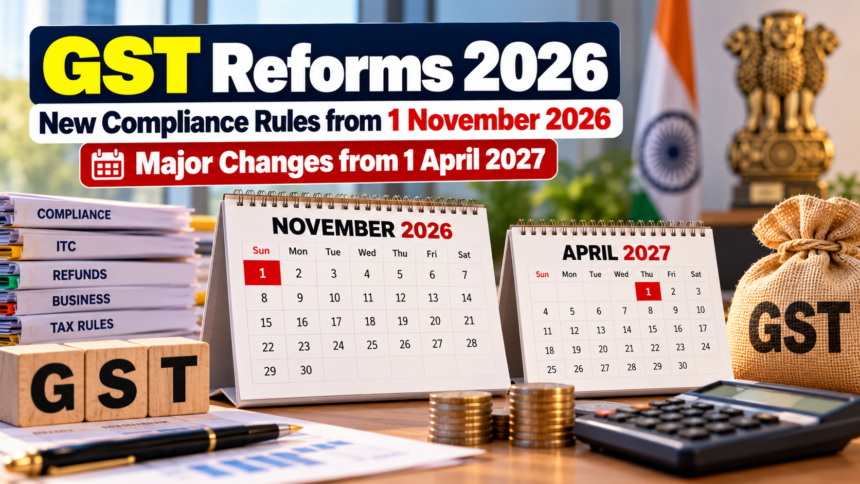
The next phase of Goods and Services Tax (GST) reforms in India is expected to begin on November 1, 2026, with changes aimed at reducing compliance requirements for businesses, improving input tax credit (ITC) processes and speeding up refunds. Reforms requiring amendments to GST laws are targeted for implementation from April 1, 2027.
Sanjay Mangal, Member (GST) at the Central Board of Indirect Taxes and Customs (CBIC), outlined the proposed timeline during a media interaction. The decisions follow the 57th GST Council meeting held in New Delhi on October 8, 2026, under the chairmanship of Union Finance and Corporate Affairs Minister Nirmala Sitharaman.
According to Mangal, the Council focused on procedural and structural improvements intended to make GST compliance easier while addressing delays in refunds and problems associated with input tax credit.
GST Reforms from November 1, 2026
Changes that do not require amendments to the GST Acts are expected to be introduced in phases from November 1, 2026. The exact rollout will depend on the system upgrades and preparations required for each measure.
One of the planned steps is the introduction of automated refund sanctioning, wherever applicable, after November 1. The facility will cover future refund claims rather than applications that are already pending. The objective is to make eligible refunds faster and more efficient once the necessary systems are ready.
The reforms are intended to simplify routine procedures and reduce the administrative burden on taxpayers.
Major GST Law Changes Expected from April 1, 2027
Measures requiring amendments to the Central and state GST laws are targeted for April 1, 2027, subject to the necessary legislative process.
The proposed changes include revisions to arrest provisions, rationalisation of prosecution thresholds, modifications to e-way bill rules and a minimum threshold of ₹10,000 for issuing show-cause notices.
Mangal clarified that the proposed changes to arrest provisions will not affect arrests that have already taken place. The changes are expected to apply only after the amendments take effect on April 1, 2027.
The department is also examining whether interim guidance should be issued while the legislative process is underway. However, no final decision on this matter has been taken.
Measures to Curb Fake Invoices and Fraudulent ITC Claims
The GST Council is also moving towards technology-based checks designed to identify and prevent fraudulent transactions earlier in the process.
Under the proposed return-filing changes, tax declared as payable by a supplier and passed on to a recipient as input tax credit will need to have actually been paid. The measure is intended to address cases involving fake invoices and improper ITC claims.
By strengthening checks within the return-filing process, the authorities aim to reduce opportunities for tax fraud rather than relying only on action after irregularities have occurred.
Relief for Small Businesses and No Immediate GST Rate Changes
The Council has given in-principle approval to a simplified return-filing arrangement for businesses that make only business-to-consumer (B2C) supplies and have annual turnover below ₹5 crore. Under the proposed system, eligible businesses would file returns annually while paying tax quarterly.
Small traders with turnover of up to ₹5 crore will also be eligible for late-fee relief if they submit their returns within the same month in which they are due, even when filing after the original deadline.
Unlike the September 2025 GST Council meeting, which focused on rate rationalisation and reductions covering around 400 items, the latest meeting did not consider any GST rate revisions. Rate-related issues are expected to be discussed at a future meeting, although a date has not yet been announced.
The earlier rate exercise was intended to pass benefits on to consumers, with the government monitoring the process. The current reforms, by contrast, focus primarily on simplifying compliance, improving ITC flow and making refunds more efficient. Any consumer benefit would be indirect, potentially arising from smoother business operations and savings shared by industry.
Overall, the proposed changes represent a push towards a simpler GST system while addressing concerns about fraudulent claims, compliance costs and refund delays.
Disclaimer: This article is intended for general informational purposes only and is based on the details provided about the proposed GST reforms. Implementation dates and provisions may be subject to official notifications, legislative amendments and further government clarification. Businesses should consult official CBIC and GST Council communications or a qualified tax professional before making compliance decisions.