
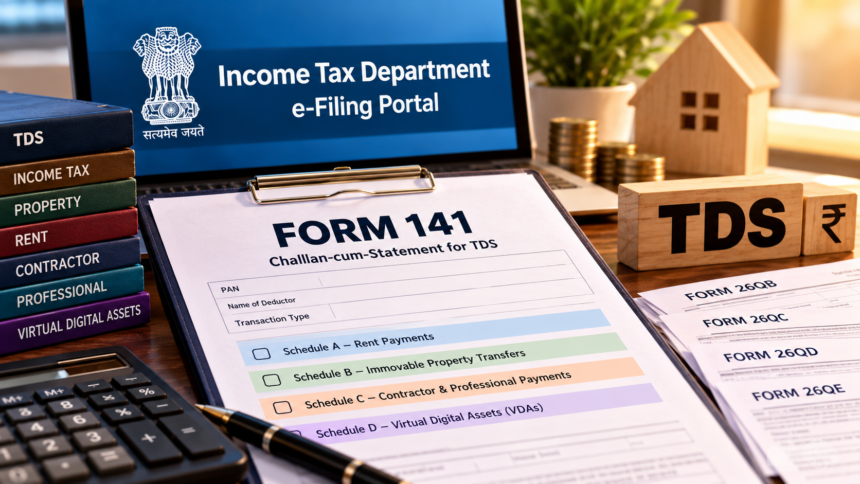
The Income Tax Department has introduced Form 141 to simplify the reporting and payment of Tax Deducted at Source (TDS) on certain transactions under the Income Tax Act, 2025. The new consolidated challan-cum-statement replaces four earlier forms—26QB, 26QC, 26QD and 26QE—which were used under the Income Tax Act, 1961.
Form 141 covers specified transactions involving property purchases, rent payments, payments to contractors and professionals, and transfers of virtual digital assets (VDAs). Although the new form brings these reporting requirements under one framework, taxpayers must select the appropriate schedule and file a separate form for each transaction category.
What Is Income Tax Form 141?
Form 141 is a unified challan-cum-statement designed to report TDS on specified transactions covered under Section 393(1) of the Income Tax Act, 2025.
Previously, taxpayers used different forms depending on the nature of the transaction. The new system combines those requirements into a single form structure, with separate schedules for different categories.
According to the department’s guidance, Form 141 must be submitted through a PAN-based login on the Income Tax Department’s e-Filing portal. The form’s stated applicability is limited to resident deductees.
Form 141: Four Schedules Explained
The new form contains four schedules, each covering a specific type of transaction.
Schedule A – Rent payments: Used for reporting TDS on rent paid by an individual or Hindu Undivided Family (HUF).
Schedule B – Immovable property transfers: Covers TDS reporting for transactions involving the transfer of immovable property.
Schedule C – Contractor and professional payments: Applies to specified payments made by an individual or HUF to contractors or professionals.
Schedule D – Virtual digital assets: Covers TDS reporting on transfers of virtual digital assets by an individual or HUF.
These schedules bring together the reporting requirements previously handled through Forms 26QB, 26QC, 26QD and 26QE.
Can You Report Different Transactions in One Form 141?
No. Form 141 does not allow taxpayers to report different transaction categories in a single filing. A separate form must be submitted for each applicable category.
For example, if a taxpayer needs to report TDS on both a property transfer and rent payments, two separate Form 141 filings will be required, with the relevant schedule selected for each.
The department also allows multiple deductees to be included in a single form, subject to specific conditions. They must belong to the same deductee category, and the month in which the TDS was deducted must be identical.
Therefore, the new form simplifies the overall reporting structure but does not eliminate the need for separate filings across different transaction types.
Who Can File Form 141?
Form 141 is intended for transactions involving resident deductees, and taxpayers must access the Income Tax Department’s e-Filing portal using a PAN-based login.
Before submitting the form, taxpayers should identify the transaction category, choose the corresponding schedule and follow the official filing instructions.
For transactions involving non-resident sellers or other non-resident deductees, taxpayers should check the applicable provisions and official guidance rather than assume that Form 141 can be used.
Disclaimer
This article is intended for general informational purposes only and is based on the information provided about Form 141 under the Income Tax Act, 2025. Taxpayers should consult the latest official Income Tax Department notifications, instructions and applicable legal provisions before filing TDS statements. The applicability of the form and the requirements for individual transactions may vary according to the relevant rules and circumstances. This article does not constitute tax or legal advice.