
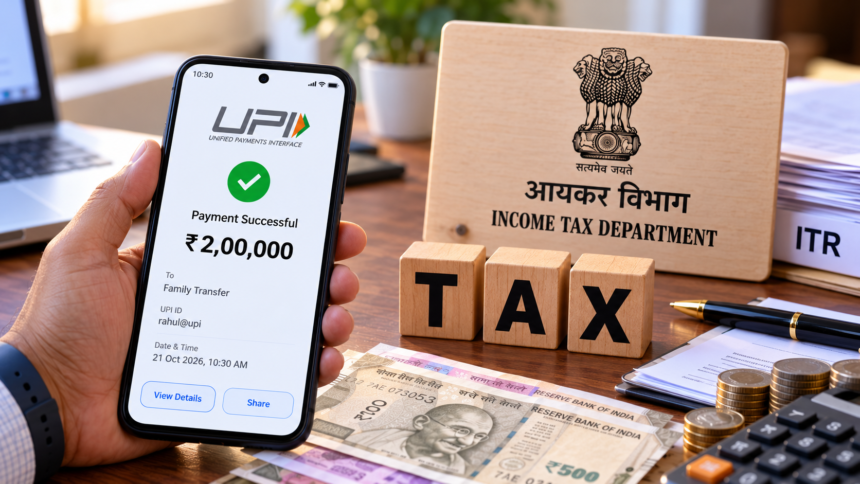
Receiving a large amount through UPI does not automatically result in an income tax notice. However, the Income Tax Department may seek an explanation when substantial amounts appear in a bank account but do not match the income declared in a tax return.
For example, a salaried person reporting an annual income of ₹12 lakh might receive ₹40 lakh in total bank credits during the year. These transactions could include business receipts, transfers from friends or money received from family members. Such credits are not automatically taxable, but the account holder may need to establish their source and purpose if the transactions are questioned.
According to CA Parag Jain, Tax Head at 1 Finance, income tax law does not prescribe a single annual UPI transaction limit that automatically triggers a notice. The key issue is whether the taxpayer can explain the money received and distinguish taxable income from other transfers.
Is There a UPI Transaction Limit That Triggers an Income Tax Notice?
A common misconception is that crossing a particular UPI transaction amount automatically leads to reporting to the Income Tax Department. Jain explained that the position is more nuanced.
Under the Statement of Financial Transactions (SFT) framework, certain cash deposits are reportable when the total reaches ₹10 lakh in a savings account or ₹50 lakh in a current account during a financial year. These thresholds relate to specified cash deposits and do not apply in the same way to UPI, NEFT, RTGS or IMPS transfers.
Nevertheless, digital payments are not exempt from scrutiny. Bank statements may be examined during tax proceedings, and taxpayers could be asked to explain credits that appear inconsistent with their declared income.
Jain also clarified that frequently cited UPI limits, such as ₹1 lakh per transaction and higher limits for certain categories, are operational limits set under NPCI and bank rules. They are not income tax thresholds.
Under Section 102 of the Income Tax Act, 2025, unexplained credits may have tax consequences if the taxpayer cannot satisfactorily establish their source. Consequently, even a credit of ₹60,000 could be questioned, just as a transaction involving ₹6 lakh could be. The amount alone does not determine whether the transaction will attract scrutiny.
Why Freelancers, Tutors and Small Businesses Need Proper Records
For people who regularly receive UPI payments, the tax treatment depends primarily on why the money was received.
Payments earned by providing professional services or conducting business are generally treated as business or professional income. By contrast, money received from a friend to share the cost of a restaurant bill does not become income simply because it was transferred to a bank account.
Problems can arise when personal transfers and business receipts are mixed in the same account, making it difficult to establish the actual business turnover.
Jain referred to Karnataka, where more than 13,000 small traders reportedly received GST notices in 2025 based on UPI inflows. Some traders had collected payments on behalf of other people, causing their total bank credits to appear higher than their actual business turnover.
One reported case involved a vegetable vendor in Haveri who received a notice concerning ₹29 lakh despite selling GST-exempt produce.
To reduce confusion, Jain recommended maintaining separate accounts for professional and personal transactions, issuing invoices for business payments and keeping records that clearly identify the nature of each receipt.
Can Receiving and Forwarding Money Create Tax Problems?
Receiving money and subsequently transferring it to another person can also raise questions if the purpose of the transactions is unclear. For example, someone might collect contributions from friends for a group purchase or receive funds on behalf of a relative.
Although such transfers can be legitimate, repeated incoming and outgoing transactions may resemble patterns associated with money mule accounts. Banks and investigating agencies examine these patterns because such accounts can be used to move money connected with financial fraud.
From an income tax perspective, an unexplained credit may still be examined even if the recipient later transfers the money elsewhere. Forwarding the amount does not, by itself, establish the source of the original credit or prove that it is exempt from tax.
However, a pattern of transfers alone does not establish money laundering or other wrongdoing. Any legal consequences depend on the facts of the case and the applicable law.
Jain advised taxpayers to maintain written records identifying who sent the money, the reason for receiving it and the person to whom it was subsequently transferred. Bank statements and other supporting documents can help demonstrate the purpose of these transactions.
How to Avoid Problems With Large UPI Transactions
People who regularly receive digital payments should keep clear records and ensure that their financial transactions can be reconciled with their income tax returns.
Business owners, freelancers and tutors should maintain invoices and payment records, while individuals handling money on behalf of others should preserve evidence explaining the purpose of those transfers.
The important distinction is between the total money credited to a bank account and the income actually earned. Large UPI transactions are not automatically taxable or grounds for an income tax notice, but taxpayers should be prepared to explain their source and purpose if the authorities ask for clarification.
Disclaimer: This article is intended for general informational purposes and should not be treated as tax or legal advice. The tax treatment of bank credits depends on the nature of the transactions, supporting documentation and applicable laws. Readers should consult a qualified chartered accountant or tax professional for advice on their individual circumstances and verify the latest provisions through official sources.