
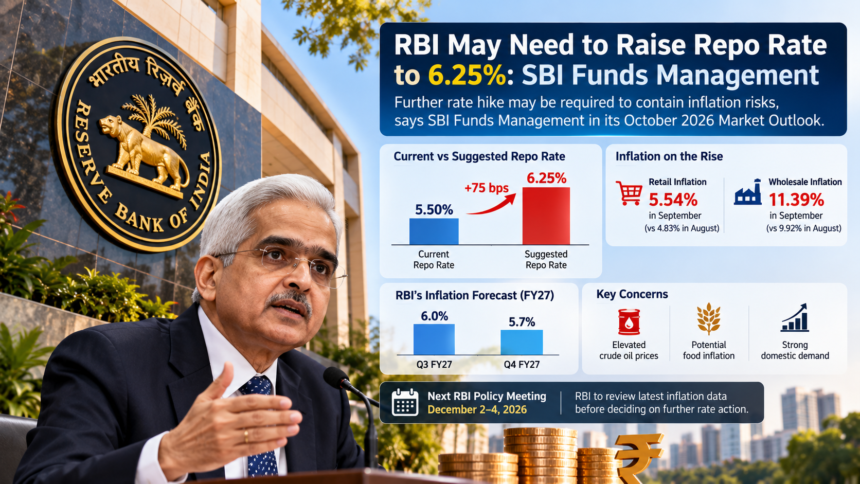
SBI Funds Management has indicated that the Reserve Bank of India (RBI) may need to increase its benchmark repo rate to at least 6.25% to address rising inflation risks. The assessment comes as both retail and wholesale inflation have accelerated, raising concerns about continued price pressures in the Indian economy.
In its October 2026 Market Outlook report, the fund house said additional monetary tightening could be necessary even after the RBI raised the repo rate by 25 basis points to 5.50% earlier this month.
According to the report, a policy rate of at least 6.25% could help bring the real interest rate to around 1%. This would mean a further increase of 75 basis points from the current rate, although SBI Funds Management has not specified when such an increase might be required.
Rising Retail and Wholesale Inflation Raises Concerns
The fund house’s assessment follows a sharp increase in India’s inflation figures. Government data released last week showed that retail inflation climbed to 5.54% in September, compared with 4.83% in August.
Wholesale inflation also accelerated during the same period, rising to 11.39% from 9.92%.
SBI Funds Management noted that even with its current estimate of Consumer Price Index (CPI) inflation at 5.20% for FY27, inflation remains around 120 basis points above the RBI’s 4% target.
The report said this gap indicates that additional policy measures may be needed to bring inflation under control. Persistent price increases could make it more difficult for the central bank to achieve its inflation objective.
Inflation Forecast Could Limit Scope for Rate Cuts
The RBI has projected inflation at 6% for the third quarter of FY27 and 5.7% for the fourth quarter, reflecting continued pressure on prices.
SBI Funds Management identified several risks that could push inflation higher, including elevated crude oil prices, a possible increase in food prices and strong domestic demand.
According to the fund house, these factors could push inflation above the RBI’s upper tolerance limit of 6% for two consecutive quarters.
Against this backdrop, the report suggested that the near-term direction of monetary policy could involve either another rate increase or a pause. It indicated that rate cuts were unlikely to be an immediate option while inflation risks remain elevated.
Liquidity Management Remains Important for the RBI
Apart from interest rates, SBI Funds Management highlighted the role of liquidity in the banking system. It warned that surplus liquidity could reduce the effectiveness of rate increases, making careful liquidity management an important part of the RBI’s efforts to control inflation.
The central bank must therefore consider both the policy rate and the amount of liquidity available in the financial system when assessing the appropriate monetary policy response.
The RBI’s next Monetary Policy Committee meeting is scheduled for December 2–4. The committee is expected to review the latest inflation data and other economic indicators before deciding whether to raise rates further, maintain the existing rate or change its policy stance.
For now, the suggestion to raise the repo rate to 6.25% represents SBI Funds Management’s assessment rather than an announced RBI decision. The central bank’s eventual move will depend on its evaluation of inflation and broader economic conditions.
Disclaimer: This article is intended for general informational purposes and reports the assessment attributed to SBI Funds Management. The suggested repo rate is not an official RBI decision or a guaranteed forecast of future policy. Readers should refer to official RBI announcements for confirmed monetary policy decisions.