
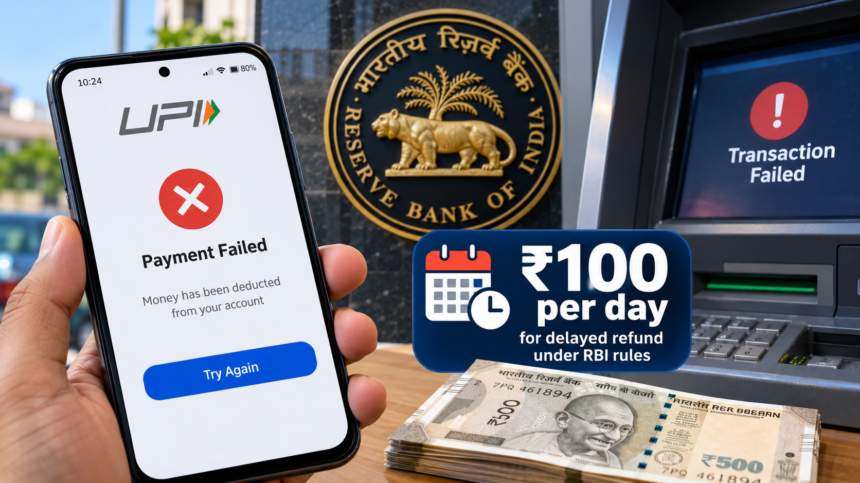
Have you ever made a UPI payment or withdrawn cash from an ATM, only to find that the transaction failed while the money was deducted from your bank account? If the amount is not returned within the deadline set by the Reserve Bank of India (RBI), you may be eligible for compensation of ₹100 per day for the delay.
The compensation depends on the type of transaction and the time allowed for the bank or payment service provider to reverse the amount. Under RBI rules, eligible compensation must be credited automatically, without requiring the customer to submit a separate claim.
What Qualifies as a Failed Transaction Under RBI Rules?
RBI’s September 20, 2019 circular, titled Harmonisation of Turn Around Time (TAT) and Customer Compensation for Failed Transactions Using Authorised Payment Systems, sets out the deadlines for resolving different types of failed transactions.
A transaction may be considered failed when it cannot be completed for reasons beyond the customer’s control. Examples include communication problems, an ATM running out of cash, a session timing out, or money being deducted from the sender’s account without reaching the intended beneficiary.
The framework also addresses certain delays involving transaction reversals and crediting funds. It came into effect on October 15, 2019, and applies to domestic transactions in which both the sender and beneficiary are located in India. Where applicable, authorised non-bank payment service providers are also covered.
The prescribed turnaround time represents the maximum period allowed to resolve the relevant transaction failure. If a reversal exceeds the applicable deadline, compensation may become payable under the RBI framework.
Transaction-Wise Refund Deadlines and ₹100 Compensation
The time limit for reversing a failed transaction varies by payment method. Some transactions must be corrected within one day after the transaction date, while others have a five-day deadline.
| Transaction type | Example | Reversal deadline | Compensation for delay |
|---|---|---|---|
| ATM or micro-ATM withdrawal | Account debited, but cash not dispensed | T+5 days | ₹100 per day beyond the deadline |
| UPI P2P transfer | Money sent to another person but not credited | T+1 day | ₹100 per day beyond the deadline |
| UPI P2M payment | Merchant does not receive payment confirmation | T+5 days | ₹100 per day beyond the deadline |
| Card-to-card transfer | Recipient does not receive the transferred amount | T+1 day | ₹100 per day beyond the deadline |
| Card payment at a PoS terminal, including cash at PoS | Payment is not confirmed at the shop | T+5 days | ₹100 per day beyond the deadline |
| Online card payment | Website does not confirm the payment | T+5 days | ₹100 per day beyond the deadline |
| IMPS transfer | Money is debited but not credited to the recipient | T+1 day | ₹100 per day beyond the deadline |
| National Automated Clearing House (NACH) | Failed transaction is not reversed or the amount is not credited | T+1 day, where the beneficiary bank is responsible | ₹100 per day beyond the deadline |
| NACH debit after mandate cancellation | Automatic payment is deducted despite cancellation | T+1 day for resolution by the customer’s bank | ₹100 per day beyond the deadline |
| Prepaid cards and wallets — off-us | Transaction is processed through UPI, IMPS or a card network | Depends on the payment system used | Applicable payment-system rules apply |
| Prepaid cards and wallets — on-us | Recipient does not receive the money or merchant confirmation fails | T+1 day | ₹100 per day beyond the deadline |
Source: RBI’s circular on turnaround times and customer compensation for failed transactions. The examples and descriptions have been simplified for clarity.
What Do T, T+1 and T+5 Mean?
Under the RBI framework, T refers to the calendar date on which the transaction takes place. Accordingly, T+1 means the following calendar day, while T+5 means five calendar days after the transaction date.
For example, if a UPI transfer fails on October 18 and the money is deducted without being credited to the recipient, the applicable T+1 deadline would be October 19. If the reversal is delayed beyond the prescribed deadline, compensation may be payable for the delay.
For an unsuccessful ATM withdrawal on October 18, the T+5 deadline would be October 23.
The original framework calculates the timeline using calendar days. RBI had introduced a temporary COVID-19-related relaxation that allowed working-day calculations for a specified period. Its circular dated May 21, 2021, extended that relaxation until December 31, 2021. That temporary relaxation has expired, so the framework uses calendar days rather than excluding weekends and bank holidays.
How to Claim Compensation for a Delayed Refund
If money has been deducted but the transaction has failed, customers should first check the transaction status and contact their bank or payment service provider if the amount is not reversed within the applicable deadline.
Under RBI’s rules, compensation payable for an eligible delay should be credited automatically. Customers should check their account statement to confirm whether both the reversal and any applicable compensation have been received.
If the bank or payment service provider does not resolve the issue, customers can escalate their complaint through the RBI Integrated Ombudsman Scheme, subject to the applicable complaint requirements.
The important point is that the compensation deadline depends on the payment method. Customers should identify the relevant transaction category and check the applicable RBI turnaround time before determining whether compensation is due.
Disclaimer: This article is intended for general informational purposes and does not constitute financial or legal advice. Compensation eligibility and refund deadlines depend on the applicable RBI directions and the specific transaction. Customers should verify the latest rules with the RBI or their bank before taking action.