
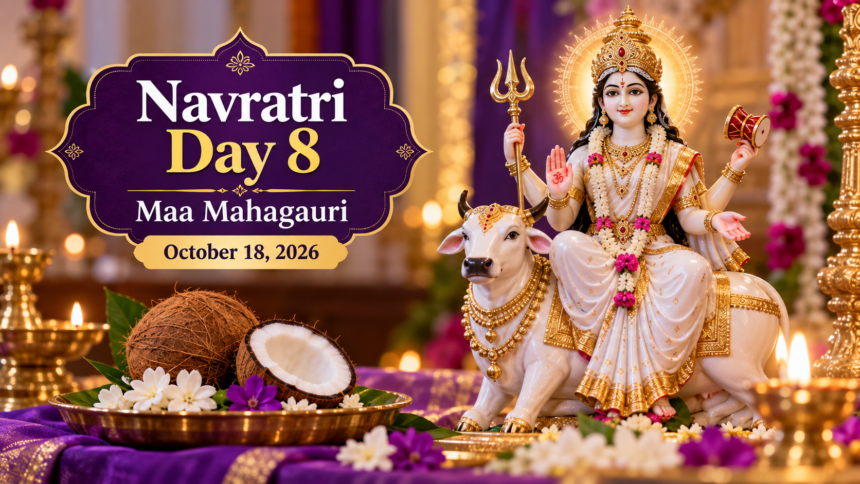
New Delhi: The eighth day of Navratri will be observed on Sunday, October 18, 2026, as Durga Ashtami, also known as Maha Ashtami. The day is dedicated to Maa Mahagauri, the eighth form of Goddess Durga, who symbolises purity, peace and divine grace.
Devotees mark this auspicious occasion by performing traditional puja rituals, offering prayers and preparing special bhog. Coconut is considered a sacred offering to the goddess, while Kanya Pujan is an important tradition followed by many families. Worshipping Maa Mahagauri is believed to bring peace, prosperity and harmony while helping devotees overcome fear and negativity.
Navratri Day 8: Date, Colour and Bhog
- Date: Sunday, October 18, 2026
- Goddess: Maa Mahagauri
- Day colour: Purple, associated with spiritual awareness, devotion, inner strength and prosperity
- Traditional bhog: Coconut
- Special ritual: Kanya Pujan
Maha Ashtami holds special religious significance for devotees of Goddess Durga. Many families organise prayers and offer food to young girls as a mark of respect for the Divine Feminine.
Who Is Maa Mahagauri? Significance of the Eighth Form of Durga
Maa Mahagauri is worshipped as the eighth manifestation of Goddess Durga during Navratri. She is associated with Goddess Parvati in her youthful form and is revered as the consort of Lord Shiva. The name Mahagauri combines the words Maha, meaning great, and Gauri, associated with fairness, brightness and radiance.
In traditional depictions, the goddess has a luminous complexion compared with a conch shell, the moon and white jasmine flowers. She is known as Shwetambardhara because she wears white garments and is commonly shown riding a white bull, also associated with Nandi.
Maa Mahagauri is depicted with four arms. Two hands hold a trident (Trishul) and a drum (Damru), while the other two display the Varada mudra, symbolising the granting of blessings, and the Abhaya mudra, representing protection from fear.
Her worship is associated with purity, tranquillity and spiritual renewal. According to religious beliefs, devotees seek her blessings to overcome difficulties, find relief from fear and suffering, and attain wisdom, prosperity and harmony in family life.
Maa Mahagauri Puja Vidhi for Durga Ashtami
Devotees can follow traditional rituals to worship Maa Mahagauri on the eighth day of Navratri.
Morning preparations: Begin the day with a bath and clean the home temple and the area around the Navratri Kalash.
Prepare the altar: Place an idol or picture of Maa Mahagauri on a clean platform covered with a white or purple cloth.
Light the diya: Light a ghee or oil lamp and incense sticks before beginning the prayers.
Offer flowers and puja samagri: Present fresh white flowers, such as jasmine or mogra, along with kumkum, sandalwood paste and rice grains (akshat).
Prepare the bhog: Offer coconut or milk to the goddess. Traditional Ashtami prasad may also include halwa, puri and black chana.
Perform Kanya Pujan: Families observing this ritual wash the feet of young girls, apply tilak and serve them a meal as a gesture of devotion and respect.
Complete the puja: Perform aarti and offer prayers for peace, prosperity, good health and harmony.
Maa Mahagauri Mantra and Its Meaning
Devotees chant sacred mantras while worshipping Maa Mahagauri to express their devotion and seek her blessings.
Primary mantra
ॐ देवी महागौर्यै नमः॥
Transliteration: Om Devi Mahagauryai Namah.
Meaning: I bow to Goddess Mahagauri, the divine mother who represents purity, radiance and grace.
Dhyan mantra
श्वेते वृषे समारूढा श्वेताम्बरधरा शुचिः।
महागौरी शुभं दद्यान्महादेवप्रमोददा॥
Transliteration: Shwete Vrishabhe Samarudha Shwetambaradhara Shuchih, Mahagauri Shubham Dadyan Mahadeva Pramodada.
Meaning: May Goddess Mahagauri, who rides a white bull and wears pure white garments, bless her devotees with auspiciousness, peace and well-being. May the goddess who brings joy to Lord Shiva bring blessings into our lives.
Maa Mahagauri Katha: The Story Behind Her Radiant Appearance
According to Hindu mythology, Goddess Parvati undertook severe penance to win Lord Shiva as her husband. She spent years meditating in the forest, enduring difficult conditions without food, shelter or water.
During her prolonged austerities, she faced extreme heat, cold, rain and dust. These harsh conditions left her body darkened and covered in dirt.
Lord Shiva was eventually moved by her unwavering devotion and determination. He accepted her devotion and cleansed her with the sacred waters of the River Ganga.
As the accumulated dirt disappeared, her complexion became bright and radiant, resembling the moon, a conch shell and white kund flowers. This luminous form came to be known as Maa Mahagauri.
The story highlights the importance of devotion, perseverance and spiritual dedication. On Maha Ashtami, devotees remember the goddess through prayers and traditional rituals, seeking her blessings for a peaceful and prosperous life.
Disclaimer
This article is intended for general informational purposes only and describes religious traditions and beliefs associated with Navratri Day 8 and Maa Mahagauri. Rituals, offerings, interpretations and customs may vary across regions and families. Readers are advised to follow the traditions and guidance customary in their households. The religious beliefs described here should not be interpreted as guarantees of specific outcomes.