
Festive-season sales often feature no-cost equated monthly instalment (EMI) offers on smartphones, televisions and home appliances. These schemes allow customers to pay for purchases over several months instead of making a single payment. However, a no-cost EMI offer does not always mean the buyer gets the lowest possible price.
The better option depends on the total amount payable, available upfront discounts, processing fees and the financial benefit of keeping money available for other needs. Kundan Shahi, founder and chief executive officer of Zavo, and chartered accountant Rohit Saluja highlight the importance of comparing the actual costs before choosing a payment method.
No-Cost EMI vs Upfront Payment: Compare the Total Cost
When evaluating a no-cost EMI offer, consumers should look beyond the monthly instalment. Processing fees, GST on applicable charges, any interest component and discounts lost by choosing EMI can increase the final purchase cost.
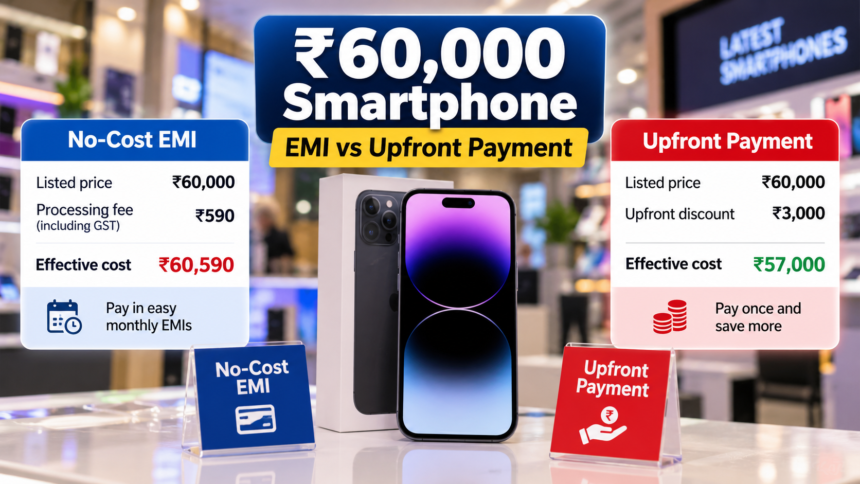
Saluja explains this with an example of a smartphone listed at ₹60,000. Under the no-cost EMI option, the buyer pays a processing fee of ₹500 plus GST, taking the total processing charge to ₹590. The buyer also misses out on a ₹3,000 discount available with upfront payment.
As a result, the effective cost of the smartphone through EMI becomes ₹60,590, compared with ₹57,000 when paid for upfront. The difference is ₹3,590.
This example shows why consumers should compare the final payable amounts rather than assume that an EMI plan is automatically cheaper because it advertises zero interest.
When Does No-Cost EMI Make Financial Sense?
No-cost EMI may be a practical choice when the product price is the same under both payment methods, additional charges are low and keeping cash available offers a clear benefit.
According to Shahi, instalments can make financial sense when the value of retaining money is greater than the processing fees, taxes and discounts lost by choosing EMI.
For example, consumers may prefer to keep money available for emergencies or leave it in an interest-bearing savings account or investment fund while paying their instalments from monthly income. However, any returns earned on the retained amount must exceed the additional cost of financing for the arrangement to provide a financial advantage.
Consumers should also account for applicable taxes on investment earnings and the timing of EMI payments. Returns from market-linked investments are uncertain and should not be treated as guaranteed income.
Maintaining cash reserves can be especially important for households that need funds for unexpected medical expenses, job loss or other emergencies. If paying the full amount immediately would significantly reduce an emergency fund, choosing EMI may be worth considering even when it involves a modest extra cost.
However, buyers should avoid taking on instalments simply because the monthly payment appears affordable. Several active EMIs can increase financial commitments, affect borrowing capacity and leave less money for essential expenses and regular savings.
What to Check Before Choosing a No-Cost EMI Offer
Before accepting an EMI offer, consumers should review the complete terms and conditions. Important details include the total amount payable, repayment tenure, processing fees, applicable taxes, foreclosure charges and penalties for missed payments.
Buyers should also confirm whether the offer is available only with a specific credit card and whether choosing EMI means losing discounts offered to customers who pay upfront.
The final decision should reflect both the household budget and the value of keeping cash available. If the upfront discount is substantial and paying immediately does not affect emergency savings, an upfront purchase may be the more economical option. If preserving liquidity is more important and repayments are manageable, no-cost EMI may be worth considering.
No-Cost EMI vs Upfront Payment: Cost Comparison
The following example shows how the two options compare for a smartphone priced at ₹60,000.
| Particulars | No-Cost EMI | Upfront Payment |
|---|---|---|
| Listed price | ₹60,000 | ₹60,000 |
| Upfront discount | ₹0 | ₹3,000 |
| Processing fee, including GST | ₹590 | ₹0 |
| Effective purchase cost | ₹60,590 | ₹57,000 |
| Additional cost compared with upfront payment | ₹3,590 | — |
Key Differences at a Glance
| Factor | No-Cost EMI | Upfront Payment |
|---|---|---|
| Purchase cost | May include processing fees and applicable taxes | May qualify for upfront discounts |
| Cash flow | Spreads payments over several months | Requires the full amount immediately |
| Emergency savings | Helps preserve available cash | May reduce savings |
| Investment potential | Retained money may earn returns if invested | Money used for the purchase is no longer available for investment |
| Additional charges | May involve fees, lost discounts and foreclosure charges | Generally involves fewer financing-related charges |
| Credit profile | Multiple EMIs affect borrowing capacity, while missed payments can damage credit scores | Avoids adding a new EMI obligation |
| Best suited for | Consumers who need liquidity and can comfortably manage repayments | Consumers who receive substantial discounts and can pay without exhausting emergency savings |
Disclaimer: This article is for informational purposes only and is not financial advice. The costs and examples provided are illustrative and may vary depending on the lender, retailer, payment method and offer terms. Consumers should review all applicable fees, conditions and repayment obligations before making a purchase decision.