
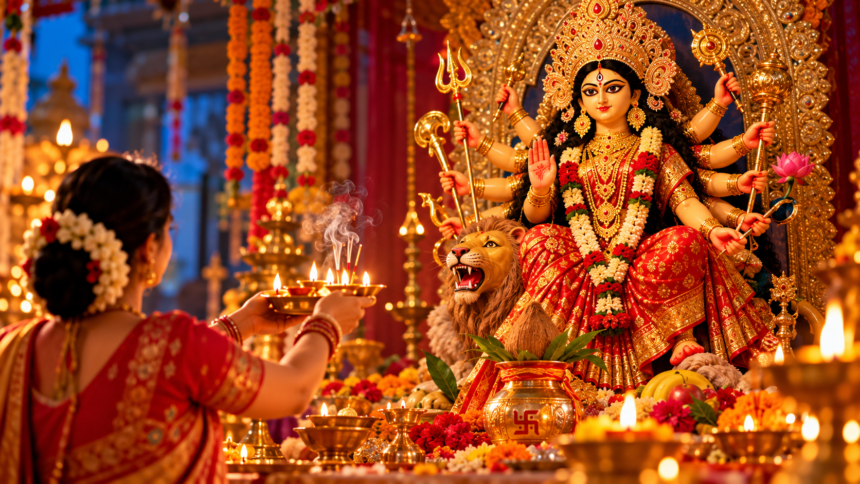
New Delhi: Shardiya Navratri 2026 will begin on Sunday, October 11, with Ghatasthapana and the worship of Maa Shailputri. The nine-day festival will continue until October 19, while Vijayadashami or Dussehra will be observed on October 20.
This year’s calendar has a notable Tithi sequence, with Saptami continuing across October 17 and 18. Both Durga Ashtami and Maha Navami fall on October 19 according to the New Delhi Panchang calculation.
Shardiya Navratri 2026 Dates and Colours
| Date | Day | Tithi | Puja/Observance | Navratri Colour |
|---|---|---|---|---|
| October 11 | Sunday | Pratipada | Ghatasthapana, Maa Shailputri Puja | Orange |
| October 12 | Monday | Dwitiya | Maa Brahmacharini Puja, Chandra Darshan | White |
| October 13 | Tuesday | Tritiya | Maa Chandraghanta Puja | Red |
| October 14 | Wednesday | Chaturthi | Maa Kushmanda Puja | Royal Blue |
| October 15 | Thursday | Panchami | Maa Skandamata Puja, Upang Lalita Vrat | Yellow |
| October 16 | Friday | Shashthi | Maa Katyayani Puja, Saraswati Avahan | Green |
| October 17 | Saturday | Saptami | Maa Kalaratri Puja, Saraswati Puja | Grey |
| October 18 | Sunday | Saptami | Saptami Tithi continues | Purple |
| October 19 | Monday | Ashtami | Durga Ashtami, Maa Mahagauri Puja, Maha Navami | Peacock Green |
| October 20 | Tuesday | Navami/Dashami observances | Navami Homa, Durga Visarjan, Vijayadashami | — |
The above dates and Tithi sequence follow the New Delhi Panchang calculation. Exact timings may differ depending on the city and local Panchang.
When Is Ghatasthapana and Who Is Worshipped?
Shardiya Navratri will start on October 11, 2026. The Pratipada Tithi begins on the night of October 10 and continues through October 11. Since Pratipada is present at sunrise on October 11, the date is observed as the first day of Navratri.
The festival begins with the worship of Maa Shailputri, the first form of Navdurga.
Ghatasthapana will also be performed on October 11. In New Delhi, the main Ghatasthapana Muhurat is approximately 6:19 AM to 10:12 AM, while the alternative Abhijit Muhurat is around 11:44 AM to 12:31 PM.
Ghatasthapana marks the formal beginning of Navratri worship, with the Kalash being established during the prescribed Muhurat.
The nine forms of Goddess Durga associated with the festival are worshipped as follows:
- October 11: Maa Shailputri
- October 12: Maa Brahmacharini
- October 13: Maa Chandraghanta
- October 14: Maa Kushmanda
- October 15: Maa Skandamata
- October 16: Maa Katyayani
- October 17: Maa Kalaratri
- October 18: Saptami Tithi continues
- October 19: Maa Mahagauri and Maa Siddhidatri
Durga Ashtami and Maha Navami 2026
Durga Ashtami will be observed on Monday, October 19, 2026. Maa Mahagauri is worshipped on Ashtami, which is considered an important day during Navratri.
The same date also marks Maha Navami in the given calendar. Devotees may perform Ashtami or Navami Puja, Kanya Pujan and Havan according to their family traditions and the applicable local Panchang.
Maha Navami is associated with the worship of Maa Siddhidatri and the performance of Navami-related rituals.
Because of the Tithi sequence in 2026, devotees following specific rituals should check the Panchang applicable to their location rather than relying solely on a general calendar.
Dussehra 2026: When Is Vijayadashami?
Vijayadashami or Dussehra will be celebrated on Tuesday, October 20, 2026. It marks the conclusion of the Navratri period and is traditionally associated with the victory of good over evil.
Durga Visarjan and other Dashami rituals are performed according to regional customs. The festival period is dedicated to Goddess Durga and her nine forms, with devotees observing daily worship, fasting, prayers, scripture recitation and other forms of Shakti worship.
The nine forms of Navdurga represent different aspects of divine feminine power, while Vijayadashami brings the festival period to its conclusion.
Disclaimer
This article is provided for general informational purposes and is based on the Panchang details mentioned in the source material. Tithi dates, Muhurat timings and ritual schedules can vary by location and Panchang calculation. Devotees should consult their local Panchang, temple or religious authority for the exact timings applicable to their city before performing specific rituals.