
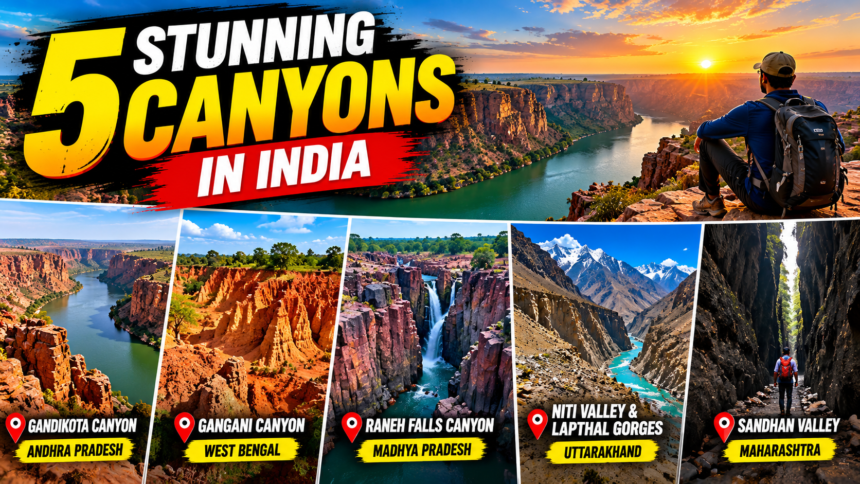
New Delhi: India is home to some remarkable natural landscapes, including deep gorges, towering cliffs and rugged valleys formed over thousands and, in some cases, millions of years. Shaped by rivers, glacial activity and erosion, these geological formations offer spectacular views while also providing access to forts, temples, forests, waterfalls and wildlife areas.
From the red quartzite cliffs of Gandikota in Andhra Pradesh to the colourful rock formations of Raneh Falls in Madhya Pradesh, each destination has its own distinctive landscape. Uttarakhand’s Himalayan gorges offer a high-altitude setting, while Maharashtra’s narrow Sandhan Valley provides a very different canyon experience.
Here are five remarkable canyon landscapes to explore in India.
Gandikota Canyon, Andhra Pradesh
Often compared with the Grand Canyon of the United States, Gandikota Canyon features a gorge that reaches around 300 feet in depth. Its dramatic landscape is marked by layered red quartzite and granite cliffs.
The Pennar River gradually carved the gorge through the Erramala Hills over millions of years, creating the expansive canyon visible today.
The landscape also has a strong historical connection. The 13th-century Gandikota Fort stands along the edge of the gorge, combining the natural setting with medieval architecture.
Nearby attractions include Gandikota Fort, Gandikota Canyon View Point, Madhavaraya Temple and Belum Caves.
Gangani Canyon, West Bengal
Known as the “Grand Canyon of Bengal,” Gangani Canyon is recognised for its rusty-red badlands and unusual formations created by erosion.
The landscape features escarpments, earth pillars, pinnacles, caves and sharp ridges. The Shilabati River played an important role in shaping the terrain, with flowing water contributing to extensive rill and gully erosion in the Pleistocene-era laterite soil.
Visitors can also explore attractions around the canyon, including the Gangani Watch Tower, Shilabati Riverbed, Sarbamangala Temple, Bagdoba Forest and Lake.
Raneh Falls Canyon, Madhya Pradesh
Located in Madhya Pradesh, Raneh Falls Canyon stretches for about 5 kilometres and is known for its crystalline gorge and varied geological formations.
The Ken River has carved its way through the volcanic rock landscape, exposing several types of rocks. Visitors can see formations featuring pink granite, black basalt, brown quartz, red jasper and green dolomite.
The area combines the canyon landscape with waterfalls and wildlife experiences. Nearby attractions include the Crystalline Gorge and Waterfall Viewpoints, Ken Gharial Sanctuary, Vulture View Points and Khajuraho Temples.
Niti Valley and Lapthal Gorges, Uttarakhand
The Niti Valley and Lapthal Gorges offer a completely different canyon experience at high altitude in the Himalayas. The area is characterised by massive mountain walls, rugged rock formations and a stark, desert-like landscape.
Glacial waters of the Dhauliganga River have carved steep and rugged gorges through the surrounding Himalayan terrain.
Among the nearby attractions are Niti Village, Dhauliganga River viewpoints, Malari Village and fossil-hunting areas in Lapthal. Niti Village is also described as the last village before Tibet.
Sandhan Valley, Maharashtra
Popularly known as the “Valley of Shadows,” Sandhan Valley is a deep and exceptionally narrow rock canyon in Maharashtra’s Sahyadri Western Ghats.
Its towering rock walls create a dramatic environment, with some sections becoming so narrow and deep that sunlight does not reach the valley floor. The rugged terrain makes Sandhan Valley particularly appealing to travellers interested in adventure and natural landscapes.
Nearby places include Samrad Base Village, Ratangad Fort and Umbrella Falls.
From the expansive gorge at Gandikota to the narrow passages of Sandhan Valley, these destinations showcase the remarkable variety of India’s canyon landscapes. Rivers, erosion, volcanic formations and glacial waters have shaped each location differently, while nearby historical, cultural and natural attractions add to their appeal.
Disclaimer
This article is intended for general informational purposes only. The descriptions, geological details and nearby attractions are based on the information provided in the source material. Travel conditions, accessibility, local regulations and attraction availability may vary. Visitors should verify current conditions and local guidelines before planning a trip.