
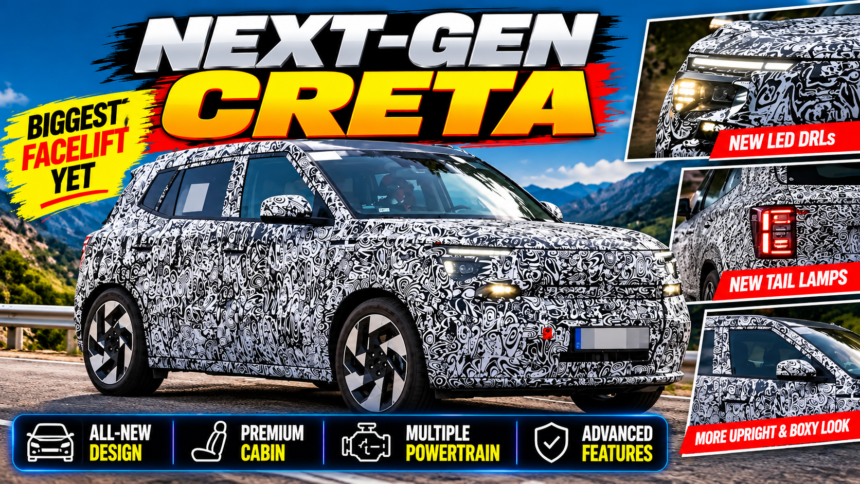
Hyundai is preparing a major update for the Creta, with the next-generation SUV currently undergoing testing across India, Europe and the United States. Early test vehicles have been seen with gradually reduced camouflage, offering a glimpse at the design direction Hyundai could take with the upcoming model.
The new Creta is expected to adopt a more upright and boxy SUV design along with the K3 platform, Pleos Connect technology and an Augmented Reality Head-Up Display. A hybrid powertrain is also expected to be part of the new-generation model, with the setup tipped to deliver mileage of more than 25 kmpl.

New Boxy Design and Exterior Changes
The upcoming Hyundai Creta is expected to look considerably different from the current-generation model. Hyundai appears to be moving towards a more upright and traditional SUV profile, with cleaner body surfaces and less prominent body cladding.
At the front, the SUV is expected to feature a wide illuminated light bar positioned above the main headlamps. The headlights are placed lower on the front fascia, while the bumper could feature an active shutter grille and lower splitter designed to improve aerodynamic efficiency.
The side profile is expected to include flush-fitting door handles, a rising beltline and sharper A-pillars. Aerodynamically designed alloy wheels and a flatter roofline could further enhance the boxier appearance of the new Creta.

Technology-Focused Interior and Pleos Connect
The cabin of the next-generation Creta is also expected to receive a substantial technology upgrade. Spy images indicate a cleaner dashboard layout featuring a large, tablet-style floating touchscreen.
The infotainment system is expected to use Hyundai’s Android-based Pleos Connect platform. The system is designed to bring connected-car functions and smart features together within the vehicle’s infotainment ecosystem.
Other expected equipment includes a panoramic sunroof, powered and ventilated front seats, a Bose sound system, dual-zone climate control and wireless smartphone charging. The SUV is also expected to feature a digital instrument cluster and an Augmented Reality Head-Up Display.
The new Creta is expected to move to Hyundai’s K3 platform. One potential benefit of the new architecture is a longer wheelbase, which could create additional space for passengers in the second row.
Multi-Powertrain Strategy and Hybrid Engine
Hyundai is expected to follow a multi-engine strategy for the next-generation Creta instead of relying on a single powertrain. The existing 1.5-litre naturally aspirated petrol, 1.5-litre U2 CRDi diesel and 1.5-litre turbo-petrol engines are expected to continue with the new generation.
The biggest addition could be a hybrid powertrain combining a 1.5-litre naturally aspirated petrol engine with an electric motor and a small battery pack. This setup is expected to deliver fuel efficiency of more than 25 kmpl.
Different engines could be paired with different transmission options. The expected gearbox lineup includes a 6-speed manual, CVT, 6-speed automatic and 7-speed DCT.
The next-generation Hyundai Creta is therefore expected to bring changes across its exterior design, cabin technology, platform and powertrain lineup while retaining a range of engine and transmission choices for different buyers.
Disclaimer
The design, features, platform, engine options, transmission choices and mileage figures mentioned in this article are based on currently available information and expectations surrounding the next-generation Hyundai Creta. Hyundai may change these specifications or features before the vehicle is officially launched.