
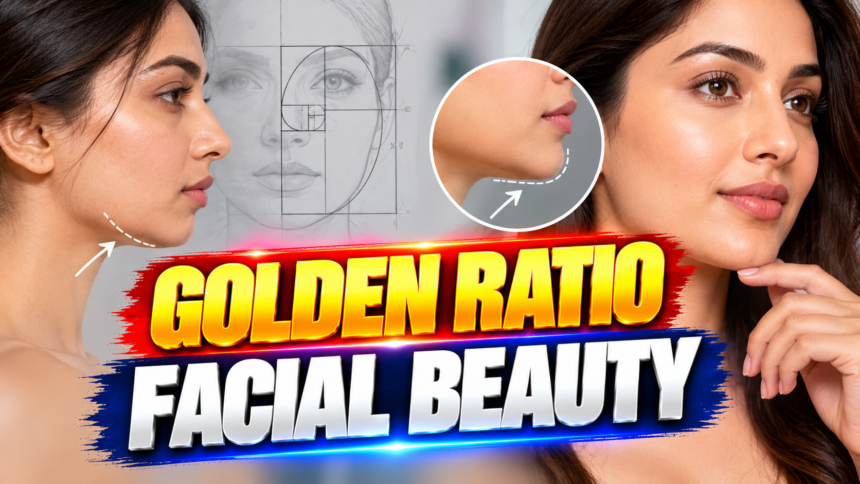
For many years, the idea of the “golden ratio” has been associated with facial beauty. The concept is based on the belief that specific mathematical proportions can determine whether facial features appear balanced and attractive. However, modern aesthetic medicine is increasingly taking a different approach, recognising that beauty cannot be defined by a single formula that applies to every person.
This approach is particularly relevant when considering Indian faces. Factors such as facial anatomy, ethnicity, gender and individual features all influence facial balance. According to Dr Debraj Shome, Co-Founder and Director of The Esthetic Clinics, contemporary facial aesthetics is increasingly focused on understanding each person’s unique anatomy instead of trying to make every face conform to the same mathematical proportions.
Why the Chin Has a Bigger Role in Facial Balance
Although the chin is relatively small compared with other facial features, even a minor change in its projection can influence the appearance of the entire face.
A systematic review titled Injectable Filler-Based Chin Augmentation: A Systematic Review of Non-Surgical Volumetric Techniques, authored by Dr Debraj Shome, Dr Debalina Bose, Dr Ashwin Prabhughate, Dr Rasesh Shah and Dr Rinky Kapoor, highlights the importance of tailoring facial augmentation to individual anatomy.
The chin contributes to the structure of the jawline and the cervico-mental region while also playing a role in the proportions of the lower third of the face. As a result, a chin that sits further back, commonly described as a “retruded chin”, can influence the appearance of surrounding facial structures rather than affecting only the chin itself.
The Connection Between the Chin and Jawline
Modern facial aesthetics increasingly considers the chin and jawline as interconnected parts of the overall facial profile.
The position and projection of the chin can affect jawline definition and the cervico-mental angle. Ageing can also influence these areas as changes take place in the mandible and the soft tissues supporting the face.
For this reason, assessing a single facial feature separately may not provide a complete picture of facial harmony. The relationship between the chin, jawline and other facial structures can be equally important when planning an aesthetic procedure.
Why Individual Anatomy Matters for Indian Faces
The use of beauty standards developed around one population can become complicated when those standards are applied universally.
The review notes that Asian populations, including Indians, may commonly have lower midface projection and flatter midline contours, features that can contribute to broader facial proportions. With age, changes can occur in both the soft tissues and underlying skeletal structures, including the mandible.
For Indian patients, Dr Shome’s work stresses the importance of evaluating individual anatomy rather than automatically applying standards developed around another ethnic group. Such an assessment may take into account the underlying bone structure, facial width, distribution of soft tissue and the person’s overall profile.
This means that a proportion considered balanced on one face may not necessarily produce the same result on another.
Facial Aesthetics Is About Harmony, Not Mathematical Perfection
The limitations of the golden ratio become clearer when facial beauty is viewed on an individual basis. Every face has its own combination of bone structure, soft-tissue distribution, width and profile.
According to the source, injectable fillers can provide a customisable and minimally invasive option for people with mild to moderate chin retrusion. The review reported acceptable short-term safety outcomes, with adverse effects generally described as minor and temporary, including swelling, bruising and nodularity. It also highlighted the importance of detailed anatomical assessment, appropriate technique and selecting a product suited to the individual.
The broader shift in facial aesthetics is therefore away from the idea that one measurement can determine beauty. Instead, the focus is increasingly on achieving proportion and balance while retaining the person’s individual facial identity.
Rather than reshaping every face to match a mathematical ideal, the modern approach places greater emphasis on harmony and individuality, recognising that there is no single template that every face needs to follow.
Disclaimer: This article is intended for general informational purposes only and should not be considered medical advice. Cosmetic procedures, including injectable treatments, should be discussed with a qualified medical professional after an individual assessment of facial anatomy, suitability, risks and expected outcomes.