
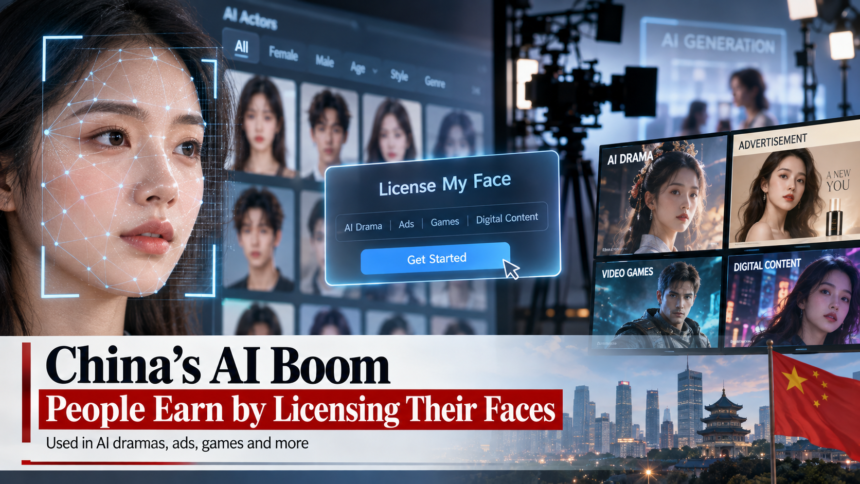
China’s rapid growth in artificial intelligence is opening up an unusual new source of income for ordinary people. Individuals are now able to license their facial likenesses for use in AI-generated dramas, advertisements, video games and other digital productions.
According to the South China Morning Post, emerging face-licensing platforms are offering fees ranging from 50 yuan, roughly ₹700, to as much as 99,999 yuan, or about ₹14 lakh. The amount a person can earn depends on several factors, including how their face will be used, the length of the licence and the number of productions permitted to feature their likeness.
How China’s AI Face-Licensing Platforms Work
Platforms such as ActID and New Claw allow people to register their faces after completing an identity verification process. Once listed, producers can browse digital catalogues and search for suitable faces based on characteristics such as age, gender and appearance.
The platforms also offer different appearance categories, including descriptions such as “girl-next-door”, “rugged” and “supermodel”. Users can specify the types of productions in which their faces can appear, including television advertisements, short dramas and video games.
In some cases, individuals can determine their own licensing fees and set limits on the number of productions that may use their likeness.
ActID said it had about 800 registered users since launching in March. Its users include professional extras, influencers and people with no previous acting experience. Around 300 of those users had agreed to license their images.
The platform also said two AI drama productions had licensed about 10 faces through its service. Fees for those projects reportedly ranged between 99 yuan and 500 yuan, or approximately ₹1,400 to ₹7,000, per episode. ActID keeps a 10% commission from the payments.
AI-Generated Content Drives Demand for Real Faces
Other companies are also entering the market as demand for AI-generated entertainment increases. Shenzhen-based Yuanxiang Xinsheng, which began operations in May, and Chengdu-based Xinzhua, launched in April, allow creators to license their faces for AI-generated dramas, advertisements and video games.
Xinzhua has approximately 370 digital actor profiles. Licensing charges on the platform range from 500 yuan, around ₹7,000, to 6,000 yuan, approximately ₹85,000. Producers can search for digital faces according to gender, age, style and genre.
The expanding microdrama sector is helping drive demand for real people’s facial likenesses. According to the report, more than 95% of the 128,000 microdramas released in China during the first three months of 2026 used AI at some stage of production.
Long Lyu, operations lead at New Claw, said AI was already changing the entertainment industry. He said licensing photo rights could provide actors and models with an additional way to earn money while continuing their careers outside AI productions.
The National Business Daily reported that one bank employee earned nearly 2,500 yuan, or around ₹35,000, after an advertising company purchased the rights to use his portrait seven times within three days.
Consent and Privacy Become Major Concerns
The growing face-licensing business has also raised questions about consent, biometric information and the long-term control people have over their digital likenesses.
Lawyers have warned that some agreements may not clearly define how a person’s face can be altered, reproduced or reused once it becomes part of an AI marketplace. This can make it difficult for individuals to understand exactly how their likeness may eventually be used.
Yile Deng, a Beijing-based lawyer who handles AI-related portrait-rights cases, said the unclear limits of authorisation remain a significant issue. She noted that users may not always know who will ultimately use their likeness or the purposes for which it could be used.
China has already witnessed disputes involving unauthorised AI face-swapping. ByteDance’s AI drama platform reportedly removed more than 85,000 videos involving unauthorised reproductions of people’s faces and voices since the start of 2026.
Disclaimer
The figures, platform details and statements in this article are based on the information provided in the source material. Licensing fees, platform policies, AI regulations and market conditions may change over time. Readers should verify the latest terms and applicable rules with the relevant platforms and official sources before licensing or using any person’s likeness.