
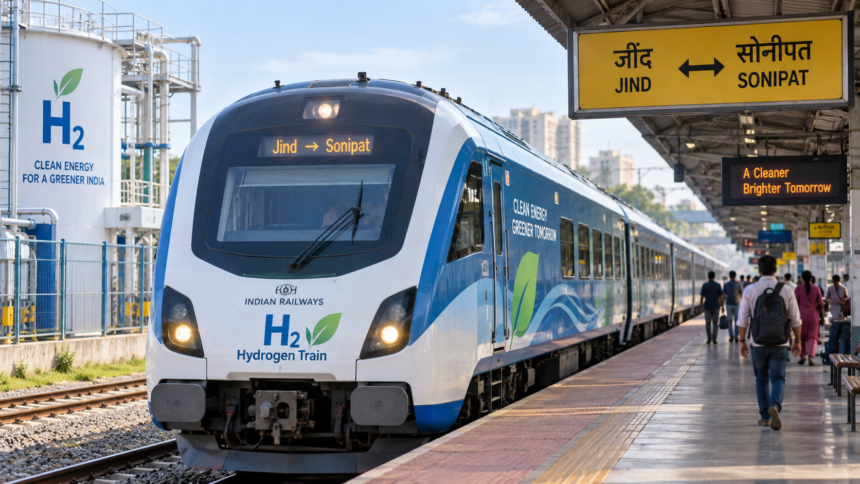
India’s only hydrogen-powered train is facing a major challenge on its current route in Haryana. The train, which can carry around 2,600 passengers, is reportedly operating with only 40 to 60 passengers during a complete journey.
The hydrogen train currently runs on the 89-kilometre Jind-Sonipat section. Because of the low passenger turnout, the service is making only one round trip a day, instead of the two trips that were originally planned.
The Northern Railway has been operating the train for the past two months, with a dedicated team of experts monitoring the new technology and its day-to-day operations.
Railways Considering Extension to Delhi
To attract more passengers, the Railways is examining the possibility of extending the hydrogen train service from Sonipat towards Delhi. Azadpur station is among the options being considered. The station is an important wholesale market for fruits and vegetables, and local residents have been seeking better connectivity to Delhi.
Before taking a final decision, railway authorities are examining the proposal from safety, technical and operational perspectives. Delhi’s heavily occupied railway network and availability of tracks are among the factors that could affect the feasibility of the extension.
Another challenge is the train’s capacity. The existing hydrogen train has 10 coaches and can accommodate around 2,600 passengers. However, services originating from Delhi generally require trains with around 18 to 20 coaches, raising questions about how the existing train would meet potential demand on the extended route.
Hydrogen Train Uses Clean Energy Technology
The train was inaugurated on July 17 and represents an important step in the development of hydrogen-based railway technology. Unlike conventional diesel-powered trains, the hydrogen train uses hydrogen to generate electricity, offering a cleaner alternative for rail transportation.
India is among the countries working on hydrogen-powered railway technology. Since the system is based on relatively new technology, railway authorities are closely monitoring its performance and conducting technical assessments before making any major expansion.
Fuel availability is not considered a major limitation because the train can travel approximately 250 to 300 kilometres on a single tank. However, the existing refuelling facility is located only in Jind. If the train is extended to Delhi, the Railways will need to plan its refuelling arrangements accordingly.
Panipat-Safidon Circuit Also Under Consideration
The low passenger turnout is not entirely new to the Jind-Sonipat route. Even the DEMU services that operated on the section previously experienced limited ridership. Three other DEMU trains are currently running on the route, but passenger numbers remain relatively low, partly because of the limited number of daily commuters and industrial workers in the area.
If extending the hydrogen train to Delhi proves difficult, another proposal has emerged from local passengers. The suggested route would run from Sonipat to Panipat, then through Safidon and back to Jind, creating a circuit of approximately 180 kilometres.
The proposed circuit could potentially connect the train with more daily commuters and improve its utilization.
Railway officials are evaluating both possibilities while keeping safety and technical feasibility as key considerations. Since the hydrogen train involves new technology, authorities do not want to expand the service without carefully assessing the operational and technical requirements.
The Railways is therefore examining how the train can be operated on a route that attracts more passengers while ensuring safe and reliable operations. The final decision on extending the service to Delhi or adopting the Panipat-Safidon circuit will be taken after all relevant factors have been reviewed.