
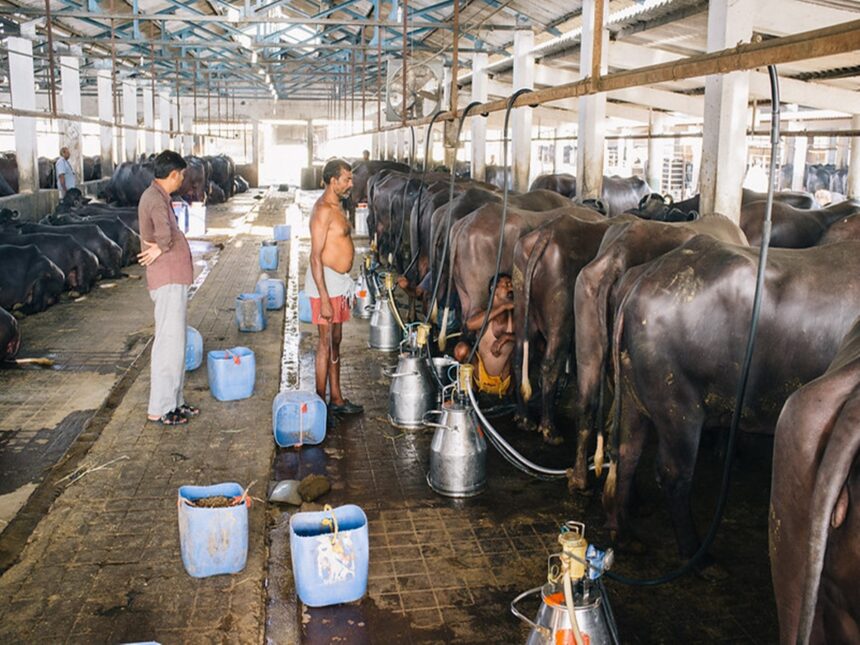
India is the world’s largest milk producer, but its presence in the international dairy trade remains surprisingly small. This contrast has intensified the debate over how the country should approach free trade agreements (FTAs): should India continue shielding its dairy farmers from overseas competition, or use trade deals as a catalyst to make the domestic industry more productive, efficient and export-ready?
Industry experts believe the answer lies somewhere in between. Protecting millions of small dairy farmers remains important, particularly in the short term. However, India must simultaneously use FTAs to accelerate improvements in productivity, animal health, processing, food safety, quality standards and supply-chain infrastructure.
India Produces the Most Milk, But Exports Very Little
India produced 247.87 million tonnes of milk in 2024-25, maintaining its position as the world’s biggest milk producer. Yet the country’s contribution to global dairy exports remains below 1% of its total milk output, largely because most of the production is consumed within India.
Commerce Minister Piyush Goyal said in April that India had not offered dairy tariff concessions in its FTAs with major partners, including the European Union, the UK, New Zealand and Australia.
The cautious stance reflects the unique structure of India’s dairy industry. Unlike many developed countries, where dairy production is concentrated among large commercial farms, India’s sector supports around 80 million small and marginal farmers, many of whom depend on just a handful of animals for their livelihoods.
Protecting these farmers from sudden import competition is therefore crucial. But experts argue that protection alone cannot provide a long-term solution.
Rupinder Singh Sodhi, former managing director of Gujarat Cooperative Milk Marketing Federation (GCMMF), which markets dairy products under the Amul brand, believes India must now concentrate on making its dairy industry globally competitive.
According to him, the country’s dairy strategy must address productivity, quality and operational efficiency while continuing to protect farmer incomes.
A sudden increase in imports could put downward pressure on domestic milk prices. That could reduce farmer earnings and eventually discourage milk production, making a balanced trade policy essential.
From Protection to Competitiveness
Experts say India’s next stage of dairy development should move from “protection only” to “protection with competitiveness.”
Divya Kumar Gulati, chairman of CLFMA of India, says simply producing large quantities of milk does not automatically make a country competitive in global markets.
India needs to increase milk yield per animal through scientific breeding, better-quality feed, mineral supplementation, preventive veterinary care and improved disease management.
Animal productivity is particularly important because India’s enormous milk output is partly the result of having a very large cattle and buffalo population rather than exceptionally high yields per animal.
The sector also needs stronger systems for:
- Scientific animal breeding
- Balanced nutrition and feed
- Preventive healthcare
- Disease control
- Modern milk collection
- Cold-chain infrastructure
- Automated processing
- Quality certification
- Residue testing
- Digital traceability
These improvements would help Indian dairy companies meet the strict requirements of premium international markets.
How FTAs Could Accelerate Dairy Reforms
Rather than viewing FTAs only as agreements that determine import tariffs, experts believe India can use them to push domestic reforms.
Rupesh Mukherjee, practice lead at TechnoServe India, notes that India produces close to a quarter of the world’s milk but contributes less than half a percent of global dairy exports.
He believes improvements in farm-level quality, bulk milk chilling, processing standards and digital tracking from the animal to the export container could significantly narrow this gap.
India could also use transition periods and safeguards for vulnerable dairy categories while setting clear deadlines for upgrading domestic infrastructure.
International trade commitments could effectively become a reason for the industry to invest in better testing laboratories, trained personnel and compliance systems.
For example, meeting international requirements related to aflatoxin M1 and antibiotic residues would require stronger testing and monitoring systems across the dairy supply chain.
Ravin Saluja, director of Sterling Agro Industries, also believes FTAs can become an important tool for reform if market-access commitments are combined with investments in infrastructure and quality standards.
However, experts caution that trade agreements by themselves will not solve India’s structural problems.
Stronger Regulation Is Needed From Farm to Factory
Dairy expert Kuldeep Sharma argues that India must strengthen its regulatory framework before expecting FTAs to transform the industry.
Standards need to improve across the entire chain, beginning with milk production and continuing through collection, transportation, storage and processing.
Milk vendors should be properly registered, cold-chain requirements should be strengthened, and traceability should become an integral part of the system.
Such measures would not only improve export potential but also raise the overall quality and safety of dairy products consumed within India.
India Should Target High-Value Dairy Exports
India’s massive domestic market is another reason its dairy exports remain relatively modest. A large portion of the country’s milk is consumed domestically, leaving comparatively little surplus for international markets.
Experts therefore say India does not need to export every dairy product. Instead, it should identify categories where Indian companies can develop a sustainable competitive advantage.
Potential opportunities include:
- Whey and whey proteins
- Butter and butterfat
- Ghee
- Cheese
- Paneer
- Dairy ingredients
- Milk powders
- Lactose derivatives
- Fermented dairy products
- Infant nutrition ingredients
- Functional dairy products
Kuldeep Sharma identifies whey, butterfat, cheese, paneer and other processed products as promising areas.
He also argues that Indian companies have historically been stronger in manufacturing products for other brands than in creating globally recognised dairy brands of their own.
A stronger focus on value-added products could allow India to move beyond occasional commodity exports and establish more durable international businesses.
Low Milk Yield Per Animal Remains a Major Problem
One of the biggest obstacles to India’s dairy ambitions is low productivity per animal.
Rajender Singh, managing director of Paras Dairy, says India’s protective policies gave the industry valuable time to develop, but the next phase must focus heavily on improving productivity.
He advocates wider adoption of genetic improvement, better feeding practices, silage and artificial insemination.
The lesson from successful global dairy producers, he suggests, is not simply about scale. Consistent productivity and milk quality throughout the year are equally important.
Saloni Godbole Tewari, co-founder of Occamy Bioscience, believes dairy farming should increasingly be viewed as a commercial enterprise rather than a secondary activity alongside agriculture.
She calls for greater attention to animal nutrition, veterinary care, breed improvement and milk quality at the point of production.
Milk testing, she says, should go beyond measuring fat and solids-not-fat (SNF). Parameters such as antibiotic residues, somatic cell counts and animal-health indicators also need attention.
Farmers producing better-quality milk should receive higher prices, while testing equipment needs to be properly calibrated and connected to traceability systems.
India Needs Selective Opening, Not Unlimited Imports
There is no complete agreement among experts on how much India should open its dairy market under FTAs. However, there is broad support for a carefully calibrated approach.
Kuldeep Sharma supports allowing imports of certain specialised products, ingredients and technologies that can strengthen domestic capabilities while continuing to protect sensitive segments such as liquid milk.
Such selective opening could introduce greater competition and expose Indian businesses to international standards without putting the livelihoods of millions of farmers at immediate risk.
Sodhi points out that India’s dairy economy is fundamentally different from those in developed countries because dairy farming remains a major source of income for millions of Indian households.
At the same time, India’s growing milk production means exports will eventually become increasingly important.
If rising milk output is not absorbed by domestic consumption, processing or exports, excess supply could push prices lower and hurt farmers.
Future FTAs Must Open Foreign Markets for Indian Dairy
Experts say India’s trade negotiations should not focus solely on keeping foreign dairy products out. They should also ensure that Indian dairy products receive meaningful access to international markets.
Mukherjee believes negotiations with countries and regions in Southeast Asia and the Gulf could create opportunities for Indian dairy ingredients. Meeting demanding European standards could also help Indian exporters access other premium markets.
Future FTAs could prioritise:
- Mutual recognition of certifications
- Faster approval of Indian dairy facilities
- Science-based sanitary and phytosanitary standards
- Lower non-tariff barriers
- Better market access for Indian dairy products
- Recognition of Indian quality systems
India must also address challenges such as foot-and-mouth disease, animal identification and end-to-end traceability.
A robust tracking system could connect information about the animal, farmer, milk collection point and processing facility, making it easier to demonstrate quality and safety to overseas buyers.
Protecting Farmers and Building Exports Can Go Together
India does not necessarily have to choose between farmer protection and global competitiveness.
Kuldeep Sharma argues that government support should be designed around farmers rather than being restricted to particular types of dairy organisations. Farmers should have the freedom to sell their milk to cooperatives, private dairies or other buyers.
The government’s role, he says, should be to create a competitive ecosystem rather than directly manage the dairy business.
Indu S, co-founder of GoKrit, similarly believes India needs to balance farmer protection with improvements in quality, traceability and reliability throughout the dairy value chain.
The Road Ahead for India’s Dairy Industry
India’s dairy story is no longer simply about producing more milk. The next challenge is turning that enormous production base into a high-quality, efficient and globally competitive industry.
A successful FTA strategy could provide temporary safeguards for vulnerable farmers while simultaneously encouraging investment in animal productivity, processing, food safety, cold chains and traceability.
The long-term goal should not be to export every litre of milk or every dairy product. Instead, India should build strength in selected high-value categories where it can compete successfully in international markets.
For India, the ideal approach is therefore protection with a clear path towards competitiveness. If trade agreements are used to improve domestic standards while securing genuine overseas market access, the country’s massive milk production could eventually translate into a much stronger position in the global dairy export market.