
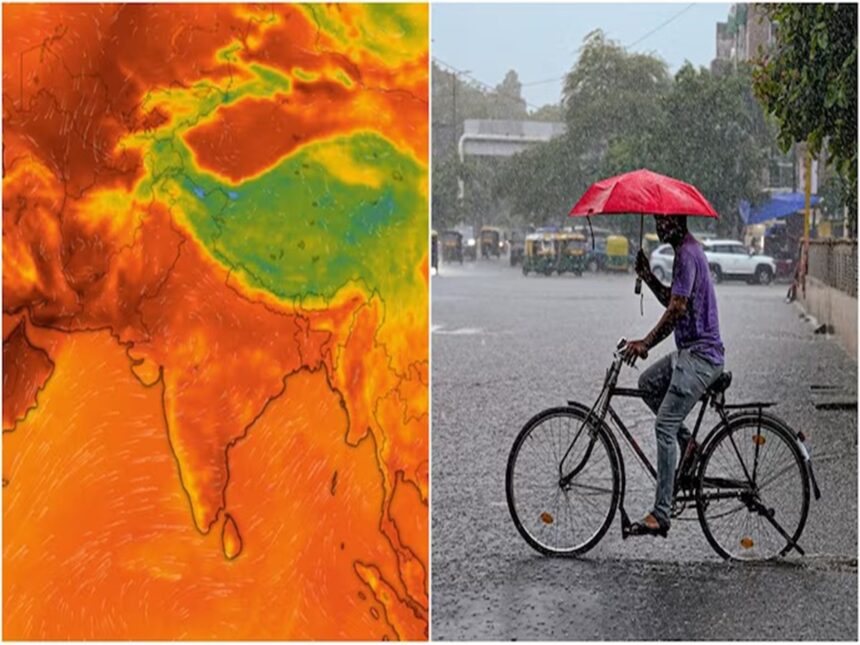
India’s southwest monsoon 2026 could face fresh challenges in the coming weeks as a strengthening El Niño threatens to disrupt rainfall patterns across the country. After an unpredictable start to the rainy season, the latest warning from the World Meteorological Organization (WMO) has raised concerns that the second half of the monsoon may be weaker than expected.
The alert comes at a time when the India Meteorological Department (IMD) has already forecast below-normal rainfall for August, increasing worries about the impact on agriculture, water resources, and overall weather conditions.
WMO Forecasts Strong El Niño During August–October
According to the WMO, the current El Niño event is expected to strengthen significantly between August and October 2026, with some forecasts indicating it could develop into a strong or “Super El Niño”.
The global weather agency noted that unusually warm ocean temperatures, combined with a likely positive Indian Ocean Dipole (IOD), could reshape weather patterns across several regions of the world. While some countries may experience excessive rainfall, others could face prolonged dry spells and drought-like conditions.
Scientists also expect global temperatures to remain above average during this period, adding to ongoing climate concerns.
India’s Monsoon Has Been Highly Uneven This Year
The 2026 southwest monsoon has witnessed dramatic swings since its onset.
June ended with a 39.8% rainfall deficit, making it one of India’s driest Junes in over a century after the monsoon’s progress stalled across large parts of the country for several weeks.
Conditions improved considerably in July, thanks to multiple low-pressure systems that triggered widespread rainfall across central, western and northern India. The showers helped reduce the rainfall deficit in several states.
However, the recovery has not been uniform. While some regions have recorded excess rainfall, others continue to struggle with below-average precipitation.
IMD Predicts Below-Normal Rainfall in August
Despite the improvement witnessed in July, the IMD has projected that August rainfall is likely to remain below normal, at around 94% of the Long Period Average (LPA).
The weather department has also indicated that El Niño is expected to strengthen further during the latter half of the monsoon season, increasing uncertainty over rainfall distribution across the country.
This raises concerns for farmers, especially during a crucial phase of the agricultural season when consistent rainfall is essential for crop growth.
What Is El Niño and Why Does It Matter for India?
El Niño is a naturally occurring climate phenomenon caused by warmer-than-normal sea surface temperatures in the central and eastern Pacific Ocean.
Although it develops thousands of kilometres away from India, the phenomenon has a significant influence on global weather systems. Historically, strong El Niño events have often been associated with weaker southwest monsoons and reduced rainfall over large parts of the Indian subcontinent.
According to the WMO, sea surface temperature anomalies in key Pacific monitoring regions could rise above 2.9°C between August and October, indicating the possibility of a particularly intense El Niño event.
Global Climate Risks Increase
The strengthening El Niño is expected to add to the challenges posed by an already warming planet.
UN Secretary-General António Guterres warned that the climate phenomenon is intensifying the effects of rising global temperatures, contributing to more frequent heatwaves, wildfires, and record-breaking ocean temperatures worldwide.
Describing the growing climate crisis, Guterres remarked that El Niño has “entered our home,” highlighting the increasing impact of extreme weather events across the globe.
What It Could Mean for India
If El Niño continues to strengthen as forecast, India could witness a more uneven distribution of rainfall during the remaining monsoon months. While some regions may continue to receive heavy showers, others could face prolonged dry spells, affecting agriculture, reservoir levels, and water availability.
With the IMD already predicting below-normal rainfall in August and global weather agencies warning of a stronger El Niño, meteorologists will closely monitor the evolving climate pattern to assess its impact on India’s monsoon and the country’s agricultural outlook in the weeks ahead.