
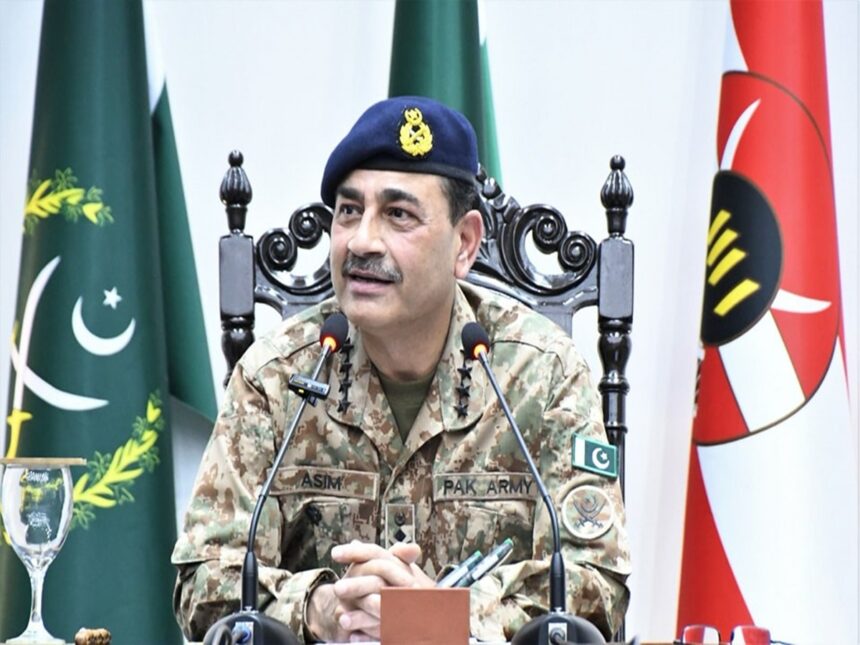
Pakistan has introduced a sweeping overhaul of its military command structure by creating the National Strategic Command (NSC), a move that centralises control over the country’s strategic and nuclear assets under the military leadership headed by Field Marshal Syed Asim Munir.
The restructuring, enabled through recent legislative changes, marks one of the most significant reforms to Pakistan’s defence framework in decades and is expected to reshape how the country’s strategic forces are managed.
National Strategic Command to Oversee Nuclear Assets
Under the new arrangement, the National Strategic Command (NSC) will take charge of Pakistan’s strategic capabilities, including its nuclear arsenal and other key defence assets.
The new command structure centralises operational authority within a unified military chain of command. According to the revised framework, the traditional civilian-led National Command Authority (NCA) will continue to receive information but will no longer exercise direct operational control over strategic assets.
Asim Munir to Lead New Military Structure
The restructuring is being led by Field Marshal Syed Asim Munir, who now serves in the dual roles of Chief of Defence Forces (CDF) and Chief of the Army Staff (COAS).
As part of the reorganisation, Lieutenant General Syed Aamer Raza, previously serving as the Chief of the General Staff, has been promoted to the rank of four-star General and appointed as the first-ever Commander of the National Strategic Command.
His appointment places him at the helm of Pakistan’s newly established strategic command responsible for overseeing critical defence operations.
Command Structure Draws Inspiration From China’s Military Model
The newly established NSC is reportedly designed along the lines of China’s People’s Liberation Army (PLA), particularly the operational structure of the PLA Rocket Force.
Working alongside Pakistan’s Strategic Plans Division (SPD), the NSC will integrate the management of nuclear warheads, missile systems, delivery platforms, and strategic weapons development under a single command authority.
The objective is to create a fully integrated joint command involving the Army, Navy, Air Force, Rocket Force, and Strategic Command, strengthening Pakistan’s deterrence capabilities while expanding defence cooperation and technological collaboration with China.
Major Changes Within Pakistan’s Armed Forces
The restructuring has also brought significant changes to Pakistan’s military administration and leadership.
Promotion Boards Delayed
Promotion boards for senior military officers have reportedly remained on hold for more than 15 months, as the armed forces continue implementing the large-scale organisational changes.
Formation Commanders’ Conferences Suspended
Routine Formation Commanders’ Conferences, a key feature of Pakistan Army leadership meetings, have reportedly been suspended since 2024, reflecting the ongoing transition and increasing centralisation of strategic decision-making.
Greater Centralisation of Military Authority
The new framework consolidates operational control within the Office of the Chief of Defence Forces, reducing the traditional autonomy previously exercised by regional Corps Commanders.
What the Military Overhaul Means
The creation of the National Strategic Command represents one of the most significant structural changes in Pakistan’s defence establishment in recent history. By centralising strategic decision-making, integrating all military branches under a unified command, and aligning aspects of its organisational model with China’s military structure, Pakistan aims to strengthen coordination over its strategic assets and modernise its defence command architecture.