
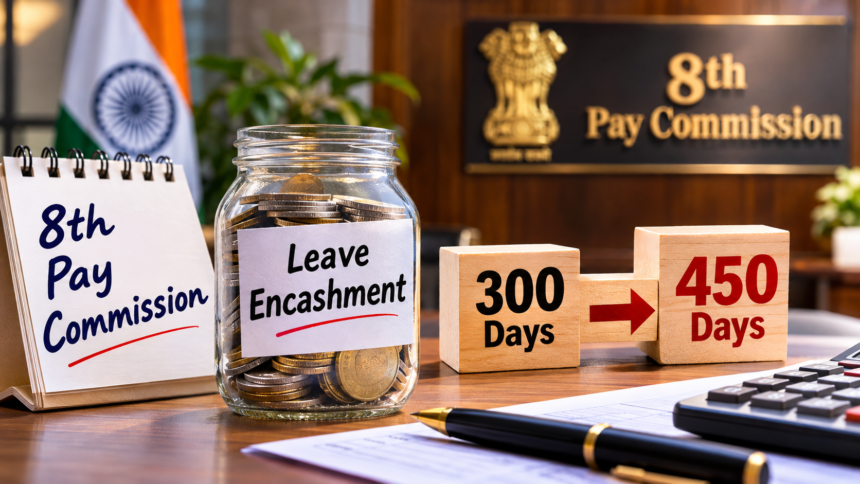
New Delhi: Central government employees may receive a higher retirement benefit if a major proposal submitted to the 8th Pay Commission is accepted. Employee organisations have demanded an increase in the maximum leave encashment limit from the existing 300 days to 450 days.
If the proposal is approved, retiring employees could receive payment for an additional 150 days of accumulated leave. This may significantly increase the lump-sum amount received at the time of retirement.
However, the proposal is still under consideration, and the 8th Pay Commission has not announced any final decision on the matter. The demand has brought renewed attention to leave encashment, an important financial benefit available to government employees when they retire.
What Is Leave Encashment for Government Employees?
Leave encashment is a retirement benefit under which employees receive money in exchange for their eligible unused earned leave (EL).
During their service, government employees can accumulate earned leave, subject to applicable rules. At the time of retirement, they can receive a cash payment for the accumulated leave within the prescribed limit.
Under the existing provision discussed in the proposal, employees can receive leave encashment for a maximum of 300 days.
The 8th Pay Commission has now received a demand to increase this limit to 450 days. If implemented, employees would be able to receive payment for an additional 150 days of eligible unused leave.
What Is the Demand of Employee Unions?
The All India Trade Union Congress has raised the issue of increasing the leave encashment limit during discussions with members of the Pay Commission.
The organisation has proposed increasing the existing ceiling from 300 days to 450 days.
Employee representatives believe that a higher limit would allow retiring government employees to receive greater financial benefits after completing their service.
At present, the maximum benefit is restricted to 300 days of accumulated leave. Under the proposed arrangement, the additional 150 days could increase the total retirement payout.
However, employees will have to wait for the commission’s recommendations and the government’s final decision before any change can be implemented.
How Is Leave Encashment Calculated?
The amount payable under leave encashment is calculated using an employee’s basic pay and Dearness Allowance (DA) at the time of retirement.
The calculation takes into account the applicable salary components and the number of eligible unused leave days.
Under the existing 300-day limit, the benefit is equivalent to up to 10 months of salary. Employee organisations are demanding that this be increased to 450 days, equivalent to 15 months.
For example, if the proposed limit is approved, an employee with sufficient accumulated earned leave could receive payment for up to 15 months instead of the existing 10 months.
The leave encashment amount also receives tax benefits under applicable income tax provisions.
How Much Additional Money Could Employees Receive?
If the 8th Pay Commission accepts the proposal, the increase from 300 to 450 days could make a considerable difference to retirement payments.
The actual additional amount would depend on the employee’s basic salary, Dearness Allowance and eligible accumulated leave balance at the time of retirement.
For now, the 450-day limit remains a demand raised by employee organisations and is not an officially approved benefit.
Central government employees will therefore be watching the 8th Pay Commission’s recommendations closely, as any decision could have a direct impact on their retirement benefits.
Disclaimer: This article is intended for general informational purposes only and is based on the proposal and information provided in the source material. The proposed increase in leave encashment from 300 to 450 days has not been confirmed as an approved government decision. Actual benefits, calculation methods and tax exemptions are subject to applicable government rules and official notifications. Employees should refer to the relevant department or official government announcements for the latest information.