
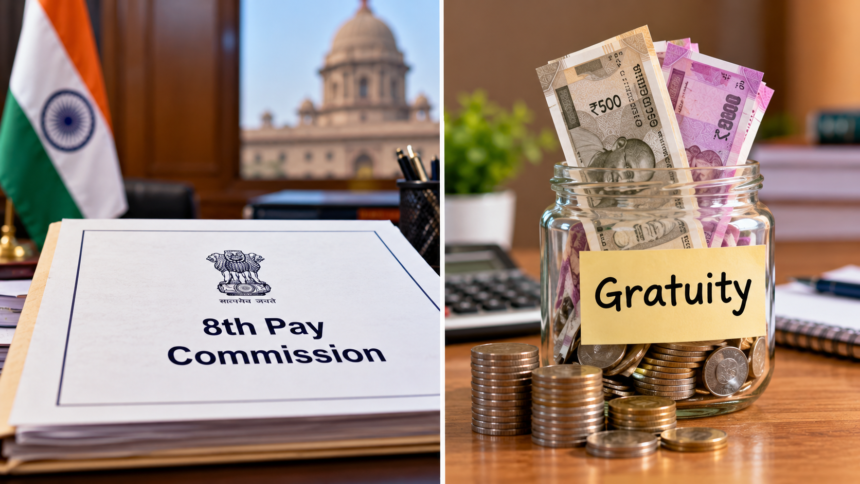
Gratuity for central government employees has become an important topic of discussion as the 8th Pay Commission works on its recommendations. Employee organisations are seeking changes to the existing gratuity rules, including a substantial increase in the maximum payment limit. Some representatives have proposed raising the ceiling from ₹25 lakh to ₹75 lakh.
Gratuity is a one-time payment made to eligible employees in recognition of their years of service. For government employees, the amount generally depends on their last drawn basic pay, dearness allowance (DA) and qualifying service. The final recommendations of the 8th Pay Commission could influence future discussions on these benefits, but any changes will require government approval.
How Is Gratuity Calculated for Government Employees?
Under the Central Civil Services (Pension) Rules, 2021, retirement gratuity for eligible central government employees is generally calculated using one-fourth of the last basic pay plus DA for every completed six-month period of qualifying service, subject to the applicable rules and limits.
The calculation can be represented as:
Retirement gratuity = (Last Basic Pay + DA) × 1/4 × Completed six-month periods of qualifying service
For example, the amount depends on the employee’s pay and the number of qualifying half-year periods completed during service.
A different formula is commonly used for gratuity calculations under the Payment of Gratuity Act for eligible private-sector employees:
Gratuity = (Last drawn salary, including eligible DA) × 15 × Completed years of service ÷ 26
The applicable formula depends on the employee’s category and the rules governing their employment.
What Is the Current Gratuity Limit?
The current maximum retirement gratuity limit for central government employees is ₹25 lakh, subject to the applicable service rules. The amount is also governed by the prescribed ceiling linked to 16.5 times the relevant emoluments.
Employee organisations argue that the existing limit should be reviewed in view of inflation and rising medical expenses. They believe changes to the ceiling and calculation method could help retirement benefits better reflect employees’ financial needs.
What Changes Are Employee Unions Demanding?
Several employee representatives have submitted proposals concerning gratuity to the 8th Pay Commission.
The employee representatives on the National Council-Joint Consultative Machinery (NC-JCM) have reportedly sought a threefold increase in the gratuity ceiling, taking it from ₹25 lakh to ₹75 lakh.
Other demands include calculating gratuity using 25 working days instead of 30 and removing the existing limit of 16.5 times the relevant emoluments.
The Indian Railways Technical Supervisors Association (IRTSA) has put forward a separate proposal. It has demanded that the maximum gratuity limit be increased to ₹50 lakh and that the calculation be based on one-third of basic pay plus DA for every completed six-month period of service.
These proposals reflect the demands of employee organisations and are not approved changes to the existing rules.
8th Pay Commission: Latest Status and Timeline
The 8th Pay Commission is a three-member panel headed by Justice Ranjana Prakash Desai. It was constituted on November 3, 2025, with a term of 18 months. Its final report is expected around May or June 2027.
The Commission is currently consulting stakeholders as part of its work on recommendations. According to the information provided, its meetings in Bengaluru concluded on October 8, while the next meeting is scheduled for October 22–23 in Mumbai.
Until the Commission submits its final report and the government approves any proposed changes, the existing gratuity rules and limits will continue to apply.
Disclaimer: This article is intended for general informational purposes and does not constitute financial, employment or legal advice. The gratuity changes discussed are proposals from employee organisations and should not be treated as approved policy. Employees should consult official government notifications and the applicable service rules for confirmed information.