
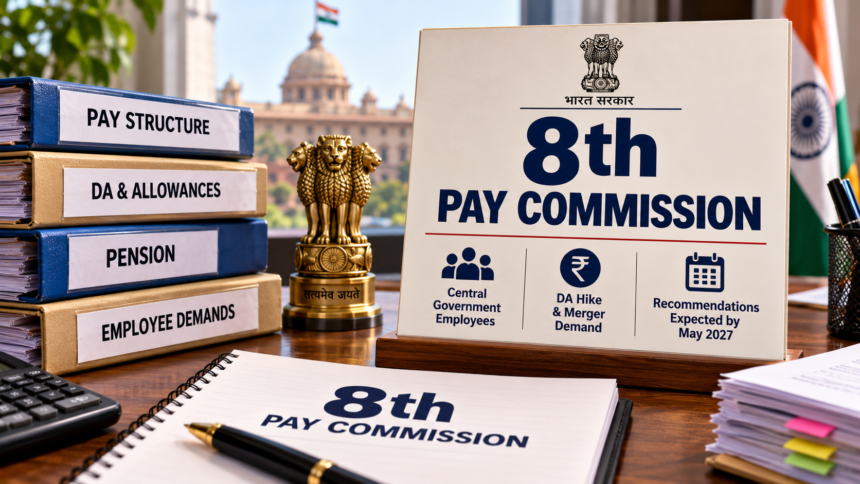
The 8th Central Pay Commission (CPC) is currently consulting central government employee organisations, pensioner groups, unions and other stakeholders before preparing its recommendations. The commission is expected to submit its report by May 2027, based on the timeline outlined in its Terms of Reference (ToR).
The panel is chaired by former Supreme Court Justice Ranjana Prakash Desai. Its other members include Pankaj Jain, a former IAS officer serving as Member-Secretary, and Professor Pulak Ghosh, a Professor of Finance and a member of the Prime Minister’s Economic Advisory Council.
The proposed changes could affect more than one crore people, including approximately 50 lakh central government employees and around 65 lakh pensioners. The coverage includes eligible defence personnel, railway employees and retirees.
What the 8th Pay Commission’s Terms of Reference Say About DA
Dearness Allowance (DA) is intended to help government employees manage the impact of inflation on their household expenses. It is linked to basic pay and also influences the overall compensation structure of eligible employees. Pensioners receive a related benefit known as Dearness Relief (DR).
Under the 7th Central Pay Commission framework, DA is revised twice a year using the prescribed inflation-linked formula based on the All-India Consumer Price Index. Announcements are commonly made around March and October, with revisions generally effective from January and July, respectively.
The 8th CPC’s Terms of Reference, approved by the Union Cabinet, define the areas the commission must examine before making its recommendations. These include pay structures, allowances such as DA, Dearness Relief and House Rent Allowance (HRA), along with other monetary and non-monetary benefits.
The commission is expected to assess possible changes by considering rationalisation, current functional requirements and the specialised needs of different categories of employees.
Why Are Government Employees Demanding a DA Merger With Basic Pay?
Employee unions and representative organisations have been pressing the government to consider merging DA with basic salary. Their demand is linked to the increase in DA, which reached 60% of basic pay in the latest figures cited in the article.
Some employee groups argue that a merger could increase basic pay, which is used to calculate several other salary and retirement benefits. These may include provident fund contributions, pension benefits, gratuity and certain allowances.
However, as of October 2026, the government has not officially announced a DA merger. It has also clarified that no proposal to merge DA with basic pay or introduce a higher fitment factor is currently under consideration.
The fitment factor is another important issue for employees because it is used in determining revised pay under a pay commission framework. Employee organisations are seeking a higher factor as part of their expectations from the 8th CPC.
Key DA and Minimum Salary Demands From Employee Groups
Several organisations have submitted demands relating to inflation adjustment, minimum pay and DA calculations.
- All India Defence Employees Federation (AIDEF): The federation has sought inflation-adjusted compensation and recommended raising minimum monthly pay to ₹69,000.
- Maharashtra Old Pension Organisation: The organisation has proposed a minimum DA increase of 4%, a DA merger at the 50% level and minimum monthly pay of ₹65,000.
- National Council–Joint Consultative Machinery (NC-JCM): The council has called for an inflation-linked wage model and proposed increasing minimum monthly pay from ₹18,000 to ₹69,000.
AIDEF has also submitted a second memorandum to the 8th CPC seeking changes to the DA calculation method. It argues that the existing formula gives greater weight to expenditure categories that are relatively stable, while lower-paid employees may spend a larger share of their income on essentials such as food, education, healthcare, house rent and medicines.
The federation has called for a calculation method that better reflects these household expenses.
When Will the 8th Pay Commission Submit Its Recommendations?
The commission’s Terms of Reference provide for recommendations within 18 months of its constitution on November 3, 2025. Under this timeline, the report is due by May 2027.
Submitting the report will not necessarily mean that revised salaries and pensions will take effect immediately. The implementation process could take another two to three years, depending on the government’s decisions and the arrangements required to put the recommendations into effect.
Consequently, if the recommendations are submitted in 2027, full implementation could extend into 2029 or 2030. The final timeline, salary revisions, fitment factor and any decision on DA merger will depend on the commission’s recommendations and the government’s subsequent approval.
Disclaimer: This article is intended for general informational purposes only and should not be treated as official confirmation of future salary increases, DA merger or pension revisions. The demands mentioned are proposals from employee organisations and may not be adopted by the government. Readers should consult official government notifications and the 8th Central Pay Commission for confirmed decisions and implementation details.