
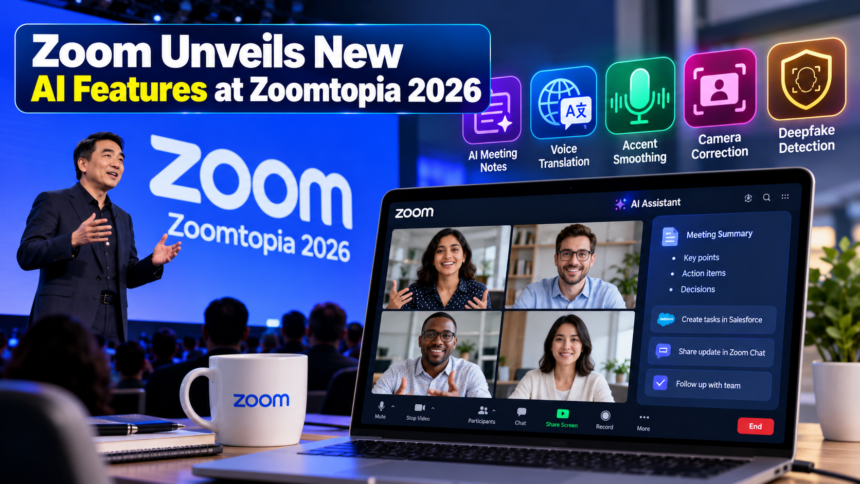
Zoom has unveiled a new range of artificial intelligence features at its Zoomtopia 2026 conference, expanding its technology beyond traditional video meetings. The announcements include AI agents for handling follow-up tasks, voice translation, accent smoothing, camera adjustments and tools designed to identify potential deepfakes.
A key part of the update is the Unified Context Layer, a system that connects meeting conversations with documents, chats and supported business applications. Several of the new features are scheduled to arrive between October 2026 and early 2027.
Zoom’s Unified Context Layer Connects Meetings With Everyday Work
Zoom’s new Unified Context Layer is designed to help AI understand business discussions by bringing together information from meetings, documents, chats and third-party applications. The goal is to help users move from conversations to practical next steps.
For example, when a team discusses a customer issue during a meeting, Zoom’s AI agents could use the available context to assist with follow-up tasks in platforms such as Salesforce and Zoom Chat.
Zoom founder and CEO Eric Yuan highlighted the importance of business context in AI, stating, “AI models are only as powerful as their understanding of your business, and that context makes all the difference.”
The company also announced several features with different release timelines:
| Feature | Expected availability |
|---|---|
| My Notes Workflows | October 2026 |
| Enriched meeting notes | November 2026 |
| Personalised meeting summaries | December 2026 |
| AI-powered Zoom Chat experience | December 2026 |
| ZoomMate Agent Teams | Available now |
Voice Translation, Accent Smoothing and Camera Improvements
Zoom is also developing AI tools aimed at making online communication more accessible and natural. Its Translate Me feature is designed to translate speech into another language while using a synthetic version of the speaker’s own voice.
Another upcoming tool, Touch up my Voice, will provide real-time accent smoothing. Meanwhile, Pose Correction is intended to adjust how users appear on camera when they look away from the screen.
These communication and camera features are expected to be introduced between October and December 2026.
Deepfake Detection and New AI Controls
Zoom is preparing a deepfake detection feature that will flag potentially synthetic audio or video during meetings, recruitment processes and customer interactions. The company expects the feature to become available in December 2026.
Alongside detection technology, Zoom is introducing administrative controls that will help organisations define what their AI systems can access and generate. These controls are intended to give businesses greater oversight of AI use within their operations.
Zoom Expands AI Integration Beyond Video Meetings
Zoom also plans to increase its compatibility with external AI assistants, including Claude, Codex and Copilot. This move reflects the company’s broader effort to make its platform useful for tasks beyond hosting video calls.
With its new AI agents, connected business context and communication tools, Zoom is expanding its focus towards helping users manage work and complete tasks through AI-supported workflows.
Disclaimer: This article is based on the information provided about Zoomtopia 2026 and the company’s announced AI features. Release dates and availability may change. Readers should refer to Zoom’s official announcements for the latest updates.