
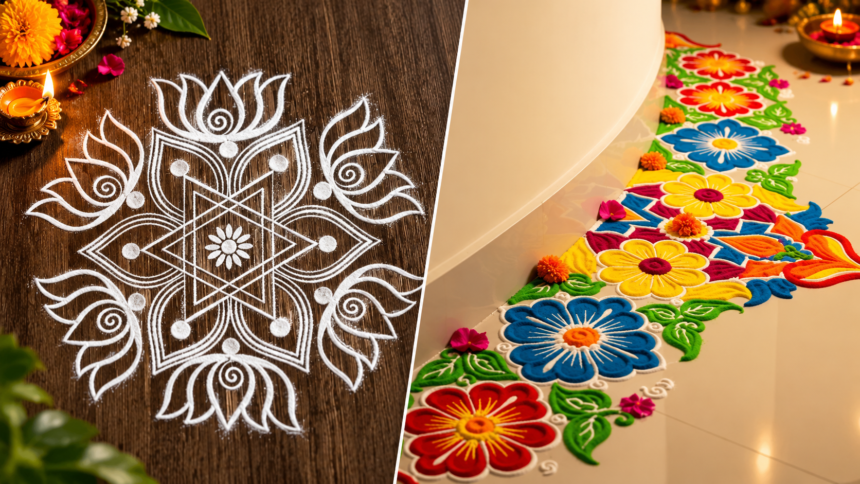
As Diwali approaches, homes across India are decorated with colourful Rangoli designs featuring geometric patterns, floral artwork and vibrant powders. Creating Rangoli at the entrance is one of the festival’s most recognisable traditions, combining artistic expression with cultural and religious significance.
The term Rangoli is commonly associated with the Sanskrit word Rangavalli, meaning rows of colours. Beyond decorating homes, this traditional art form represents hospitality, auspicious beginnings and the welcoming of prosperity. Its customs and designs vary across regions, but the practice continues to hold an important place in Diwali celebrations.
The History and Regional Traditions of Rangoli
Rangoli has deep roots in Indian cultural traditions, with references to floor art appearing in historical and religious narratives. Chitralakshana, an ancient treatise associated with Indian art, is cited in discussions of the tradition’s history. Stories from the Ramayana and Mahabharata also form part of the broader cultural background surrounding traditional decorative art.
According to a popular Diwali legend, when Lord Rama returned to Ayodhya after 14 years of exile, the people decorated their homes and the kingdom to welcome him. Colourful patterns made with powders and flowers are associated with these celebrations and the tradition of welcoming his return.
Another story found in Puranic tradition tells of a priest whose son died. Lord Brahma is said to have instructed the priest to draw the boy’s portrait on the floor, leading to the creation of the first Rangoli. These accounts are part of the folklore associated with the art form.
Rangoli is known by different names across India. In Tamil Nadu, it is called Kolam; in Andhra Pradesh, Muggu; in West Bengal, Alpana; in Uttar Pradesh, Chowk Purana; in Rajasthan, Mandana; and in Bihar, Aripan. Although the designs and materials differ, these practices share a common purpose of decorating spaces and marking auspicious occasions.
Why Is Rangoli Drawn at the Doorstep on Diwali?
The entrance of a home holds special importance during Diwali, and Rangoli is traditionally created there for several cultural and spiritual reasons.
Welcoming Goddess Lakshmi: Diwali is closely associated with Goddess Lakshmi, who represents wealth and prosperity. According to popular belief, a clean, decorated home with Rangoli at the entrance welcomes the goddess and invites her blessings. The artwork symbolises preparation for prosperity and good fortune.
Keeping negative influences away: Rangoli’s bright colours and symmetrical patterns are traditionally believed to help ward off negative energy and buri nazar, or the evil eye. In this cultural understanding, the designs serve as a symbolic form of protection for the household.
Expressing hospitality: A Rangoli at the entrance offers a colourful welcome to guests, relatives and visitors. The practice reflects the Indian value of Atithi Devo Bhava, which encourages people to treat guests with great respect. It also communicates the joy and warmth associated with festive gatherings.
Reflecting ecological awareness: Traditionally, Rangoli was often made using rice flour, turmeric, kumkum, dried leaves and flower petals. Rice flour could serve as food for ants and small insects, reflecting an idea of coexistence with other living beings and the principle of Ahimsa, or non-violence. Certain natural materials have also been traditionally used for their insect-repellent properties.
Rangoli Colours, Patterns and Their Meanings
Rangoli designs often feature colours and motifs that carry symbolic meanings. Their interpretations can vary according to regional customs and family traditions.
Red is associated with strength and energy, while yellow represents brightness and knowledge. Blue is linked with calmness, green with nature and new beginnings, and white with purity and peace.
Floral and religious motifs are equally significant. The lotus is associated with Goddess Lakshmi and prosperity, while peacocks and parrots can represent beauty and knowledge. Images of diyas symbolise light overcoming darkness, while the kalash represents abundance.
Geometric designs featuring circles and triangles are often interpreted as representations of the cosmos, infinity and the cyclical nature of life. Small footprints drawn towards the entrance symbolise the arrival of Goddess Lakshmi and the hope for prosperity in the household.
In Kolam designs, dots known as pulli form the basis of intricate patterns. The lines drawn around them are sometimes interpreted symbolically as the journey through life’s obstacles with patience and grace.
How Rangoli Is Evolving in Modern Celebrations
Rangoli has expanded beyond traditional doorstep decorations to become a widely recognised form of artistic expression. Once practised as a regular morning ritual in many households, it is now also featured in festive displays, competitions and contemporary decorative designs.
In 2026, Rangoli styles include three-dimensional artwork, portrait designs, floating flower arrangements in water-filled urlis and eco-friendly patterns created with stencils and organic colours. These approaches offer new ways to celebrate while drawing on the tradition’s artistic roots.
Whether made with coloured powders, flower petals or natural materials, Rangoli remains an important part of Diwali for many Indian families. Creating a design at the entrance is more than a decorative activity; it is a way to express hospitality, honour cultural traditions and welcome auspicious beginnings during the festival of lights.