
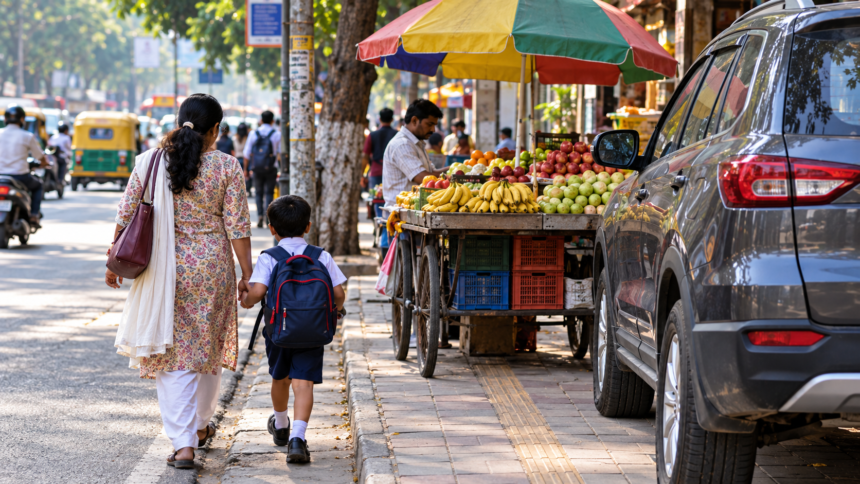
Every morning, a familiar scene plays out on roads across Indian cities. A parent walking a child to school finds the footpath blocked by a parked vehicle or a roadside vendor. With no clear space left to walk, the pedestrian is forced onto the road, often alongside moving traffic.
This raises a basic but important question: who is actually entitled to use a public footpath?
While the answer may appear complicated on the ground, Indian law provides a framework that recognises both the rights of pedestrians and those who depend on public spaces for their livelihood.
What Does the Law Say About Footpaths?
The Supreme Court’s 1985 judgment in Olga Tellis and Others v. Bombay Municipal Corporation established an important principle concerning the right to livelihood. The case involved pavement dwellers facing eviction, and the Court held that the right to life under Article 21 includes the right to livelihood because earning a living is essential to life.
At the same time, the Court clarified that this right is not unlimited. Pavements are public spaces intended for public use, and their occupation or use remains subject to applicable law and a fair legal process.
The issue of pedestrian access has received further attention from the Supreme Court. In a 2026 ruling, the Court recognised safe walking on clearly marked footpaths as a fundamental right linked to Article 19, which protects freedom of movement, and Article 21, which guarantees the right to life.
Following this development, the government proposed a national programme, referred to as the Bharat Janpath Yojana, with a target of developing 10,000 kilometres of connected and walkable footpaths across 100 Indian cities.
Pedestrians and Street Vendors Both Have Rights
The conflict on footpaths is not simply a matter of pedestrians versus vendors.
Street vendors also have legal protections. The Street Vendors (Protection of Livelihood and Regulation of Street Vending) Act, 2014, provides registered vendors with the right to operate in designated vending zones. These zones are determined through local mechanisms that include representatives of street vendors.
This means that the right of a person to walk safely and the right of a vendor to earn a livelihood can both exist at the same time.
The difficulty arises when there is no clearly defined space for different activities.
Why Footpaths Become a Daily Battleground
In many cities, the same stretch of pavement may be used for walking, vending, parking and other activities. When authorities do not clearly mark and enforce separate spaces, pedestrians are often left with the least usable portion.
The consequences can be particularly serious for elderly people, people with visual impairments and parents walking with young children. What may be a minor inconvenience for one pedestrian can become a significant safety risk for another.
India has expanded major road infrastructure at a rapid pace, including highways, flyovers and expressways. However, footpaths remain an important part of everyday urban infrastructure that often receives less attention.
Some cities have started addressing the problem by identifying usable pedestrian space, formally designating vending areas and keeping parked vehicles away from walking zones. Where such arrangements are implemented effectively, the aim is to provide adequate space for both pedestrians and vendors rather than forcing them into direct competition.
A Clear Division of Public Space Could Reduce Conflict
The issue does not necessarily require choosing between a pedestrian trying to reach work or school and a vendor trying to earn a living. Both have legitimate interests that can be accommodated through proper planning and enforcement.
The larger question is how public authorities define and manage footpaths so that their primary purpose—safe pedestrian movement—is protected while lawful vending activities are also given appropriate space.
For pedestrians, vendors and vehicle owners, clearly marked boundaries and consistent enforcement could reduce the daily disputes over who gets to occupy the pavement.
Disclaimer: This article is intended for general informational purposes and summarises the legal and policy information provided in the source material. Laws, court rulings, government programmes and local regulations may change or be interpreted differently depending on the circumstances. Readers should refer to official court judgments, legislation and government notifications or seek qualified legal advice for specific legal matters.