
Millions of people across India use UPI every day to transfer money, pay shopkeepers and complete online transactions. Now, a new Merchant Discount Rate (MDR) framework announced by the National Payments Corporation of India (NPCI) has brought changes to certain merchant payments.
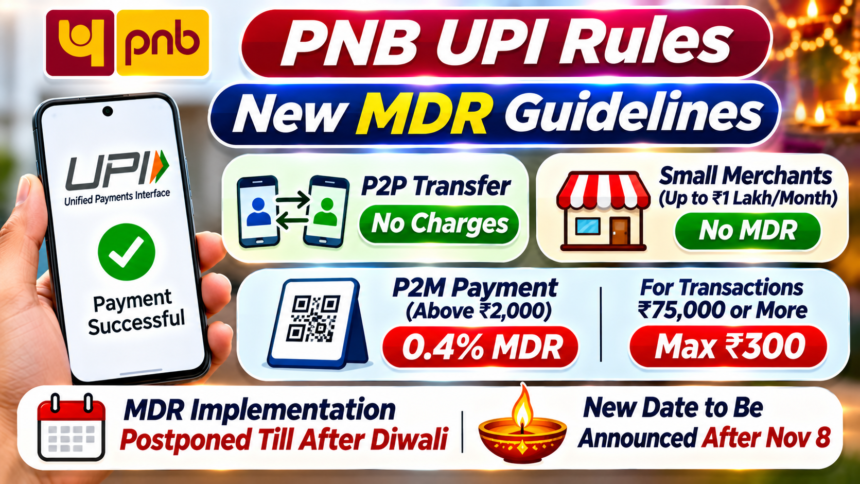
Under the proposed framework, selected Person-to-Merchant (P2M) transactions above ₹2,000 will attract an MDR of 0.4%. However, ordinary users making payments through UPI will not have to pay this charge. Person-to-Person (P2P) money transfers will also remain completely free.
The implementation of the new MDR framework, which was originally scheduled for October 15, 2026, has been postponed until after Diwali. Here is what PNB customers and other UPI users should know about the revised rules.
What Are the New NPCI UPI Payment Rules?
The new framework distinguishes between two types of UPI transactions: Person-to-Person payments and Person-to-Merchant payments.
When someone transfers money directly to a friend, relative or family member, it is classified as a P2P transaction. These transfers will continue to remain free, regardless of the amount sent.
Payments made by customers to shops, businesses or other merchants fall under the P2M category. Under the new framework, selected merchant transactions exceeding ₹2,000 will attract an MDR of 0.4%.
For transactions worth ₹75,000 or more, the MDR will be capped at ₹300 per transaction.
Small Merchants Will Continue to Get Zero MDR
The new rules also provide relief to small shopkeepers and businesses accepting payments through UPI QR codes.
Merchants receiving up to ₹1 lakh per month through UPI QR codes under the Person-to-Person-Merchant (P2PM) category will continue to receive payments without MDR charges.
This exemption is intended to protect small businesses, neighbourhood shops and street vendors from additional payment-related expenses.
Will Customers Have to Pay Extra for UPI Transactions?
No. According to the government’s clarification, the MDR is a charge payable by eligible merchants within the digital payment ecosystem. It is not an additional fee that customers have to pay while making UPI payments.
The charge is distributed among payment ecosystem participants, including banks and payment service providers. Merchants are not permitted to pass this MDR cost on to customers.
Therefore, people using UPI to send money to others or pay eligible merchants will not face an additional MDR charge.
NPCI Postpones MDR Implementation Until After Diwali
The new MDR framework was initially scheduled to come into effect on October 15, 2026. However, the NPCI decided to postpone its implementation in view of the festive shopping season.
On October 13, NPCI announced that MDR on selected Person-to-Merchant UPI transactions would be introduced immediately after Diwali. The exact implementation date will be announced separately.
Until the revised date is notified, UPI users and merchants should follow the existing applicable payment rules.
Important Things UPI Users Should Remember
Person-to-Person UPI transfers will remain free, irrespective of the transaction amount. Selected merchant payments above ₹2,000 will attract an MDR of 0.4%, subject to the applicable exemptions and conditions. The maximum MDR for transactions of ₹75,000 or more is ₹300.
Small merchants receiving up to ₹1 lakh monthly through UPI QR codes under the P2PM category will continue to enjoy zero MDR. Most importantly, customers will not be required to pay this merchant charge separately.
These rules form part of the NPCI’s revised UPI framework and apply across participating payment systems, rather than being a separate PNB-only fee policy.
Disclaimer: This article is intended for general informational purposes only. UPI charges, exemptions and implementation dates are subject to NPCI and government notifications. Users and merchants should check official NPCI, PNB and government updates for the latest applicable rules.